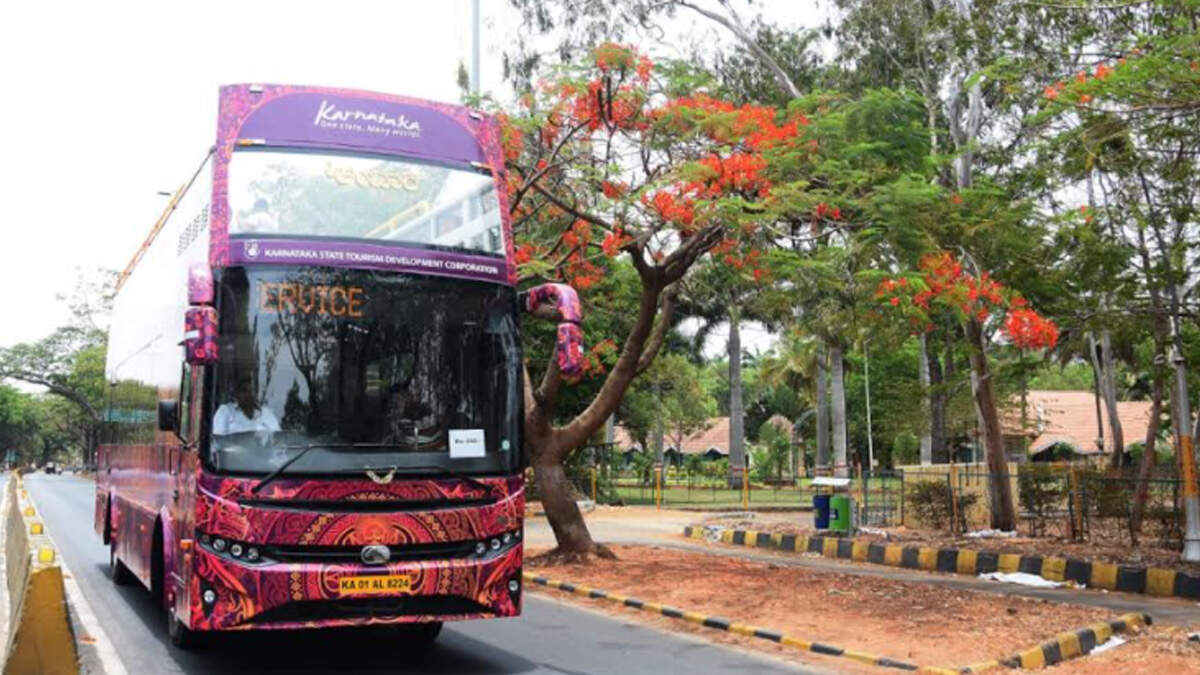
BENGALURU: Double-decker buses were a common sight on Bengaluru roads in the 1970s and 80s, but were phased out in 1997. The lone such bus that remained in the BMTC fleet was used for city tours till 2014. While state transport corporations, including BMTC, tried to reintroduce double deckers to bring back the nostalgia, plans have not materialised yet. However, Mumbai’s BEST (Brihanmumbai Electric Supply and Transport) is planning to induct 100 electric double-decker buses in the maximum city.
Phased out in 1997; BMTC has no new plan
BMTC’s double-decker buses were popular in areas like Majestic, Indiranagar, Jayanagar, Shivajinagar and KR Market from 1970s to 1990s. In the 1980s, a double-decker bus ferrying schoolchildren tilted near Ramakrishna Mission in south Bengaluru. This dented the image of such buses among the public. They were completely taken off the roads in 1997, barring one.
In 2009, BMTC planned to buy one or two double-decker buses but didn’t succeed. In 2017, its administrative board approved a proposal to buy five double-decker buses for sightseeing services but the corporation couldn’t get a manufacturer. Officials said they don’t have any plan to re-introduce double-decker buses as of now. “Our daily ridership has reduced from 36 lakh to 16 lakh. Our focus now is to regain that,” said an official.
KSRTC proposal in cold storage
KSRTC had identified long-distance routes where it would be feasible to run double-decker buses. The corporation feels buses with 82-seat capacity — double than that of buses with just one level — will fetch higher revenue since KSRTC will not have to bear the cost of additional staff. In 2017, the Union ministry of road transport and highways also zeroed in on five potential routes for double-decker bus services — from Bengaluru to Mangaluru, Chennai, Hubballi, Mysuru and Hyderabad. KSRTC buses mainly ply on highways which are wider and have less overhead electrical lines. However, the demand for its existing services is less after Covid-19, so the plan was put in abeyance.
KSTDC unable to extend Ambari to state capital
Similar to London’s Big Bus Tours, Karnataka State Tourism Development Corporation (KSTDC) procured six double-decker buses, whose body has been built by Bengaluru-based KMS Coach Builders. Each has a seating capacity of 40 (20 seats each in upper and lower deck). These buses were operational when KSTDC launched its double-decker service Ambari in Mysuru for sightseeing purposes in March. But it was hit by Covid-19 and is yet to be resumed. KSTDC is unable to extend the service to places like Hampi and Bengaluru due to overhead cables and other obstacles.
Advantages
*Double-decker buses can carry more passengers while occupying the same road space
* Staff salaries constitute the lion's share of operational cost. Double-decker buses need no extra crew
* Crowding in buses could be reduced by maintaining social-distancing norms
* Could be used for Bengaluru Darshan, a sightseeing service
* Suitable for arterial roads like Outer Ring Road during rush hours
* Electric double-decker buses have less operational cost and are environment friendly
Challenges
* Overhead electric and telecom cables may obstruct these buses; tree branches may have to be trimmed
* Foot Over Bridges and flyovers
* Few vehicle manufactures are in the double-decker bus segment since demand is less
* Poor condition of roads, gradient and curvature which are not suitable for these buses
* Not feasible on narrow roads since turning radius is more than that of ordinary buses
* Financial woes and reduced BMTC ridership
Mumbai may get 200 more
Mumbai got its first double-decker bus in 1937. BEST had 242 double deckers in its fleet, which gradually dropped to 48. It is planning to procure 200 such buses, including 100 for which tenders have been floated
Service launched in Kolkata last yr
Double-decker buses were introduced in Kolkata in the 1920s but disappeared from roads over the years. In October 2020, West Bengal Transport Department launched two double-decker buses through heritage spots of the city. They are equipped with CCTV cameras, panic buttons, automatic doors and destination boards