
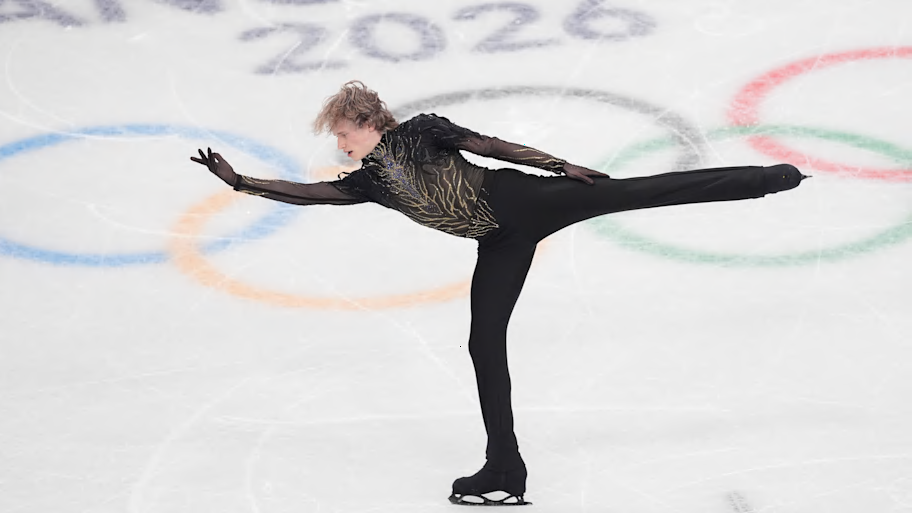
Figure skating is one of the most-watched events at the 2026 Milan Cortina Olympics and for good reason. Every four years, fans get to see some of the most graceful and athletic performances from the best skaters in the world, who will incorporate a variety of technical skills and jaw-dropping maneuvers in their program.
One commonly seen skill in a skater’s arsenal is the spin. You’ve likely seen a skater turn their body several times on the ice before gliding out of a spin, calm and composed as ever. How is it possible that the skater doesn’t get dizzy from all the spinning?
Here’s a brief explainer on how modern Olympic figure skaters have mastered the art of the spin.
Do figure skaters get dizzy?
The short answer is yes. But they learn how not to.
Years of training and practice can enable athletes to shut off signals from the balance organs in the inner ear that cause dizziness. It’s the same way gymnasts and ballerinas keep themselves from falling over.
To dig a little deeper into the science behind it, the sensation we call dizziness comes from the vestibular organs in the inner ear. In the inner ear, fluid-filled chambers sense the rotation of the head from tiny ear hairs that react to the movement of the fluid. When you turn around quickly, the fluid keeps moving, which can make you feel like you’re still spinning. This sensation is more precisely known as vertigo.
Skaters can use differing strategies to prevent themselves from getting dizzy, one of which is maintaining a uniform speed during their revolutions. Another more scientific strategy is training their brains to trigger optokinetic nystagmus, a type of eye movement. This is a visual mechanism that counteracts nystagmus, which is a reflexive spinning of the eyes that happens when you move your head during a spin.
Here’s Amir Kheradmand, an assistant professor of neurology at Johns Hopkins Hospital, going into more depth about optokinetic nystagmus:
Optokinetic nystagmus occurs in the opposite direction of the nystagmus and allows us to track a moving object—such as a train whizzing by—with our eyes while our head remains in place. As the first few cars of the train move out of view, our eyes jump back to their initial position to follow the next few, and the motion repeats. Skaters can train themselves to engage this opposing eye movement when they rotate to offset the nystagmus and keep the world from spinning.
Beginner figure skaters will usually only be able to do one or two rotations before feeling affected by the dizziness, but with time and practice, they can build up their tolerance and perform as many as seven or eight rotations on the ice. The more rotations, the higher the difficulty of the spin is.
The most spins ever recorded on ice is 115, set by Swiss figure skater Lucinda Ruh, aptly known as the “Queen of Spin,” in 2003.
What is spotting?
You may have heard of some athletes using a technique called spotting to combat dizziness. Athletes like ballet dancers will fix their gaze on one “spot” that they lock onto whenever they come out of a spin. This helps them orient themselves even as their body continues to move at a constant speed. Over time, they may even be able to train their brain to suppress the inner ear signals that are causing the dizziness.
A potential drawback to this technique is that since figure skaters are spinning at speeds much faster than that of, say, ballet dancers, trying to spot could cause neck problems.
More Winter Olympics on Sports Illustrated
- How U.S. Figure Skater Ilia Malinin Got His Awesome 'Quad God' Nickname
- SI:AM | Johannes Høsflot Klæbo Is the Breakout Star of These Winter Olympics
- Shaun White Took an Emotional Halfpipe Run at Milan Cortina Games, and Fans Loved it
- Cross-Country Skier Goes Sleeveless En Route to Sixth-Place Finish
- Fans Loved What Myles Garrett Did for His Girlfriend Chloe Kim During Halfpipe Final
This article was originally published on www.si.com as Why Don’t Olympic Figure Skaters Get Dizzy?.