Does size matter? It strikes me that the biggest single issue facing theatre-makers at the moment is the issue of size. By which, I primarily mean venue capacity and length of run.
Look at the seemingly contradictory set of responses which meet Katie Mitchell and Dan Rebellato's (recent articles discussing works from opposite ends of the size spectrum. Let's maybe add in Simon Casson's article from late last year in which he discusses wanting to reach out to the "X Factor masses" (a phrase which possibly wants a bit of examining) alongside Andy Field's gently repeated point that Forest Fringe is both fully open to the public and free at the point of delivery in the face of repeated claims of its "exclusivity".
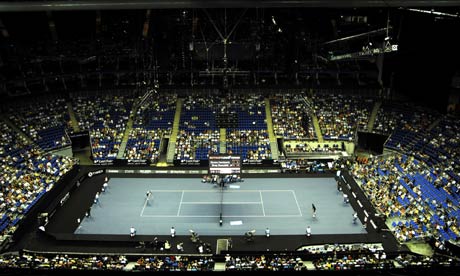
In a way, these two poles seem to articulate one of the most significant problems that theatre faces. On one hand, theatre can make wonderful claims for its ability to create a unique, intimate, fragile atmosphere between the performer and an audience within touching distance — but does so for only 25 people per night, in the basement of a specific venue, in a specific place, for a limited run. On the other hand, theatre can hold its head up high, point to record-breaking box office receipts even in a recession, and point out that thousands of people a night pack out massive theatres because they are still hungry to see the "real thing". Live.
Of course, this is a false binary and "theatre" occupies pretty much all sizes between these two extremes. Although it's worth noting that it can't really get any bigger and can only get a bit smaller.
What interests me is the level of antipathy that seems to exist between the two camps. What's entertaining about the terms of engagement is that they're so fabulously asymmetric: a battle between intimacy and enormity, between fragility and robustitude. Perhaps between profit and poignancy?
None of these qualities are inherently good or bad, per se. The problem is, that while both these things are called "theatre", there's a sense that one or other should eventually emerge as being "real theatre" and the other should be revealed to be the fraud. That's how that narrative always goes. In this case, I respectfully suggest that a passing lexicographer should break up this ridiculous fight between two things which may as well be a pig and a stepladder for all the good fighting is going to do them.
However, the question of how success and, perhaps, "importance" are judged will persist. It is inevitable in an age where the internet has made nearly everything else much more accessible. The question is, on one hand: how do we justify deeming something that only a maximum of 300 people can attend as "vital". On the other hand, if it is vital, how on earth do we justify not saying so ... ?