OSAKA ― Prepaid IC cards are used around the nation to pass through railway ticket gates and pay bus fares. But in the Kansai area for some reason, systems where people pay later are the norm. It's said that this reflects Kansai residents' impatient nature, but is that actually the case?
--Unpleasant history
The leading IC card in the Kansai area is "PiTaPa," which can be used mainly for private railways, subways and buses. With about 3.4 million people registered, PiTaPa is the only IC card, among 10 major cards used in Japan for transportation services, that lets people pay later.
Fares for trains and other transportation services used by the card's holder are withdrawn from their bank account at a later date.
PiTaPa cards can also be used to pay up front in areas outside Kansai, but users should be aware -- with trains operated by East Japan Railway Co. (JR East) and major private railway companies in the Kanto region, passengers cannot enter a station through the ticket gate if the balance on their card is less than the minimum fare.
With trains operated by West Japan Railway Co. (JR West) and major private railway companies in Kansai, passengers can pass through the ticket gates with IC cards, whether PiTaPa or not, if the card has a prepaid balance ranging from 1 yen to 10 yen.
Fares are paid when exiting a ticket gate, illustrating how later payments are emphasized in Kansai.
Tomonori Yokoe, who was involved with PiTaPa's introduction in 2004, said the adoption of a later-paying system is closely linked to the temperament of Kansai residents. If a prepaid system had been adopted, passengers with an insufficient balance would have lined up in front of fare adjustment machines to charge their prepaid cards, he said.
This "would have led to complaints being filed one after another, especially when passengers are taking the train to their office or school, because Kansai people are impatient," Yokoe said.
Yokoe thought it was crucial to make passengers feel like they were "profiting a bit." Under a later-paying system, it would be easier to offer such services as discounts and awarding points based on the number of rides.
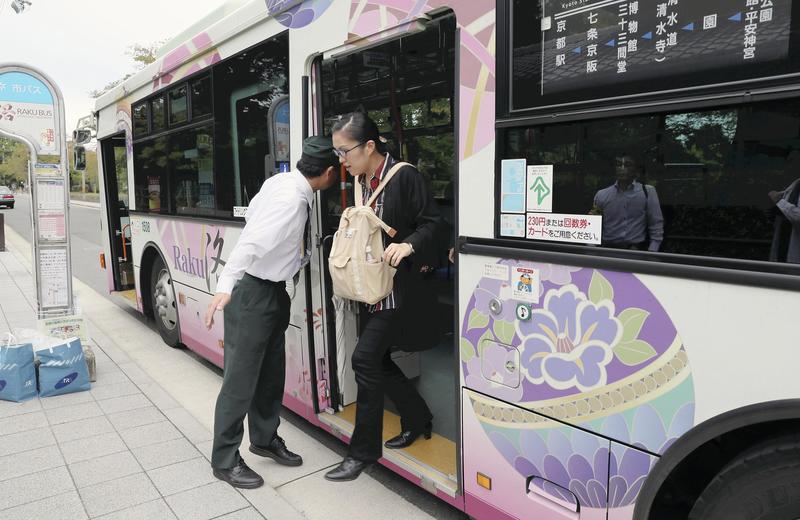
Paying later is not limited to railway transportation. On bus routes in such major Kansai cities as Osaka, Kyoto and Kobe, fares are often paid when passengers get off, even on routes where a uniform fare is charged regardless of the distance traveled.
In the Kanto region, on the other hand, a prepaid system requiring passengers to pay when they get on the bus is prevalent on bus routes with uniform fares.
It is said to take less time for passengers to get off under a prepaid system, thus reducing the possibility of bus service being delayed. But Kansai bus operators have had a bad experience with prepaid fares. In 1951, the then Osaka municipal government's transportation bureau shifted to a prepaid system for part of the bus routes on which uniform fares had been adopted. Later, however, it reinstated a later-paying approach.
Shinya Nakao, head of the Kansai branch of the Japan association of bus lovers, said the later-paying system was reinstated because passengers had voiced such complaints as "it's unreasonable to pay the fare before the service is completed" and "it feels like government control."
--Cashless payments lag
The history of later-paying system dates back at least to the Edo period (1603-1868). Foodstuffs and goods were sold to familiar and regular customers without charging them on the spot, and payments due were generally collected twice a year ― in the obon period in August and at year-end. Nakao, who was born and raised in Osaka, said, "Osaka was a mercantile city, and the preference for paying later for meals and other things appears to still be rooted there."
According to a survey conducted by JCB Co. in 2018, the usage rate of e-money in the Kansai area stood at 63.0%, 16.6 percentage points lower than in the Tokyo metropolitan area and also short of the national average of 70.3%.
The usage rate for e-money at convenience stores is high around the nation, in parallel with the payment of railway and bus fares. However, PiTaPa cannot be used at most Seven-Eleven and Lawson convenience stores because its system is not compatible, a factor contributing to the low e-money usage rate in Kansai.
Credit cards, which are also a key form of cashless payment, would seem likely to be used more often in Kansai, as payment is made at a later date. However, a payment fee is imposed of about 3% to 5% of the sales price. As a result, according to a credit company executive, "Shop owners and others have a strong sense of resistance against credit card payments, considering it beneficial for the customer if the price is cut by the same percentage as the commission."
There are signs of change. The Kyoto municipal government's transportation bureau reexamined the later-paying system for bus fares in spring last year and begun a phased shift to a system for passengers to pay uniform fares for about 60 bus routes when they get on the bus.
In an experiment conducted three years ago, this approach was received better than expected. In Kansai, a key point could be how to emphasize the advantages involved for either a prepaid or later-paying system.
--Other IC cards
There are five prefectures in which IC cards still cannot be used for transport services.
Transportation IC cards have been issued in great quantities, led by JR East's Suica card at about 83 million. This is followed by PASMO, which is used mainly for private railways and buses in the Tokyo metropolitan area, at about 40 million cards.
The top 10 IC cards, including PiTaPa, became usable in each other's service areas from 2013.
There are also IC cards that can be used in limited areas, including SAPICA, which is good in Sapporo city and its neighboring areas. Among six JR companies, Shikoku Railway Co. does not issue specific cards of its own, while it makes JR West' ICOCA available for part of its lines.
According to the Land, Infrastructure, Transport and Tourism Ministry, the top 10 IC cards could not be used in five prefectures as of this spring, including Aomori and Tokushima.
Other IC cards include e-money such as nanaco and WAON, which are categorized as a distribution-related type because they are affiliated with major supermarket operators. As with transportation IC cards, they are mostly prepaid.
The telephone cards first issued in 1982 by Nippon Telegraph and Telephone Public Corp. (now NTT Corp.) are said to be the precursors of prepaid cards. Three years later, the now defunct Japanese National Railways introduced the Orange Card.
In addition to prepaid and later-paying cards, there are debit cards that withdraw money immediately from users' bank accounts when they settle their payment at a shop. Debit cards are not as prevalent in Japan as in the United States, Europe and China.
Read more from The Japan News at https://japannews.yomiuri.co.jp/


.png?w=600)