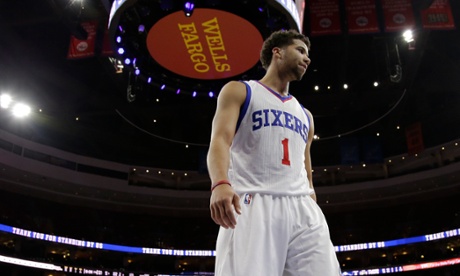
Michael Carter-Williams was part of the Sixers’ future plans. The first-round draft pick won the Rookie of the Year award in his first season and had put up promising numbers in his second. He was one of a triumvirate of future stars in the new Sixers’ marketing plan. MCW, as the 23-year-old point guard is known, was seen out and about in the city. Tuesday night, Carter-Williams even attended a Philadelphia Catholic League semifinal doubleheader at the Palestra.
And then, Michael Carter-Williams was not part of the Sixers’ future plans.
“I can’t lie I’m shocked.” MCW tweeted after he was traded to the Milwaukee Bucks at Thursday’s NBA trade deadline. “I love this city thank you for everything. I can honestly say I gave it my all. I wish Philly nothing but the best.”
The Sixers are 12-41, the third-worst record in the NBA, but that didn’t stop general manager Sam Hinkie from being incredibly active on the final day NBA players could be moved. Around the same time he was shipping MCW out, Hinkie dealt rookie small forward KJ McDaniels, an early second-round pick this year, to the Houston Rockets.
“Michael and KJ each brought their enormous talents with them to the Sixers. Once here, they both flourished within our player development program, which is a testament to their own work ethic and the dedication of our coaching staff,” Hinkie said in a canned statement. “It is important that we continue to be aggressive in the ways in which we build our roster, and sometimes that includes that includes making difficult decisions in order to further our goal of building something.”
Needless to say, these are weird times for the Sixers. The team is in the middle of a unprecedented multi-year rebuilding plan that has seen the Sixers tie the NBA record for consecutive losses with 26 last season and drop the first 17 games this season (mercifully, one short of the record). During the 2014 calendar year the Sixers went 3-36 at the Wells Fargo Center. On the same court in that span, Villanova University went 5-1.
The team is tanking. Derided by some and admired by others, the Sixers strategy has been to spend the last two seasons not caring about wins and losses. Instead it’s been about developing young players and acquiring assets for the future. In fact, it’s almost better to lose: Teams finishing with worse records get better chances in the NBA draft lottery, the weighted drawing that determines the order in which clubs select incoming players in June.
The reasoning behind the tank: It’s incredibly hard to win in the NBA without a superstar. Since 1991, almost every championship team has had one or two: the Chicago Bulls (Michael Jordan), the Houston Rockets (Hakeem Olajuwon), the San Antonio Spurs (Tim Duncan), the Los Angeles Lakers (Shaquille O’Neal and Kobe Bryant), the Boston Celtics (Paul Pierce and Kevin Garnett). The lone exception was in 2004, when the Detroit Pistons slugged their way through the playoffs on defense.
The Sixers nabbed a superstar in 1996 when they drafted Allen Iverson, who led them to the 2001 NBA Finals. They attempted to acquire another one three times in the previous decade: They traded for Chris Webber in 2005 (the Sixers lost in the first round in five games), signed Elton Brand in 2008 (he played just 29 games his first year) and dealt a boatload for Andrew Bynum in 2012 (he never played a game for the team).
Josh Harris put together a group that purchased the 76ers in 2011 from its old owner, a division of Philadelphia media giant Comcast. He and co-managing owner David Blitzer reportedly didn’t want to shake up the front office too much in 2012 and passed on hiring Hinkie, at one time the youngest VP in the league in Houston. But after the Bynum experiment bombed and the Sixers missed the playoffs, the Sixers cleaned out the front office and hired Hinkie.
The rebuild began. On draft night in 2013, the Sixers traded away promising young point guard Jrue Holiday, who had been an All-Star the previous season. With the first-round pick they got for Holiday, the Sixers drafted Kentucky star freshman Nerlens Noel – who would miss his rookie season with a torn ACL. The Sixers drafted Carter-Williams with their second pick.
The Sixers were active at last year’s deadline as well, shipping out players from previous regimes. Not only did the team stockpile a bunch of second-round picks, it was left with a gutted roster that contributed to the 26-game losing streak. The Sixers got the third pick after their 19-63 season, and selected Joel Embiid – who is likely to miss his rookie season with a broken navicular bone in his foot. With another draft pick acquired in the Holiday trade the year prior, they took Dario Šarić – a 20-year-old who has twice been named FIBA Young Player of the Year, but who won’t be coming to the NBA until at least the 2016-17 season.
Hinkie is known for his reliance on analytics, but what’s notable about his rebuild of the Sixers is how wide its scope is. He’s now spent two years doing nothing but acquire assets. The Carter-Williams trade brought back the Lakers’ first-round pick. Stocked with young players, the Sixers are so far under the salary cap they can essentially buy draft picks. In a separate deal Thursday, the Sixers acquired a first-round pick simply for taking on JaVale McGee’s salary for another two years. They can afford it. The Sixers may not keep him. “I would prefer not to comment” on what type of player JaVale McGee is, Sixers coach Brett Brown told beat writer Tom Moore. If the team buys him out, it wouldn’t be the first time. The Sixers have acquired seven players this since August who they’ve waived before they played a game. An eighth, Andrei Kirilenko, has never reported.
All this has left the Hinkie and the Sixers with a ton of draft picks. There’s a wiki page dedicated to keeping track. They had two each in consecutive drafts. They could have as many as four firsts next year, but due to draft pick protection the more likely scenario is two. The Sixers came into draft day last year with six second rounders. All the draft picks won’t work out. But if one or two of these picks are superstars, they’ll be franchise cornerstones for years to come.
It’s easy to see how this could work. If Embiid is a star and the Sixers land current consensus No. 1 Jahlil Okafor in this draft – or if Noel emerges, or one of their other three first-rounders hits – they have a group of possible superstars to build around. On the fringes, it’s even shown some promise. Second-rounder Jerami Grant has increasingly played stellar defense. Because they weren’t interested in adding many veterans, the Sixers were able to take fliers on a number of young fringe players contending teams didn’t have room for. One of them, Robert Covington, is reportedly now part of the team’s long-term plans.
So why trade Carter-Williams and McDaniels, until Thursday afternoon two young pieces of this rebuild puzzle? Hinkie, notoriously tight-lipped with the press, does tend to explain his reasoning after the fact. He’ll speak to the press Friday, but one can guess. Carter-Williams’ jump shot may never improve, and the Sixers think they can find a point guard just as serviceable elsewhere by the time they’re contending. Plus, point guards are viewed as dispensable. They may value that Lakers’ draft pick more than MCW. McDaniels, who turned 22 this month, is more curious, but he signed a one-year deal after getting drafted and was not a lock to re-sign with Philadelphia this year. Perhaps the Sixers thought he’d be gone after this season anyway. This is the flexibility this strategy offers – Philly decided these two players didn’t fit their long term plans, so they shipped them out.
Obviously, the strategy is divisive. Deadspin has been pillorying the Sixers for months. “The 76ers Are Run By A Ridiculous TED-Humping Moron,” read a recent headline. Meanwhile, NBA analyst Chris Sheridan called Hinkie the winner of draft day. “When all is said and done on the Sam Hinkie Era, the Philadelphia 76ers will be counting up their multiple titles.”
The second half of the season begins Friday night for the Sixers against Indiana, and suddenly the focus isn’t on basketball. Philly sports blog The 700 Level noted at one point Thursday six of the top nine stories on the Sixers website were about Franklin, the team’s new mascot. It’s weird: Since their 0-17 start, the Sixers had been playing OK. Brown had the team playing great defense. Sixers chatter was picking up among Philadelphia hoop heads, starved for good pro basketball: There was hope, with MCW and Noel and maybe even McDaniels and Grant and Covington.
Now, it’s a soft reset. McDaniels and MCW are gone. The Sixers’ point guards are now Tim Frazier (who has played three NBA games total) and Isaiah Canaan (a second-year player acquired in the McDaniels deal who hasn’t played an NBA game since early January). The rebuild continues, and the jury is still out on Sam Hinkie.
In the meantime, Sixers fans can look forward to the new uniforms the team will be wearing next season. At least they traded Carter-Williams before putting his name on one of the new jerseys.