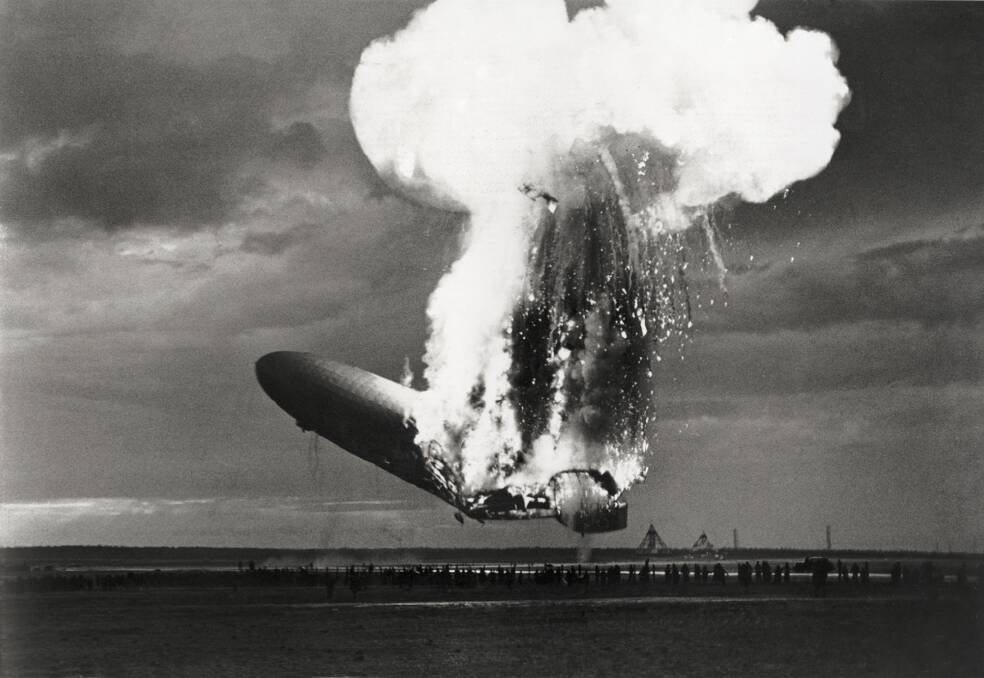
One of the most startling images in aviation history is of the Hindenburg crashing to the ground after it burst into flames.
Aboard were 36 passengers and 61 crew. Fatalities included 13 passengers, 21 crewmen and one civilian member of the ground crew. Remarkably, a few survived.
At 7.25pm, after a flight from Frankfurt, the ship caught fire. Witnesses reported seeing a dim blue flame which may have been caused by static electricity or St Elmo's Fire. Within a few tens of seconds the ship was engulfed and fell about 90 metres to the ground.
While the destruction of the vessel is commonly attributed to hydrogen, the truth is a bit more complicated.
There are a range of explanations as how the fire started. There are theories that it was the work of a saboteur. Did Adolf Hitler himself order it?
Ultimately however, no credible evidence of sabotage was uncovered by investigators.
Surprisingly, like other zeppelins, the Hindenburg had been struck by lightning several times while flying. Yet this is unlikely to ignite a fire because the ships contain hydrogen with no oxygen.
Another hypothesis is that it was caused by engine failure although evidence does not appear to support this. For one thing, the engine exhaust was less than 250 degrees Celcius, while the ignition temperature for hydrogen is 500 degrees.
While the hydrogen obviously burned, there is uncertainty about its significance with other factors. Being lighter than air, the hydrogen rapidly vented upwards, away from the body of the craft. Indeed, the mushroom cloud in the footage makes this clearly evident. As it burns, hydrogen produces water, which would have fallen onto the craft below or vented away as steam.
Proponents of the "incendiary paint theory" suggest that the most serious source of the fire was the aluminium and iron oxide coating on the canvas skin.
Putting this idea to the test, MythBusters found that, while this is flammable, it would not be enough to destroy the zeppelin.
The Fuzzy Logic Science Show is at 11am Sundays on 2xx 98.3FM.
Send your questions to AskFuzzy@Zoho.com, Twitter @FuzzyLogicSci, Podcast FuzzyLogicOn2xx.Podbean.com