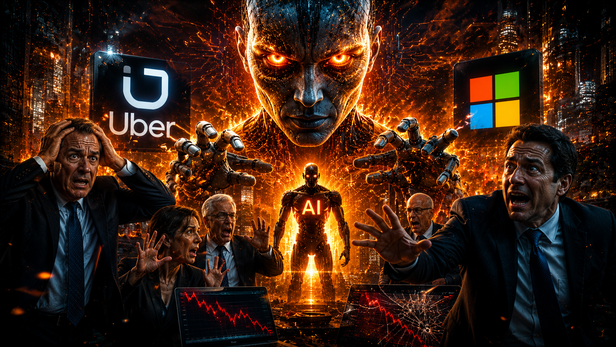
For the last few years, the world was told the same thing again and again Artificial Intelligence would save companies billions, replace expensive employees, and completely transform businesses forever. Tech giants rushed to inject AI into everything possible. Customer care, coding, hiring, logistics, even decision-making. But now, something unexpected is happening behind closed corporate doors. The same AI systems that promised huge savings are quietly becoming financial nightmares. Uber’s yearly AI budget reportedly vanished within just four months. Microsoft is now asking employees to reduce AI usage because the costs are rising too fast. Suddenly, the AI revolution does not look as cheap as companies imagined.
The AI Dream Companies Sold To Everyone
Top AI Development Companies
When AI tools exploded in popularity, companies saw them as magical solutions for everything. Businesses believed AI could reduce salaries, automate support systems, speed up operations, and increase profits instantly. Investors poured billions into AI startups while CEOs promised a future where machines would handle most routine work. This created massive excitement across industries. But many companies rushed into implementation without fully understanding the real cost of maintaining advanced AI systems. What looked futuristic and profitable during presentations is now becoming extremely expensive in real-world operations, especially for businesses trying to integrate AI into large-scale systems.
Uber’s AI Budget Shocked The Industry
Uber COO Andrew Macdonald said he's not seeing proportional productivity gains from increasing AI costs. https://t.co/1VDp9cAqTw
— Business Insider (@BusinessInsider) May 25, 2026
Uber became one of the biggest examples of aggressive AI adoption. The company integrated AI agents deeply into its systems to improve automation and efficiency. But according to reports, Uber’s yearly AI budget for 2026 disappeared within just four months. That revelation shocked many in the tech world because it exposed how expensive enterprise-level AI truly is. Unlike free public AI apps people casually use daily, large companies require advanced paid infrastructure, cloud computing, constant processing power, and maintenance systems. The costs quietly pile up until businesses suddenly realize the savings they expected are disappearing much faster than planned.
Why AI Is Becoming So Expensive
Most people think AI is cheap because they interact with simplified consumer versions like chatbots or mobile apps. But enterprise AI is completely different. Companies must pay for powerful servers, massive data processing, cloud storage, security systems, AI training models, and continuous updates. Every AI interaction consumes computing resources that cost real money. The more employees and customers use these systems, the higher the operational bill becomes. Experts say many companies underestimated this reality while chasing the AI trend. They focused on replacing humans quickly without calculating the long-term infrastructure and maintenance expenses involved.
Replacing Humans Created New Problems
Several companies replaced customer support teams with AI bots to reduce staffing costs. Initially, it looked financially smart. But over time, businesses started facing unexpected problems. AI systems made errors, misunderstood customers, and sometimes damaged core operations. Reports suggest even Amazon faced major technical issues linked to AI-driven systems. Some companies eventually rehired human workers at higher salaries just to fix the chaos AI created. This revealed an uncomfortable truth while AI can automate tasks, human judgment, emotional understanding, and decision-making still remain extremely difficult to replace completely.
The AI Bubble Hasn’t Burst Yet
Despite these growing problems, experts do not believe the AI revolution is ending anytime soon. AI remains one of the most powerful technologies ever created. The real issue is how companies are using it. Many businesses rushed to insert AI everywhere without strategy or long-term planning. Instead of treating AI as a support tool, they tried making it replace entire systems overnight. Industry analysts believe companies will now become more careful and balanced. Rather than blindly replacing humans, future AI adoption may focus on combining human intelligence with machine efficiency in smarter and more sustainable ways.
What This Means For The Future Of Work
The biggest lesson from this situation is that technology alone cannot solve every business problem. Companies that fired workers too quickly in favour of AI are now learning that humans still bring creativity, emotional intelligence, and adaptability that machines struggle to match. AI can improve productivity, but it also needs supervision, infrastructure, and careful management. The future may not belong entirely to humans or machines alone. Instead, successful businesses will likely combine both wisely. This shift could reshape how companies hire employees, manage technology, and define productivity in the coming years.
Unlock insightful tips and inspiration on personal growth, productivity, and well-being. Stay motivated and updated with the latest at My Life XP.
Frequently Asked Questions (FAQs)
1. Why is Uber’s AI budget making headlines?Uber reportedly exhausted its entire 2026 AI budget within just four months, raising concerns about the real cost of large-scale AI adoption.
2. Why are companies finding AI expensive?
Enterprise AI systems require massive computing power, cloud infrastructure, data storage, security, maintenance, and continuous updates, which make operational costs very high.
3. Did Microsoft really ask employees to reduce AI usage?
Reports suggest Microsoft advised employees to avoid unnecessary AI usage because the expenses connected to AI operations were increasing rapidly.
4. Why is enterprise AI different from free AI apps?
Consumer AI apps are simplified versions with limited usage, while enterprise AI systems run on advanced infrastructure designed to handle huge amounts of business data and operations.
5. Are companies replacing employees with AI?
Many companies introduced AI tools to automate customer service, coding, and administrative work, leading to layoffs and workforce restructuring in several industries.