The mountain that does not move, and does not need to
Ramana Maharshi arrived at Arunachala in 1896 as a sixteen-year-old and never left. Not because he was trapped. Because, as he said repeatedly, the mountain would not release him, and he had stopped wanting it to. He spent decades on its slopes and in its caves, and when people asked him about his guru, he named the mountain. Not a sage. Not a lineage. The hill itself.
This is not metaphor dressed as devotion. In Tamil Shaivite theology, Arunachala is one of the five elemental lingas, the pancha bhuta stalas, and it represents fire. The Shiva Purana describes how Shiva manifested as a column of light so immense it had no top and no bottom, and how Brahma and Vishnu both failed to find its limits. That column, the tradition holds, solidified into this particular hill in Tamil Nadu, near the town now called Tiruvannamalai. The mountain is not a symbol of Shiva. The mountain is Shiva in form. The distinction matters because it changes what you are doing when you walk around it.
What circumambulation is actually doing to you
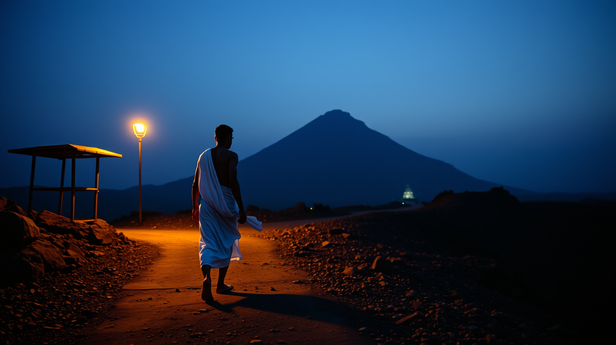
The pradakshina, the ritual circumambulation of Arunachala, covers roughly fourteen kilometres. Devotees walk it barefoot, often at night during the full moon, when the path fills with tens of thousands of people moving in the same direction in near silence. The Skanda Purana names this practice as among the most potent forms of worship at the hill, and Ramana Maharshi himself walked the pradakshina regularly, sometimes stopping for hours at particular points on the path.
What the walk does is harder to describe in the language of religious obligation. You are not walking around a monument. The hill is always to your right. Its mass is constant. Your relationship to it shifts with every turn in the path, sometimes you see the main peak, sometimes a shoulder, sometimes just rock and scrub and the sound of other feet. The hill stays still. You are the one changing position. This is the teaching, stated physically rather than verbally: the mountain does not adjust itself to offer you a better view. You walk until your angle changes.
Hindu sacred geography has always understood that certain places do something to attention that speech cannot. The Devi Bhagavata Purana describes the earth itself as a body, with specific locations carrying specific intensities of shakti. Arunachala sits in that understanding not as a special case but as its most extreme example, a place where the ground is considered to be in continuous, active transmission.
Why silence is the teaching, not the setting
Ramana Maharshi gave very few formal discourses. Most of what he transmitted happened in silence, in the hall of his ashram at the foot of the mountain. Visitors would arrive with elaborate questions about consciousness, about the self, about liberation, and find that the question dissolved before it was answered, not because Maharshi deflected it, but because something in the atmosphere of the place made the question feel differently weighted than it had outside the gate.
He attributed this directly to the mountain. In Aksharamanamalai, the hymn he composed to Arunachala, he writes to the hill as a lover writes to a beloved, with longing, with complaint, with the particular anguish of someone who cannot leave and cannot fully arrive. The hymn is not a praise song. It is a record of what proximity to the mountain does to the ego: it does not destroy it cleanly. It wears it down slowly, the way the hill itself has been worn by wind and rain across geological time.
This is the mechanism Hindu tradition proposes for certain sacred landscapes: not revelation, but erosion. The Mundaka Upanishad describes two kinds of knowledge, para vidya, the higher knowledge of Brahman, and apara vidya, all other learning. What Arunachala offers, in this framework, is not information of either kind. It offers conditions. The mountain creates the atmosphere in which a particular kind of attention becomes possible. Whether you use it is your own business.
The theology of a landscape that teaches without speaking
The idea that a place can be a teacher, a guru in the full technical sense, sits at an unusual intersection in Hindu thought. The Guru Gita, embedded in the Skanda Purana, defines the guru as the one who removes darkness: gu meaning darkness, ru meaning the one who removes. By that definition, any force that consistently moves a practitioner from confusion toward clarity qualifies. Arunachala has been making that case for centuries.
The Tevaram, the seventh-century Tamil devotional hymns composed by the Nayanmars, contains multiple poems addressed directly to the Shiva of Tiruvannamalai. Appar, one of the Nayanmars, describes the hill not as a destination but as a force, something that pulls rather than waits. The bhakti tradition in Tamil Nadu has always understood sacred geography this way: the deity is not housed in the temple. The temple was built because the deity was already there.
What Arunachala represents in the broader architecture of Hindu sacred thought is a proposition about the nature of presence. A human teacher speaks, interprets, adjusts the teaching to the student. A mountain does none of these things. It offers the same face to everyone. The teaching is identical for the scholar arriving from Chennai and the village woman who has walked three days from her district. What each person receives depends entirely on what they bring and how long they stay.
The Ribhu Gita, a text Ramana Maharshi recommended frequently, states that Brahman alone exists, and that all apparent forms are modifications of that single reality. Arunachala is, in this reading, not an exception to the world but its most legible point, a place where the modification is so stable, so old, and so massive that something in the human nervous system recognises it before the mind has formed a thought about it.
Pilgrimage to Arunachala has never been about arriving at an answer. The hill holds the question open. Every pradakshina returns you to the same starting point having moved through the same fourteen kilometres, and the hill looks different each time, not because it has changed, but because you have. After enough circuits, you stop waiting for the hill to explain itself. That shift, the tradition says, is the beginning of understanding.