An inflatable Minion on a highway in Ireland doesn’t get there on its own. Childrens’ movies – or movies aimed at kids and young teens – have never been bigger, and neither have the promotional budgets. Animated films especially are dominating the box office. Ten of the top 20 highest-grossing U- and PG-rated movies of all time are animated, including six of the top 10. And, apart from Beauty and the Beast (1994), they’ve all been released since the turn of the century.
Yet, something’s missing. Beyond all the changes in technology, marketing, sales totals, or even demographic target audiences, what’s notable about modern kids’ movies is that there are very few kids in them.

We can see this by consulting Wikipedia’s long list of children’s films released since 1980.
After cutting this list down to eliminate straight-to-DVD or made-for-TV movies, as well as some small foreign films, we get a list of approximately 745 movies. It confirms a rise in kids’ movies, overall. Our imperfect list shows there were 106 films released during the 1980s, 224 released during the 1990s. More still were released in the first decade of the new century – 261 by my count. And by the end of 2015, we’ll be on pace to pass 300 a decade by 2020. 154 children’s films have come out in the past five years.
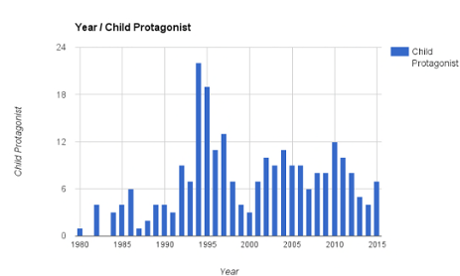
But where are the kids in all these movies? Though there’s been a rise in children’s films overall each decade, the same can’t be said for those with a child protagonist, or in which a child drives the narrative. Here’s how it breaks down by year:
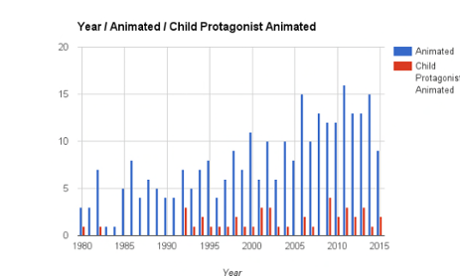
The main reason for the disappearance of child protagonists appears to be the overall drop in live-action kids’ movies. When live-action kids’ movies are made, as they were in abundance in the mid-1990s (perhaps the real golden age of kids’ films), they’re more likely to feature a child as the main character than their animated counterparts.
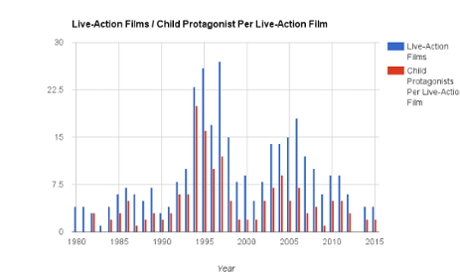
The absence of live-action children’s movies featuring child actors in central roles is even more confusing when two other factors are considered: live-action movies tend to be cheaper (Toy Story 3 cost $200m to produce, whereas Home Alone only cost $18m), and child actors are not only everywhere, especially on TV, but are also arguably better than ever.
But does it matter? Does it make a difference to kids whether they watch a real live child as opposed to an animated one, or a real kid versus a cartoon monster? How much do kids need to see other kids on screen? Will a film’s message – or morality lesson – be absorbed either way?
There doesn’t appear to be a lot of research into these questions, but we might still wonder whether constant, or continued, immersion in synthetic worlds might eventually leave kids uninterested in interacting with the real one.
When the website io9 discussed the recent dearth of movies like The Goonies, one commenter noted that “Movies like The Goonies … are no longer possible because movies like that rely on the exploration of the world of children that is separate from the world of adults, and that world no longer exists.” That is, movies like The Goonies promoted not only independence, but also independent thought.
Yet, these days, it’s not so much that child exploration no longer occurs. There remains a world that exists for children to explore that’s separate from the world of adults. The difference is that now that exploration is done on phones or tablets, where an imaginary world requires no imagination at all. And, where cinema once reinforced the idea of the explorer child existing in a wider, tactile world, it now reinforces the non-reality of a pre-packaged computer simulation where children rarely exist at all.
But at least the marketing department can sell giant balloons.
- A longer version of this post originally appeared on Colin Horgan’s blog.