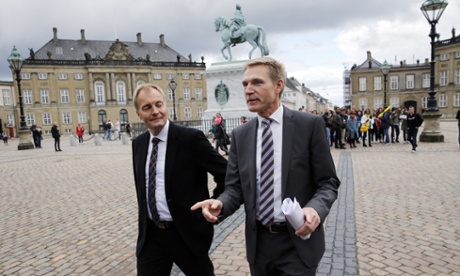
After four years of centre-left government, Denmark has swung back to the centre-right.
On the surface, the outcome is not monumental. In 2011, the centre-left won with a majority of 0.5 points.
Meanwhile, on Thursday, the centre-right won by 4.5 points. The Social Democrats even increased their vote share.
However, what does make the election (for lack of a better word) historic is the rise of the rightwing Danish People’s party (DPP). It won the biggest vote share in its 20-year history and, most significantly, emerged as the largest party in the bloc of those to the right of the political spectrum.
The Danish election continues a trend that began in Norway’s 2013 election: the rise of rightwing, anti-immigration parties in Nordic countries.
Although such parties are on the up – with few exceptions – across Europe, what makes the Nordic example somewhat different is that due to more representative voting systems in these countries, the parties’ parliamentary strength is greater in Denmark, Sweden, Finland and Norway than it is elsewhere.
In the UK, Ukip’s 12.5% vote share in May only translated into one seat due to Britain’s first-past-the-post system. France’s Front National regularly struggles to win seats in elections at different levels because of the country’s two-round voting system.
Over the past two decades, the DPP, the Sweden Democrats, the Finns in Finland and Norway’s Progress party have all seen their support trend upwards in election after election.
While support for the Finns and the Progress party dipped slightly in the most recent Finnish and Norwegian elections compared with previous ones, both became parties of government for the first time following their 2015 and 2013 elections.
This is an important distinction to what happens in Sweden compared to the other three Nordic countries: the Sweden Democrats are shunned by the other parliamentary parties who refuse to deal with the rightwing party due to its policies.
Yet the strength of the Sweden Democrats’ 49 seats following the 2014 election meant neither the centre-left nor the centre-right parties had the numbers required to form a government. A six-party budget deal was needed in order to form a government and avert another election.
There are of course diverse national factors that make the specific context and politics of each country and election different, but the one factor that unites the four parties and countries is immigration – and the parties’ populist rhetoric and stance against migrants.
In Denmark, the DPP is demanding a crackdown on the country’s borders and so called “welfare tourism” as well as a hardening of policies towards asylum seekers.
The growing influence of all four parties has moved in parallel with the four Nordic countries’ changing populations and their electorates’ attitudes to immigration.
In all four countries, immigration has increased since 1998
The number of asylum seekers has increased noticeably in Sweden and Denmark, in particular over the past two years. However, in Norway the number of applicants per 1,000 people has declined (as has support for the Progress party on a vote share basis).
Most crucially, attitudes to immigration have become significantly more negative in Sweden and Denmark. According to the Eurobarometer, a record number of people now see immigration as one of the two most important issues facing these countries. In Finland, the share has declined after spiking between 2007 and 2010 (support for the Finns follows a similar pattern), and immigration is now seen as less pressing than the economic situation and unemployment (the country was in recession for most of last year, and growth is still flat).