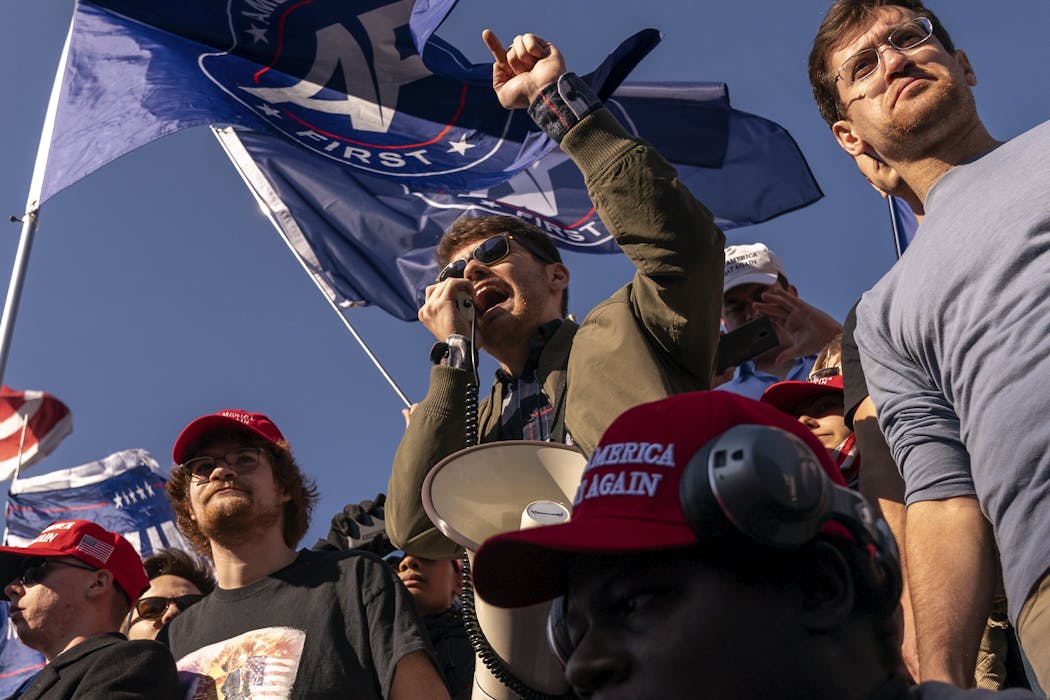
Far-right activist Nick Fuentes continues to gain momentum.
The openly racist and antisemitic podcaster has emerged as an influential figure on the American political right. Recent profiles in The Atlantic and The New York Times have elevated the 27-year-old into practically a household name.
But as a scholar of the American right, I’ve been fascinated by one aspect of Fuentes’ rise: the way some Black podcast hosts and political influencers have been receptive to some of his views.
“Isn’t that amazing?” Black pastor and radio host Jesse Lee Peterson gushed after hosting Fuentes on his show in 2023. “Finally, a white man standing up for what is right. And you heard him say it – he hate no one.”
At first blush, this might sound counterintuitive. Fuentes champions a racist vision of national populism. He has promoted the idea that the country’s identity depends on preserving its white majority. In the past, he’s defended Jim Crow, the segregationist legal regime that governed the South from the late-19th century to the 1960s, arguing that segregation was better for both Black and white Americans. He’s openly disavowed miscegenation, and castigated Vice President JD Vance for marrying an Indian woman and fathering mixed-race children.
Black people and white nationalists, however, have joined forces in the past. And a number of cultural and political shifts have broadened Fuentes’ appeal to Americans of all races.
Finding common ground
In the 20th century, Black and white nationalists were able to find common ground on the topic of racial separatism.
Marcus Garvey, a leading proponent of the back-to-Africa movement in the 1920s, and Elijah Muhammad, the former leader of the Nation of Islam, saw white nationalists as kindred spirits.
Garvey envisaged a new nation built by the descendants of African slaves. To him, the ostensible racism of the Ku Klux Klan helped drive home his message that the U.S. would never be a place that could incorporate Black people as equals. In 1922, he met with Edward Young Clarke, the Klan’s acting leader. Garvey later explained how the two shared the same vision: Clarke “believes America to be a white man’s country, and also states that the Negro should have a country of his own in Africa.”
Meanwhile, Muhammad embraced the idea of Black superiority.
In George Lincoln Rockwell, the leader of the American Nazi Party from 1959 to 1967, Muhammad saw a white man who may have disagreed about which race was superior but was nonetheless serious about carving out a territory somewhere in the U.S. to build a separate Black nation. Even though Rockwell spoke of Black people as a “primitive race” and had organized a “hate tour,” Muhammad invited him to speak at the Nation of Islam summit in 1962. To Muhammad, they both had the same goal: separation of the races.
Uniting in opposition to Israel
Importantly, among both Black nationalists and white nationalists, race mixing was often cast in an antisemitic framework, with Jews accused of spurring racial integration. Rockwell claimed Jewish communists were behind the Civil Rights Movement, while the Nation of Islam published a pseudo-historical book in 1991 claiming that Jews were responsible for the transatlantic slave trade.
Today, antizionism and antisemitism are where Fuentes and some Black conservatives appear to have found common ground.
Hamas’ attack on Oct. 7, 2023, and Israel’s ensuing annihilation of Gaza have destabilized politics not only in the Middle East but also in the U.S.
Historically, the mainstream media in the U.S. has championed Israel, while both of the country’s major political parties have backed Israel financially and militarily.
However, due to a number of factors – including Americans’ widespread exposure on social media to the destruction of Gaza, the growing diversity of the U.S. and its ballooning debt – cracks in this uniform support have emerged.
Fuentes routinely implicates a “Jewish oligarchy” as the source of many problems that bedevil the world today, and his strident denunciation of Israel and the larger Jewish community has endeared him to antisemites and anti-Israel factions on the right, and this includes some Black Americans.
Take Myron Gaines, an internet personality who founded the “Fresh and Fit Podcast” in 2020. Born in Brooklyn, Gaines is of Sudanese descent and was raised as a Muslim. Originally, his podcast focused on issues related to the manosphere, a largely online movement that champions masculinity and opposes feminism.
But since the Oct. 7 attacks, Gaines became a vociferous critic of Israel, claiming “Zionist fingerprints” were “all over” the 9/11 attacks and JFK’s assassination. On this issue, he found common ground with Fuentes, who has frequently appeared as a guest on his program. On occasion, Andrew Tate, a popular British biracial social media personality, has joined them for discussions.
All three share an antisemitic worldview – promoting, at various points, the notion of Jewish control of finance, media and governments – with a pronounced misogynist streak.
Then there are the Hodgetwins, Keith and Kevin Hodge. The Black twin brothers launched their podcast in 2008 and now boast an estimated 2 million followers. They’ve recently interviewed a range of antisemitic guests on their program, including Fuentes, David Duke, Leonarda Jonie and Stew Peters.
In July 2025, Candace Owens hosted Nick Fuentes for a two-hour interview on her podcast. They had traded barbs in the past, but they had also, at times, praised each other. When Owens was fired from The Daily Wire for her criticism of Israel in 2024, Fuentes instructed his supporters to “stand with Candace.”
During the July 2025 interview, there were some tense moments: Owens needled Fuentes over why he hadn’t married and started a family. She also objected to his belief that race determined a person’s abilities and to his claim that Black civilization was inherently inferior. But the tone was generally cordial, and they agreed that the pro-Israel lobby had an outsized influence on American politics.
Race is becoming less black and white
There’s also a broader cultural shift at play: Racial identity is becoming increasingly fluid.
As political scientist Eric Kaufmann argued in his 2019 book, “Whiteshift: Populism, Immigration and the Future of White Majorities,” America may be becoming more racially diverse, but this doesn’t necessarily portend a politics of racial liberalism.
Instead, he argues that those with multiracial backgrounds will tend to identify – and be identified – with the largest and most socially dominant racial group. In other words, a significant number of multiracial Americans will “airbrush” their polyglot lineage and instead focus on their European provenance. As racial boundaries become more fluid, more people of multiracial heritage may come to culturally and politically identify as white.
Just as President Donald Trump was able to draw a higher share of Black and Latino voters than any GOP presidential candidate in recent memory, Fuentes has been able to connect with nonwhite audiences. And just as Stewart Rhodes, the founder of the right-wing, anti-immigrant Oath Keepers, is part Hispanic, the former leader of the “Western chauvinist” Proud Boys, Enrique Tarrio, is Afro-Cuban American.
Fuentes himself reflects this trend. He acknowledges his Mexican ancestry – from his paternal grandfather – and yet remains an unapologetic white nationalist, calling for “total Aryan victory.”
Black podcasters may be amenable to Fuentes due to the country’s racial reality. Any program of forced racial expulsion and separation simply doesn’t seem feasible in contemporary, multiracial America.
Fuentes seems to recognize this; in fact, he recently called for a united populist front to include the political left. He urged leftists to jettison their advocacy of open borders and wokeism. Meanwhile, he’s counseled the political right to abandon its reverence for the free market.
Perhaps Fuentes favors a form of national socialism not unlike the kind that emerged in fascist Germany and Italy. But for Gen Zers who are experiencing economic uncertainty and social isolation, such a program can sound attractive – no matter their race.

George Michael does not work for, consult, own shares in or receive funding from any company or organization that would benefit from this article, and has disclosed no relevant affiliations beyond their academic appointment.
This article was originally published on The Conversation. Read the original article.