As yet, my children have not directly experienced family break-up, the death of a parent or even the less dramatic difficulties of moving house or horrible bullying at school, but I find most children’s books seem to be on these themes. That’s fine, but what books could they read in addition which have stories that aren’t about these problems and how to overcome them?
Fiction covers many things – and overcoming difficulties is likely to be one of them! After all, to make a story exciting, to grab the reader’s attention and to keep them turning the pages, something pretty big has to happen.
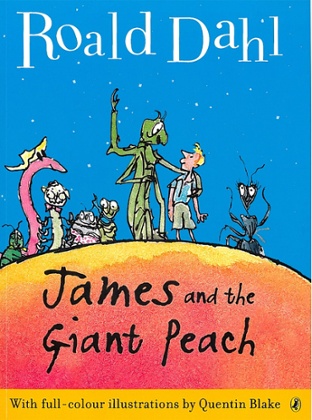
Roald Dahl was the past master at the dramatic opening. In James and the Giant Peach for example, after only one gentle paragraph which introduces the idyllic life of James and his parents, he follows it up with a second that is quite different in tone: “Then, one day, James’s mother and father went to London to do some shopping and there a terrible thing happened. Both of them suddenly got eaten up (in full daylight, mind you, and on a crowded street) by an enormous angry rhinoceros which had escaped from the London Zoo.”
As Dahl goes on to point out, it is bad for the parents but at least their troubles are over quickly while James is left with the terrible prospect of living the rest of his life with his horrible aunts Spiker and Sponge. Luckily, the Giant Peach turns up and rescues him from his terrible fate and a whole new adventure begins. In the shortest time possible, so as to crack on with the main point of the story, Dahl combines the high drama of the parents’ death in an imaginative and wholly arresting incident with a shocking emotional hit of the pathos of a child facing a grim future with oppressive relatives. And, on top of all of that, he does what almost all good fiction for children has to do, he gets rid of the parents.
One of the things that happens in childhood is that, by degrees, the child becomes increasingly independent. Charting that independence and helping children to navigate it is something that fiction does superbly. But doing things alone means that parents need to be got rid of somehow and often, although not always, there needs to be some emotional imperative to make the child behave in a particular way.
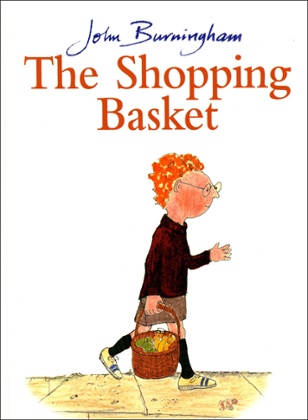
At the youngest level, in a book such as John Burningham’s The Shopping Basket the parents don’t need such a violent removal. Written at a time when children might have gone shopping alone, in a series of playfully scary encounters with different animals who try to help themselves to Steven’s purchases, it describes the real dramas which Steven might encounter as he “pops down to the shops” in an imaginative way. And there are no parents on hand to help.
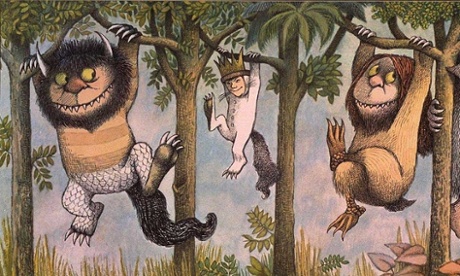
Similarly, in Maurice Sendak’s classic Where the Wild things Are, Max’s mother is even closer at hand but still far enough away for Max to have to deal with his problems alone. When his bad behaviour is confronted and contained by his mother, Max’s rage takes him off on a madcap adventure into the fiercesome world of the Wild Things. It is not somewhere that a mother would go but, as all young readers know, Max’s mother is not far away: his supper is waiting for him – and it is still hot.
As children get older, both greater distance and a bigger emotional trauma are needed to achieve the necessary physical and emotional space for independence. The specific experience does not have to be one they have experienced for it to be meaningful; fantasy is every bit as able to give young readers those emotional opportunities. In fact, achieving this in realistic fiction is especially difficult just now as in the real world many children are never away from adult eyes and so their adventures are inevitably curtailed.
As a result, both the action and the emotional traumas are family/school related as in family breakup and the remaking of “blended” families, or in the sudden death of a parent which allows for a whole new set of opportunities and less watchful parental eyes.
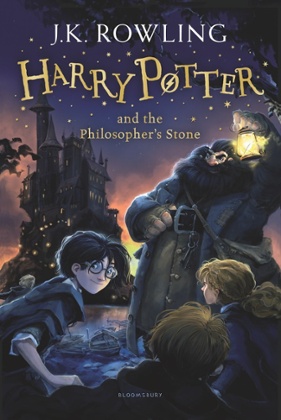
Fantasy and historical fiction are two good places where readers may find children a wider range of sources for their adventures or traumas while also enjoying greater freedom – although they too may have some of the above characteristics. Harry Potter, for example, is loved for many things and being dramatically orphaned at the beginning of the sequence in Harry Potter and the Philosopher’s Stone is one of them.
A new wave of mystery or detective fiction is also proving a fertile place for children to act boldly, sometimes alone and sometimes not, and often after the shock of something mysterious happening. Such books are not new - Carolyn Keene’s many Nancy Drew titles, featuring the eponymous female sleuth, were highly popular in both the US and the UK – but it good to see some new examples of them.
In Robin Stevens’s Murder Most Unladylike, Daisy and Hazel set up a secret detective agency at Deepdean School for Girls. Following clues is always fun but what if there’s nothing very exciting to detect? Luckily, they find a missing body and then it disappears and soon there is drama a-plenty and it may even threaten the two girls’ friendship. Or try Lauren Child’s thrilling Ruby Redfort series, which starts with Look into My Eyes.
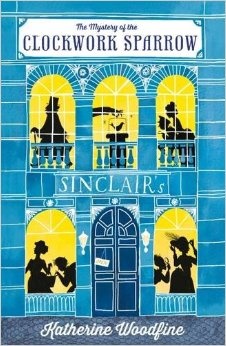
Katherine Woodfine’s The Mystery of the Clockwork Sparrow is equally exciting even if there is no dead body! A twisting plot of thefts and mysteries, including the disappearance of the highly valued Clockwork Sparrow, is gripping to follow in the delightful setting of a very classy department store where such occurrences definitely should not happen! Stories like these provide and exciting drama that is far removed from stories of everyday life.
Do you have books to recommend on this theme? Email childrens.books@theguardian.com or get in touch on Twitter @GdnchildrensBks, where you can also ask The Book Doctor a question using #BookDoctor.
Your suggestions
Glenn, on email
Alan Garner’s The Weirdstone of Brisingamen and The Moon of Gomrath could go on the list.
Ian, on email
Terry Nation, Rebecca’s World: it’s not the greatest children’s book ever written, but it is very close.
Nuits de Young, on email
I would recommend John Gordon, The Giant Under the Snow; Alan Garner, Weirdstone of Brisingamen, Moon of Gomrath, and Elidor. I used to read a lot of Rosemary Sutcliff: the historical settings and characters who were nearer adults than children also helped. Also Tolkien, and Icelandic sagas, Arthurian legends, and mythology.
Judy, on email
A couple of older ones… Enid Blyton, The Magic Faraway Tree series and The Famous Five; E. Nesbit, Five Children and It.
For younger kids, most anthropomorphic books just don’t have the need for a parent, such as Edward the Emu (by Sheena Knowles, followed by Edwina the Emu), Slinky Malinki (by Lynley Dodd) or Hairy Maclarey.
For slightly older readers, King of Shadows by Susan Cooper
Becca, on email
How about Small Change for Stuart by Lissa Evans – the main character starts by moving house (so he has the time and no friends, necessary in order to start the plot rolling), but the story is a fun mystery and the sequel is as good.
Annie, on email
I am recommending Magic Molly, The Mirror Maze and also The Wishnotist, both by Trevor Forest. These books are an excellent small person’s look at family issues and help little ones to understand that they are not alone when things go wrong in their lives.
Bonnie, on email
I would like to recommend Magic Molly, The Mirror Maze or The Wishnotist, by Trevor Forest and The Portal to Forever by Bonnie Sullivan Raymond. All three are entertaining page turners for children. Even reluctant readers are entranced by these titles and will not want to stop reading until the end of the book.
John, on email
Arthur Ransome’s Swallows and Amazons series had the right idea: the parents willingly removed themselves just enough for the children to function quasi-independently. That’s not quite right, because Cdr. Walker was away on naval business so much of the time – but even he arranged to be helpful in finishing “We Didn’t Mean to Go to Sea” and then in setting up the plot of “Secret Water”Mother was conveniently busy with baby Bridget until the children grew up enough to be able to look after her (again, in “Secret Water”).Captain Flint was enough of a child to be acceptable in most of his appearances, and Timothy, the Armadillo-wannabe, was just as shy as any adolescent boy could be.
Tamara, on email
Books that have independent, adventurous children in it without the trauma of death or divorce:
-Ivy and Bean series
-Cobble Street Cousins
-Encyclopedia Brown
-Lotta books by Astrid Lundgren
-Ronia the Robbers Daughter and Children of Noisy Village by Astrid Lundgren
- Katie of the James Mayhew books
-most of the kids in the Magic Treehouse series go off on independent adventures
Donyale, on email
I very much enjoyed your list and would like to add one more writer: Frances Hardinge. While some of her heroines in particular suffer from a lack of parents (Mosca Mye in Fly By Night being the archetype), others have wonderful families. One of the things that I was most impressed by in Verdigris Deep was that the young hero’s parents actively help and support him, and that he feels the benefits of their love and support. I remember pausing and trying to remember the last time I had seen that in a children’s book.