Ever since Bethesda introduced the Horse Armor Pack for Oblivion in 2006, in-game cosmetics have slowly taken over the gaming industry. While most games sell skins in their own shops, with prices determined by the developers themselves, Valve’s flagship esports title, Counter-Strike, takes a characteristically hands-off approach. So with a fully formed, player-driven economy, supply and demand mechanisms, and more, here’s why CS2 skins cost so much.
Why are CS2 skins so expensive?
Put simply, CS2 skins are expensive because their prices are set by players, not Valve. Unlike in other games, where skins are sold at a fixed price set at the developers’ whim, every CS2 skin has its price tag determined by a genuine supply-and-demand marketplace. If a player (or collector) is willing to pay a million dollars for a particular knife, then that’s the market value for that skin going forward.
While nearly all skins are first acquired (minted) through case openings, their actual value is determined on the marketplace. That can either be Steam’s own Community Market, which gives 30 percent of all sales to Valve, or third-party markets built on Valve’s APIs. With StatTrak, Souvenir, Limited Edition, and countless wear values, each skin is distinct within the game, but in the eyes of the market, they’re grouped together to determine the skin’s value.

How the CS2 marketplace and skin economy work
Had CS2 skin sales been limited to the Community Market alone, then the skins could only ever be used to boost your Steam account balance. Sure, that may buy you an extra game or two here and there, but it isn’t “real” money that you can spend to pay your bills or buy something IRL.
That’s where CS2‘s skin economy truly becomes unique through the existence of third-party marketplaces. Once a player owns a skin, they can list it on a third-party marketplace (like CS.Money, Skinport, Buff163, etc.) and sell it for actual, spendable money. This turns the virtual item from just a set of pixels into an actual asset that can be bought and sold for real-world money.
Adding further incentive to the third-party platforms, while Valve takes a 30 percent cut on every sale in the Community Market, most platforms allow you buy and sell skins with very low transaction fees. This means your profit or loss depends entirely on what other players are willing to pay.
Why scarcity drives the CS2 skin economy
Much like real world economics, scarcity is the single biggest price driver in the CS2 economy, and it operates on several layers at once.
Drop rates are engineered so that the rarest skin tier in any case/collection (usually knives or gloves) have a roughly 0.26 percent chance of dropping. That built-in rarity alone creates a massive price gap between common skins and rare ones from the same case or collection.
Related—Every Arabesque collection skin in CS2
Limited supply compounds this further. Whenever Valve retires a case or stops producing a specific skin, the total number in existence is essentially frozen forever. Methods like Trade Ups can sometimes bump up the total, while inventories being banned from trading take away lucrative skins en masse. All in all, fewer items and more buyers means prices keep climbing year on year.

Then there’s the detail collectors obsess over: float values. Every skin has a wear rating between zero and one, which determines its visual condition (Factory New to Battle-Scarred). Within that range, extremely low floats become disproportionately desirable, despite often having no visual differences. In fact most collectors pride on owning the No. 1 lowest float value for any particular skin.
Rare or unique patterns can often make skins even more valuable. Skins like the Case Hardened series generate a unique pattern seed on creation, and certain seeds (like an all-blue Case Hardened) are hunted specifically and can sell for many times the base price.
Finally, the value of any skin can be further enhanced by applying stickers to it. Stickers, especially rare stickers from Valve-sponsored Major events, can add thousands of dollars to the price of an otherwise ordinary weapon skin.
Related—All CS2 Anime Stickers in 2026
Putting all these factors together is why two nearly-identical skins in-game can have wildly different price tags, as the economy is pricing in the specific combination of skin, float, pattern, and stickers.
Why people spend thousands on virtual items
To an outsider, spending $2,000 on a knife in a video game can seem irrational. Especially when you compare it to the price of a more dynamic melee skin in a game like Apex Legends or VALORANT. Even League of Legends‘ legendarily expensive “Signature Immortalized” Faker Ahri skin only cost about $500.
But the psychology behind a CS2 skin purchase is drastically different from other games. Instead it follows the mindset behind luxury goods.
Status and identity play a major role in skin purchases. In CS2, your loadout is visible to teammates and opponents every match. A rare knife or a gloves skin functions like a visible flex, a signal of time invested, money spent, or both. It’s a small, constant broadcast of identity in a hobby people spend hundreds of hours in.

Collecting drives another chunk of demand. Some players aren’t interested in flexing at all. They are completionists chasing a specific set of skins, a particular skin across every wear tier, or every sticker from a Major.
Exclusivity compounds both motivations. A skin that can never be manufactured again carries a story: “this can only get rarer.” That scarcity narrative is emotionally powerful even when the item has no functional use.
This is where CS2 skins start to resemble established luxury and collector markets:
- Like a Rolex , a rare CS2 knife holds value due to limited production and the item being a status symbol in the community.
- Like Pokémon cards, individual item value depends on condition (float, in CS2 ‘s case) and rarity within a print run (the case) that will never be reopened.
- Like sneaker culture , hype around limited releases (a new Major case) creates immediate resale premiums driven by scarcity rather than utility.
The major difference, of course, is that CS2 skins are entirely digital, inspectable, and traded in a transparent marketplace in real time. The transparency and traceability combines to make the price more legitimate, while the digital exclusivity reduces the possibility of counterfeits.
How CS2 skins gain value over time
While most skins are bought to be a part of an active player’s loadout for the game, some players don’t buy skins to use them. They buy them expecting the price to rise, treating skins as a genuine alternative asset.
This works because of a straightforward supply mechanic: when Valve discontinues a case, that’s the entire supply, permanently. No more of that skin will ever be created. Meanwhile, CS2‘s active player base has continued growing year over year, meaning more people are competing for a fixed pool of older items.
Related—Every Spy Tech collection skin in CS2
Basic supply-and-demand economics does the rest. Supply continues to shrink relative to a growing audience, so prices for early, discontinued skins tend to climb over multi-year periods.
That said, this isn’t a risk-free investment. Skin values can drop sharply if Valve floods the market with a similar-looking new skin, or if a game update changes an item’s popularity. An example of such a change would be the changes made to Doppler skins early in the transition from CS:GO to CS2, which drastically changed how the knives looked in-game.
Skins also carry platform risk. They exist entirely within Valve’s ecosystem, meaning their value is contingent on Steam and CS2 continuing to operate as they currently do. Treating skins as a serious investment vehicle means accepting volatility and platform dependency that traditional physical assets don’t carry.
Valve accidentally created a virtual economy
Valve didn’t set out to build a financial market. What it built was a trading feature. But the Steam Market, combined with peer-to-peer trading, effectively created a self-sustaining economy with no fixed prices.
These steps align well with Valve’s consumer focused philosophy in all their products. Be it through availability of repair parts for the Steam Deck, or no-questions-asked refunds for any game purchase on Steam, Valve has proven consistently that it has the gamer’s interest in mind. And their hands-off approach to the CS2 skin economy is no different.
Unlike a normal in-game store where an item costs whatever the publisher decides, every CS2 skin’s price is community-determined. Valve doesn’t set the value of a Dragon Lore; the aggregate of thousands of buyers and sellers does, constantly, in real time, the same way a stock price reflects collective market sentiment rather than a company announcement.
This is what makes the CS2 economy structurally different from most in-game cosmetic systems. Valve built the framework (cases, keys, the Market, trading) and let player behavior determine everything downstream. The result is a system that behaves like a genuine free market, complete with speculation, volatility, and price bubbles, layered on top of a video game.
Why are CS2 knives so expensive?
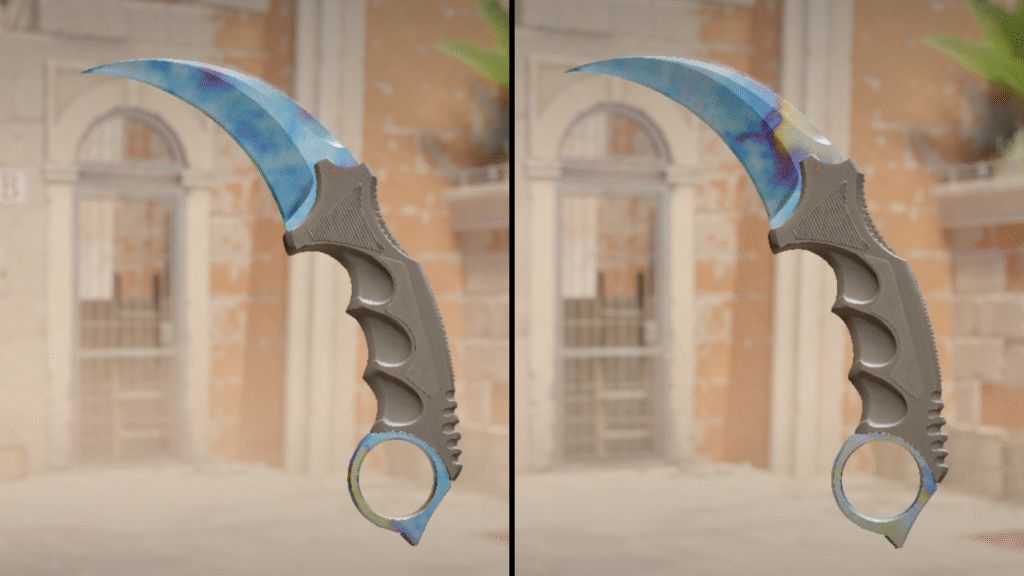
While a number of skins have reached astronomical prices in the past, none enamor the CS2 community as much as knives do. That stems from a combination of reasons that originate from the items’ scarcity and prestige.
Rarity is built into the drop structure for a knife. Knives (and gloves) occupy the rarest tier in almost every case, with around a 0.26 percent chance per case opening. Most players will open hundreds in the search of a knife without ever pulling one.
Even when you pivot into the more recent Trade Up contracts for knives, it takes five already-rare Covert skins and converts it into a knife that could have any finish from a Fade to a Rust Coat, making it quite a risky transaction.
Beyond just acquiring a knife, the particular knife you get also makes a huge difference. Knives like the Butterfly or Survival blades have unique inspect animations, movement flourishes, and visual details that other skins don’t get. That makes them feel like a distinct tier of item rather than just another skin.
That rarity translates directly into prestige. A knife is instantly recognizable in-game as a marker of luck or investment, making it the clearest status symbol available in CS2.
Finally, low supply increases all these factors. Because knives are already the rarest drop in any case, discontinued knife skins from retired cases are especially scarce, pushing top-tier examples into five-figure territory.
Will CS2 skins keep increasing in value?
There’s no certain answer, but several factors come into play both for and against CS2 skins as an investment.
On the growth side, CS2‘s player base has remained large and active following the 2023 transition from CS:GO. And Counter-Strike 2 shows no signs of losing its position as one of the most-played competitive shooters. A larger, sustained player base generally supports rising demand for older, scarcer items.
On the risk side, Valve’s policy decisions are unpredictable. A single change, such as new case mechanics, adjusted drop rates, or changes in trading rules, can shake up the market overnight. Since Valve controls the entire supply pipeline even though it doesn’t control pricing, it has all the power.
Gambling regulations are also a factor to consider. While not directly related, skins are often used as currency in unregulated gambling platforms. Valve has recently cracked down on such platforms, requiring esports tournament organizers to prevent any advertising from sites using Steam’s APIs.
Realistically, the rare and historically significant items will likely retain or grow their value. But the broader market remains considerably more volatile and dependent on Valve’s decisions both now and in the future.
Frequently Asked Questions (FAQs)
Why are CS2 skins so expensive?
CS2 skins are expensive because prices are set by player supply and demand in a free market, not by Valve. Scarcity, discontinued cases, rare patterns, and social status all push prices upward.
Who decides skin prices?
The community does, through the Steam Market and third-party trading platforms. Valve only sets the price of keys; everything else is market-driven.
Why are knives worth more than other skins?
Knives have the lowest drop rate in any case (about 0.26 percent). Combined with unique animations and their position as the clearest status symbol in-game, that makes them the most sought-after item.
Can CS2 skins lose value?
Yes. New case releases, changes to drop mechanics, declining player interest, or regulatory action against skin trading and gambling can all reduce demand and lower prices.
Are CS2 skins a good investment?
CS2 skins can appreciate over time, but they carry a volatility risk since their entire value depends on Steam and CS2 continuing to operate as they do today.
What are the most expensive CS2 skins?
Some of the most expensive CS2 skins include the Karambit “Blue Gem” Case Hardened, which has received offers over $1 million from collectors, the AWP Dragon Lore, and Butterfly Knives’ in the Doppler finishes. Amongst stickers, the Titan (Holo) from Katowice 2014 remains the most expensive even in 2026.