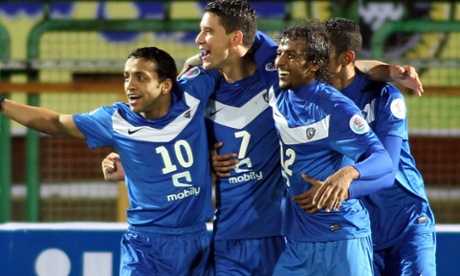
On the way to Guangzhou Evergrande’s home stadium for the second leg of the 2014 Asian Champions League quarter-final, Western Sydney Wanderers had their team-bus rammed by an over-enthusiastic local fan. At least it would have woken up any players catching up on sleep lost after early morning phone calls to their hotel rooms. Fans are just as passionate, perhaps even more so, about Saudi Arabia’s biggest club, already arrived down under for Saturday’s first leg of the 2014 Asian Champions League final. Western Sydney Wanderers would love to lift the trophy, but for Al Hilal it’s different. This Riyadh institution needs to win.
In 2013, Guangzhou were in a similar position and a first title was as huge as this year’s exit, at Sydney’s hands, was painful. In the wider world, the Chinese club with Lippi and all the rest are seen, rightly or wrongly, as the continent’s biggest club but this is certainly not the case in Riyadh. Al Hilal feel that such an accolade is theirs by right. Fans in Asia (perhaps everywhere?) tend to treat the often weird rankings by the Germany-based website International Federation of Football History & Statistics with disdain when they don’t like them but as gospel when they do. So the label of ‘the Asian club of the 20th century’ is one that is still cited with pride.
Perhaps the accolade was accurate. Al Hilal are a big club, though it helps when your president is a member of the Saudi royal family and you play in the beautiful 67,000 capacity King Fahd Stadium, not often full for league games but packed to the rafters for big Asian Champions League fixtures. Al Hilal merchandise stores dot the country’s cities. Thirteen league trophies have been lifted, a record, and 18 prestigious Crown Prince Cup wins. In the 1970s, Brazilian legend Rivelino had a spell, comparing local passion for the club favourably with back home. More meaningful have been the homegrown legends such as Sami Al Jaber and Mohamed Al Deayea, a pair of players with over 300 international appearances between them.
The history is there but in the past decade, Al Hilal have slipped somewhat from continental consciousness, largely thanks to relatively poor international showings. In 1991 and 2000, the ‘Blue Wave’ won the Asian Club Championship, the forerunner of the Asian Champions League. They also won two Cup Winners’ Cups and two Super Cups, competitions that no longer exist. This has led some to say that these six trophies make the team the most successful ever in Asia which it probably is to those people who would believe that Luton Town are bigger than Everton and Aston Villa bigger than Manchester United by virtue of winning more League Cups. There is only one Asian title that matters. If Al Hilal beat Wanderers, they will have three in the cabinet, level with South Korea’s Pohang Steelers, and one ahead of Saudi rivals Al Ittihad.
In the internet age, Ittihad’s back to back Asian Champions League titles put them ahead of Al Hilal in terms of international profile. The second, in 2005, was truly majestic under coach Anghel Iordanescu. The former general in the Romanian army is also a past Al Hilal manager, and one of six from the eastern European country to occupy that very hotseat in Riyadh. The latest is current occupant, Laurentiu Reghecampf, is just 39.
In contrast to Ittihad, Al Hilal have just one Asian Champions League semi-final appearance to look back on, in 2010 when they expected to breeze past Iranian club Zob Ahan. Almost 70,000 fans were silenced in the second leg by Igor Castro. “We felt that they expected to beat us with little problem,” the Brazilian told the Guardian. “That helped us for motivation but it also put pressure on themselves. We could feel it at their stadium.” And while Hilal attacked and attacked, the goal never came.
That was a painful loss, now it is time to put it right. Abdullah Al-Sudairy can take some credit for their appearance in the final this year. The 22 year-old has claimed the goalkeeping spot and could be Saudi Arabia’s No1 for years to come if eight clean sheets in nine Champions League games are anything to go by. Only Al Ain stained that record with two goals in the second leg of the semi-final, though a 3-0 advantage from the first leg was enough. As well as the 2003 champions, the Saudis knocked out 2011 winners Al Sadd of Qatar in the quarters and saw off Uzbek powerhouse Bunyodkor in the second round, after topping a tough group.
Central defender Kwak Tae-hwi is a crucial member of the eleven and captained Ulsan Horangi to the 2012 title. The big Korean has formed a formidable central defensive partnership with Brazilian Digao. The pair are not the quickest but love nothing more than an aerial battle whether in their own area or that of the opposition. A little further up the pitch, big-money Brazilian signing Thaigo Neves is a formidable midfield presence. Al Hilal have experience and plenty of leaders such as Saud Kariri, who was a part of Ittihad’s all conquering team a decade ago.
https://www.youtube.com/watch?v=opkaaJRcWfQ
And there is Yasser Al Qahtani. Nasser Al Shamrani, gets most of the headlines these days because he gets most of the goals – ten so far in this year’s tournament – but Al Qahtani, has had a magnificent career, though perhaps not quite as good as it could have been.
The Sniper, who scored at the 2006 World Cup as a 23 year-old has been one of Asia’s top strikers for a decade. He has sometimes divided and annoyed fans, partly because of stories of parties and late nights at his Riyadh pad, and he didn’t exactly impress Manchester City at a 2007 trial. He reportedly arrived with a sizable retinue in tow that cheered his every touch – Al Qahtani didn’t take kindly to a Richard Dunne ‘reducer’ either, exiting the pitch in tears. The player’s version of events is different, claiming that he was offered a deal but stayed because Al Hilal needed him. Whatever the truth, this talisman of Saudi sport deserves more when it comes to his international reputation.
That is what all connected with the club crave. It is not enough for Al Hilal to believe they are the biggest club in Asia, the rest of Asia has to believe it too.