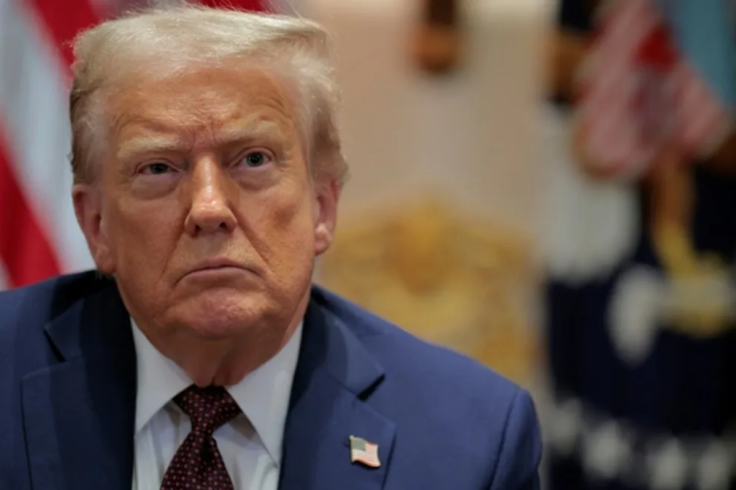
Donald Trump has joked that he must be 'careful' not to overtake William Howard Taft as America's heaviest president, after a recent medical assessment put Trump at 238lb, just shy of the BMI threshold for obesity. The president made the remark while appearing on 'Story Time with the Second Lady,' a children's podcast, where he told young listeners to 'keep yourself in good shape.'
After Trump's latest check-up, showed he has gained 14lb since April last year. Taft, who served as US president from 1909 to 1913, was famously heavy throughout his adult life. He was about 6ft tall and weighed 243lb on leaving college, later believed to have exceeded 330lb in office, according to the National Constitution Center. Taft's size has long been a historical curiosity. Trump's, by contrast, is now a live political and medical talking point.

On the podcast, Trump leaned into the comparison. 'William Taft was a large man. Very large. Loved the hot dogs at the baseball games. He was our heaviest president, and I have to be careful because I don't want to supersede his record,' he said. 'That would be possible if I allowed it to happen. Keep yourself in good shape.'
The quip was delivered lightly, but the numbers behind it are less flippant. Standing 6ft 3in tall, Trump now has a body mass index of 29.7. Clinically, a BMI of 25 to under 30 is considered overweight. At 30, the line is crossed into obesity. Trump, if the figures are accurate, is within a whisker of that cut-off.

Donald Trump's BMI and a Doctor's Quiet Warning
BMI is a blunt instrument. It ignores muscle mass, ethnicity and fat distribution, and many experts warn against reading too much into a single figure. Yet it remains the shorthand most doctors use to assess weight-related risk, and here the trend matters as much as the headline number.
Practising internist Dr Stuart Fischer, a former ER physician who has commented publicly on presidential health that Trump's most recent assessment does not give the public enough detail to judge his overall condition. Even so, he said the documented weight gain alone is not something that should be brushed off as media sniping.
'Someone has got to really quietly sit down and talk with him, and say, You're playing with fire,' Dr Fischer warned. He acknowledged that some of the commentary around Trump's health is 'foolish criticism,' but argued that unexplained weight increase at his age can be an early sign of more serious trouble, including 'a malignant form of circulatory problem ... early congestive heart failure.'
That phrase sounds dramatic, and Fischer's choice of words is deliberate. Congestive heart failure, in simple terms, is when the heart becomes too weak or too stiff to pump blood effectively. The result is a backlog in the system. Blood does not move as it should, fluid leaks into the lungs, legs and abdomen, and people begin to feel breathless, swollen, exhausted. The Cleveland Clinic notes that while the condition is serious, it is often controllable with medication, lifestyle changes and timely medical procedures.
Trump's official health assessment, as reported, gives no indication that he has congestive heart failure. There is no confirmed diagnosis of any cardiac disease, and on the record his doctors have consistently insisted that he remains fit for office. Nothing in the publicly available documents proves otherwise, and without fuller data independent experts can only speculate. Everything beyond those basic facts should therefore be taken with a grain of salt.
Fast Food, Public Image and the Heaviest President Question
Trump's relationship with food has been part of his public caricature for years. He is known to favour fast food, especially McDonald's. Earlier this year he reportedly arranged for a DoorDash delivery to the Oval Office, then sat down to what was described as a feast in the White House. Supporters tend to see this as endearingly unpretentious. Doctors tend to wince.
On its own, a fondness for burgers proves very little. Plenty of people eat poorly and live long lives; others follow the textbooks and still fall ill. But for an 80-year-old man already sitting in the 'overweight' band and edging towards obesity, every added pound complicates the picture. Extra weight strains the heart, raises the risk of diabetes and sleep apnoea, and makes any future surgery or illness harder to manage. That is basic cardiology, not partisan spin.
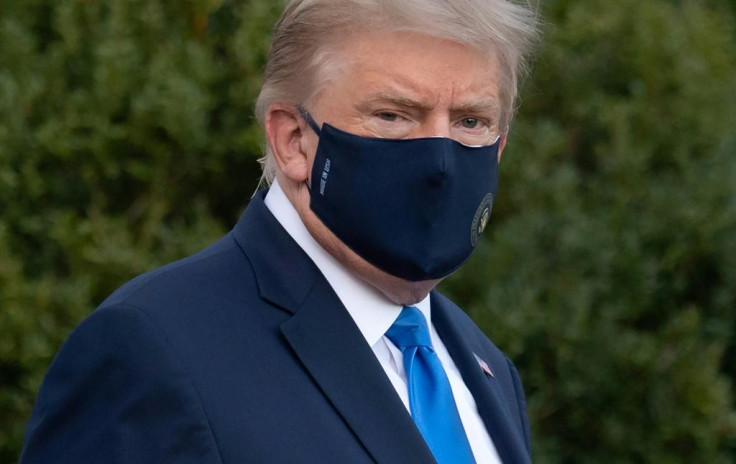
Presidents' bodies have always been loaded with meaning. Taft's heft was mocked in cartoons more than a century ago, casting him as sluggish and out of step with a fast-industrialising nation. With Trump, weight has become another proxy in the culture wars, deployed by his critics as shorthand for indulgence and by his fans as proof he is a 'regular guy' who likes the same food they do.
Strip away the noise, though, and Dr Fischer's point is disarmingly ordinary. A man in his 80s, with a BMI nudging 30 and a reported 14lb weight gain in a year, should probably be having a quiet, honest conversation with his doctor about what lies behind it.