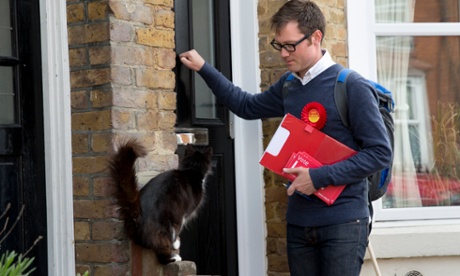
Allen Simpson is knocking on doors on Hardy Street, a Victorian terrace in Maidstone, Kent. Labour’s candidate for Maidstone and the Weald is canvassing for support and reminding any potential Labour voters to go to the polling booths on Thursday.
Simpson’s chances of victory are slim, as are the rewards for his canvassing efforts – most knocks go unanswered, a number who come to the door are babysitters. A couple of doors shut abruptly when Simpson introduces himself.
So far, so normal in a town where Labour came a distant third in 2010 and Ukip has gained ground. But what makes Simpson’s unflagging efforts to represent Labour unusual is that in his day job he is a high-achieving policy adviser at Barclays.
“You’ve got to have Tiggerish tendencies to do this,” Simpson admits.
Simpson leads the corporate banking public policy team at Barclays, the bank described by Peter Mandelson back in 2010 as the unacceptable face of the industry and later the first of many to be fined for Libor rigging. It was the public outrage which followed that £290m penalty in 2012 that prompted the establishment of the parliamentary commission on banking standards, which resulted in a string of new rules for the industry. And more penalties are to follow: only last week Barclays paved the way for £2bn of fines for manipulation of foreign exchange markets.
Simpson analyses political and regulatory proposals, directs research and comment, and writes speeches for senior figures including the chief executive Antony Jenkins, who was promoted following the Libor scandal with a remit to repair the bank’s reputation.
But the view of the City of London as overrun with hard-nosed Tories is a caricature, Simpson says. There are more Labour supporters than people would expect.
“I’ve been surprised by how many people have come up to me and said: ‘Oh, I’m Labour.’ They are high-flying managing directors and heads of things.”
Before joining Barclays in early 2012, Simpson spent almost four years in a similar job at the London Stock Exchange. He joined Labour about seven years ago but says he has been a supporter “for ever”.
Simpson, who is 32 and grew up in Maidstone, says there is no contradiction between providing political advice to City firms and standing for Labour.
“I wouldn’t have joined the City if I didn’t think there was something fundamentally valuable about financial services,” he says, drinking a coffee at the town centre Wetherspoon’s. “Something people have to come to terms with is that it is possible to be a social democrat and to believe that markets are the best way of delivering wealth.”
Simpson says he is standing for Labour because the party has always been more progressive on social matters such as women’s rights and racial equality.
He says the Tories have “misunderstood what poverty is and what it means”. Drawing on his experience growing up on a neglected council estate, he says: : “There is a tendency on the right to think all you have to do is work hard, but if you are in a second-generation unemployed family you don’t know how to work hard.”
Clare Kattner, who lives on Hardy Street and has not decided who to vote for, says she has no problem with Simpson’s role in the City. “It means he works for a living and he knows how to get his hands dirty. At least [bankers] know what it’s like to work in the real world.”
Simpson does not quite admit that he cannot win on Thursday but says he understands why the party has not funded or given much support for his campaign.
The real race in Maidstone this year is between the sitting Conservative MP Helen Grant and the Liberal Democrats’ Jasper Gerard.
Simpson has an agent and about 10 volunteers, but he says he has lost 10kg in the past month walking 10 miles a day to meet voters.
Simpson has spent £5,000 of his own money on the campaign and has raised a further £3,000 from supporters in the City.
“I think they hope that one day I will be an MP or a minister and they think I would be good at it,” he says, stressing that the donors are not buying influence – they just like him.

In Battersea, south-west London, far more is at stake for Labour, but the candidate is again a seemingly unlikely one.
The party is working furiously to win back the seat after losing it to the Tories in 2010. Labour’s candidate here is Will Martindale, also 32, and like Simpson, in banking.
Unlike Simpson, however, Martindale has had visits from Ed Miliband and just about all Labour’s big names. He has 254 volunteers, which he thinks is the biggest number of any candidate in the country.
Martindale joined the party aged 18 and went to work for JP Morgan, the US bank, as a trainee from university. A maths graduate, he worked in the arcane world of credit derivatives just at the time the financial system collapsed. He saw at first hand how banks’ systems for valuing risky securities had failed.
After leaving to work on Margaret Hodge’s campaign to defeat the British National party’s Nick Griffin in Barking in 2010, and spending three months helping the families of genocide victims in Rwanda, he did a two-year stint at French bank BNP Paribas. He then quit finance again to become head of policy at United Nations Principles for Responsible Investment, an initiative set up by former UN secretary general Kofi Annan to encourage long-term and more ethical ways of investing.
Drinking a healthy juice round the corner from his campaign office on Lavender Hill, Martindale says bad things happened in banking but that the debate in Britain is simplistic.
He was caught out last year at a discussion about making the City work better when he made headlines with what he says was intended as a jokey remark about how Labour needed to “hug a banker” to get the City onside.
“It’s either: ‘The market knows best’ or: ‘Bankers are greedy and they should all be locked up,” he says.
“People I worked with were truly ashamed at what had happened in the financial sector and they felt it had been tainted for a generation.”
Battersea, he says, demonstrates the extremes that have built up in Britain in recent years. It is one of the country’s richest constituencies, but also has many people in deep poverty. More than 1,500 people rely on food banks, including 600 children.
Martindale says even natural Conservative supporters are getting behind his message that social divisions have got out of control. “You may be on the right side of the equation but the disparity here is incredibly uncomfortable.”
A poll published by Lord Ashcroft last week, however, gave the Tories with a 12-point lead in Battersea.
Martindale and Simpson both argue that Labour leader Ed Miliband is right to call for limits on the size of big banks and for the creation of more lenders with a greater regional focus.
Martindale says the bosses who line up to attack Miliband have little credibility and that such stunts obscure a less-hostile relationship between Labour and business.
“Some readers might be surprised by the level of support for the Labour party there was within the financial sector,” he says.