I have taken part in many a pub discussion about the perennial question of whether governments lose elections or oppositions win them, or a mixture of both. If ever a postwar British government deserved to lose an election it is this one. That is why the Labour party has got to get its act together, and soon.
The gravamen of the charge against this government is that, for all the triumphalism about a long-delayed period of economic growth, it woefully mishandled the economy when it came in – and plans an assault on our already deteriorating public services, if it is re-elected, that would quite seriously threaten the social fabric of the nation.
It should never be forgotten that the coalition inherited a burgeoning economic recovery in the summer of 2010 and proceeded to bring it to a halt with its misguided programme of austerity. It was not only the cuts: it was the way that they dampened the animal spirits of the executives who make the key decisions about new investment in the private sector.
As for investment in the public sector, this too was cut back, despite the fact that long-term interest rates were at rock bottom and there were plenty of infrastructure projects to invest in. A recovering economy entered an austerity trap, and Ed Balls was quite right to complain about the way that the austerity programme led to several years of “flatlining”. True, we were affected by the weakness of the eurozone, our main export market, but this could have been counterbalanced by a more aggressive growth policy.
I think I heard the prime minister come out yet again on the wireless the other day with that pre-Keynesian howler – much in vogue with the German economic establishment – that when the private sector cuts back, it makes sense for the public sector to cut back too. On the contrary, it does not make sense, and was the reverse of what was needed after the onset of the depression which followed the financial crash of 2008-09.
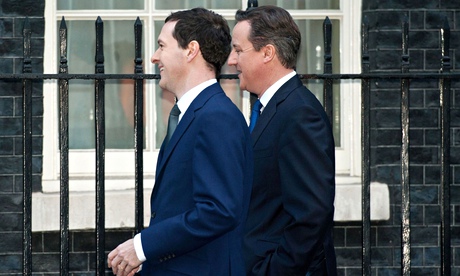
Despite the recent recovery, which is to be welcomed even if it is not the balanced one that is supposed to be part of George Osborne’s “long-term economic plan” – which, as far as I can see, he makes up as he goes along – output in the UK is anything up to 20% below what would have been indicated by a continuation of historical trends. Meanwhile reports of the damage being done to public services seem to be multiplying by the day.
However, while this country’s underlying position is nowhere near as rosy as is being made out, luck plays a crucial role in politics, and, though they must know in their hearts that their economic “strategy” is up the creek, the prime minister and chancellor have been very lucky in the short term.
Yes, they can claim not that we have “never had it so good” but that there are now glimmers of hope for living standards. This is largely the result of the fall in the price level associated with the collapse of the oil price. But to hear the two of them boast, you would think that they had together brought down the world price of crude – even that this politically timely event is all part of the famous long-term plan.
In fact the halving of the price of oil has been due to an old-fashioned economic concept: the law of supply and demand. The slowdown in the Chinese economy has had a perceptible impact on world demand for oil, while there has been a dramatic increase in the supply coming onto the market – the most obvious example being the fracking phenomenon in the US.
The fall in the oil price has of course made nonsense of Ed Miliband’s plan to freeze energy prices. But this is a classic case of the need to change minds, and policies, when circumstances change.
The government’s luck in this matter contrasts markedly with the bad luck that afflicted the chancellorship of Denis Healey in 1974-79. Indeed, I had the opportunity to compare notes with Lord Healey (now 97) when I visited him with a friend last week at his home in East Sussex.
After three postwar decades when cheap oil was taken for granted, the oil-importing nations were hit for six by the 1973-74 oil shock, and Healey’s chancellorship was beleaguered by a quintupling of the price of oil. This was both contractionary, in that it removed purchasing power, and inflationary, in that it set off a wage/price spiral of the sort the modern generation would hardly believe possible. To cap it all, Healey was faced by British trade unions at their most powerful.
By contrast, the recent collapse of the oil price has put extra purchasing power into the hands of the electorate, and lowered the price level. Whether it proves deflationary in the strict sense depends on whether it sets off a downward spiral in prices.
Evidently the Bank of England’s monetary policy committee is not convinced that such a deflationary spiral is upon us, at least not in Britain. In a collector’s item, the MPC stated in its latest minutes: “It was possible that the risks to CPI inflation in the medium term might have, if anything, shifted to the upside, but all members were also alert to the downside risk …”
Meanwhile our prime minister and chancellor boast about low inflation, hoping it will distract attention from the damage they have already done and the true implications of their post-election plans for the public services.
William Keegan’s new book, Mr Osborne’s Economic Experiment – Austerity 1945-51 and 2010- , is published this week by Searching Finance