
In February of 2021, Myanmar’s junta chief Min Aung Hlaing wrested power from the elected government of Nobel laureate Aung San Suu Kyi and effectively plunged the Southeast Asian country into a civil war.
Mr Min led the Tatmadaw, or the armed forces of Myanmar, for 15 years and was widely seen by regional experts as harbouring ambitions to lead the state. Five years on, he was elected president of the impoverished nation in a parliamentary vote on Friday.
His shift from junta chief to head of an administration follows an election analysts say was engineered by the military to preserve the generals’ grip on power.
The 69-year-old former military leader won 429 out of 584 votes cast at the Union Parliament dominated by the junta’s proxy party, the Union Solidarity and Development Party. He beat two other presidential candidates – Nan Ni Ni Aye, from the Upper House, and ex-general Nyo Saw, nominated by the military.
He will become the 11th president of Myanmar since the country gained independence from the British in 1948.
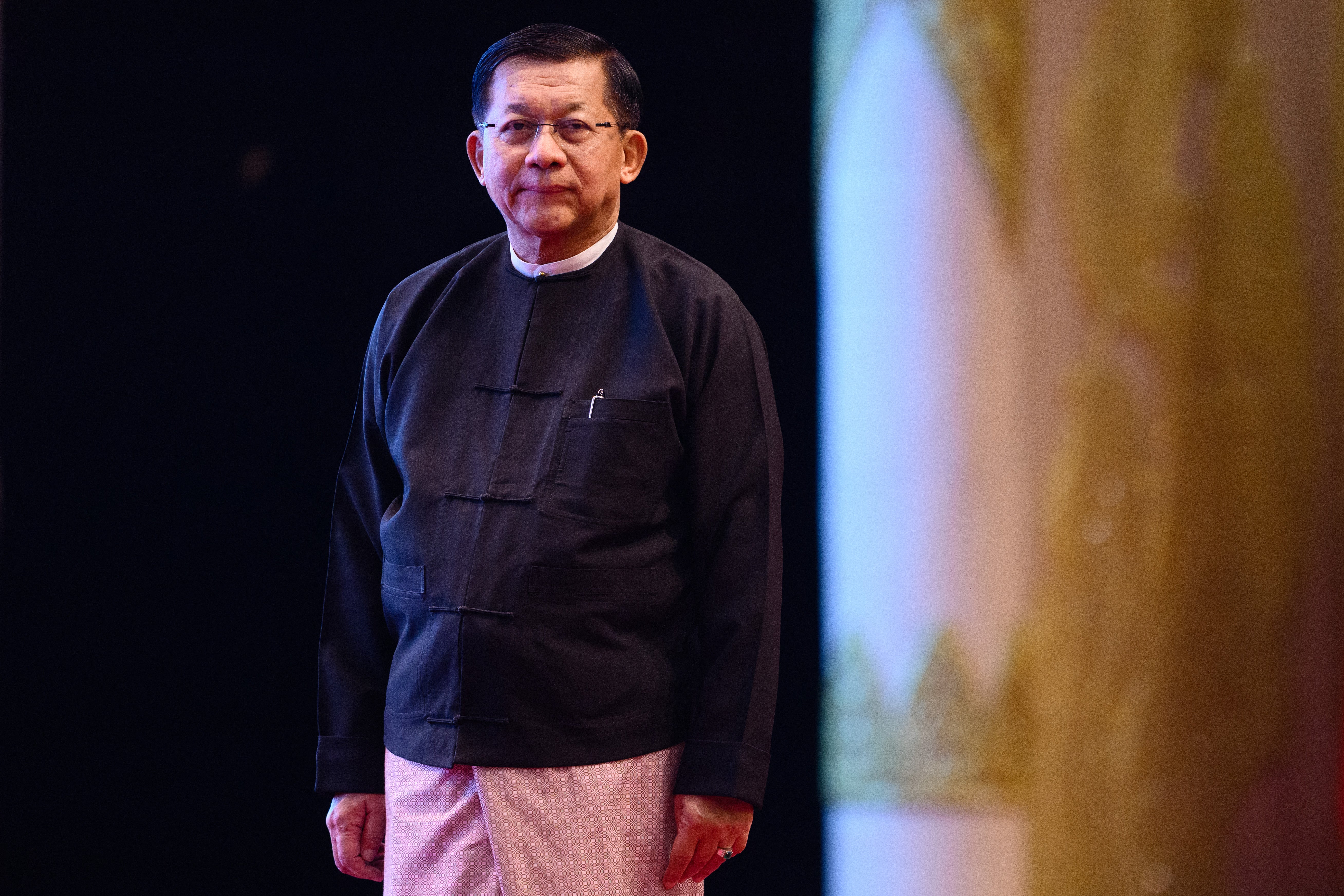
With Suu Kyi's party dissolved and other major opposition parties not contesting, the United Nations and Western rights groups deemed the elections neither free nor fair, and the polls were eventually swept by the military-backed Union Solidarity and Development Party.
"He has long harboured the ambition to trade his title of commander-in-chief for president and it appears his dreams are now becoming a reality," Aung Kyaw Soe, an independent Myanmar analyst, told Reuters.
"If Min Aung Hlaing thinks that an official civilian title will shield him from prosecution for the many grave violations of international law that he is accused of overseeing as head of the military, that is not how international justice works," Amnesty International Myanmar researcher Joe Freeman said in a statement.
Since the coup, Mr Min has only had limited diplomatic contact with many of Myanmar's regional neighbours and has rarely spoken to non-state-controlled media. He was sanctioned by several Western nations, including the US.
Analysts say Myanmar's new president is a rigid military leader, but also a political creature with a fine-tuned sense for managing the country's elites. Those qualities, the people said, have helped him keep power through battlefield defeats that have dented the military's prestige and hold over the country, exposing Mr Min to criticism from supporters of the armed forces.
Nearly 93,000 people have died in conflict since the coup, according to the Armed Conflict Location & Event Data Project, a coalition of independent international researchers.
Pulling back from absolute rule and sharing power through elections functions as "an elite management strategy, diffusing responsibility and preserving regime cohesion," said Naing Min Khant, programme associate at the Institute for Strategy and Policy Myanmar, a think tank in Thailand.
Mr Min has handed some generals lucrative positions atop military-linked businesses, even as he occasionally detained other senior officers, including court marshalling one likely successor. Such moves have helped control potential rivals, according to Mr Naing.
"Power-sharing is managed through elite pacts embedded within the officer corps, where regime survival is closely tied to collective officer survival," the analyst said.
Diplomatic backing from China, in particular, has bolstered the general's position and supported the junta's recent limited comeback on some frontlines, it was reported in December.
The deepening ties were reflected on Friday when China became the first nation to extend congratulations to Mr Min on being elected as the president. Chinese foreign minister spokesperson Mao Ning said China and Myanmar are traditional friends and close neighbours, jointly building a community with a shared future, adding that China follows a policy of friendship towards all the people of Myanmar.
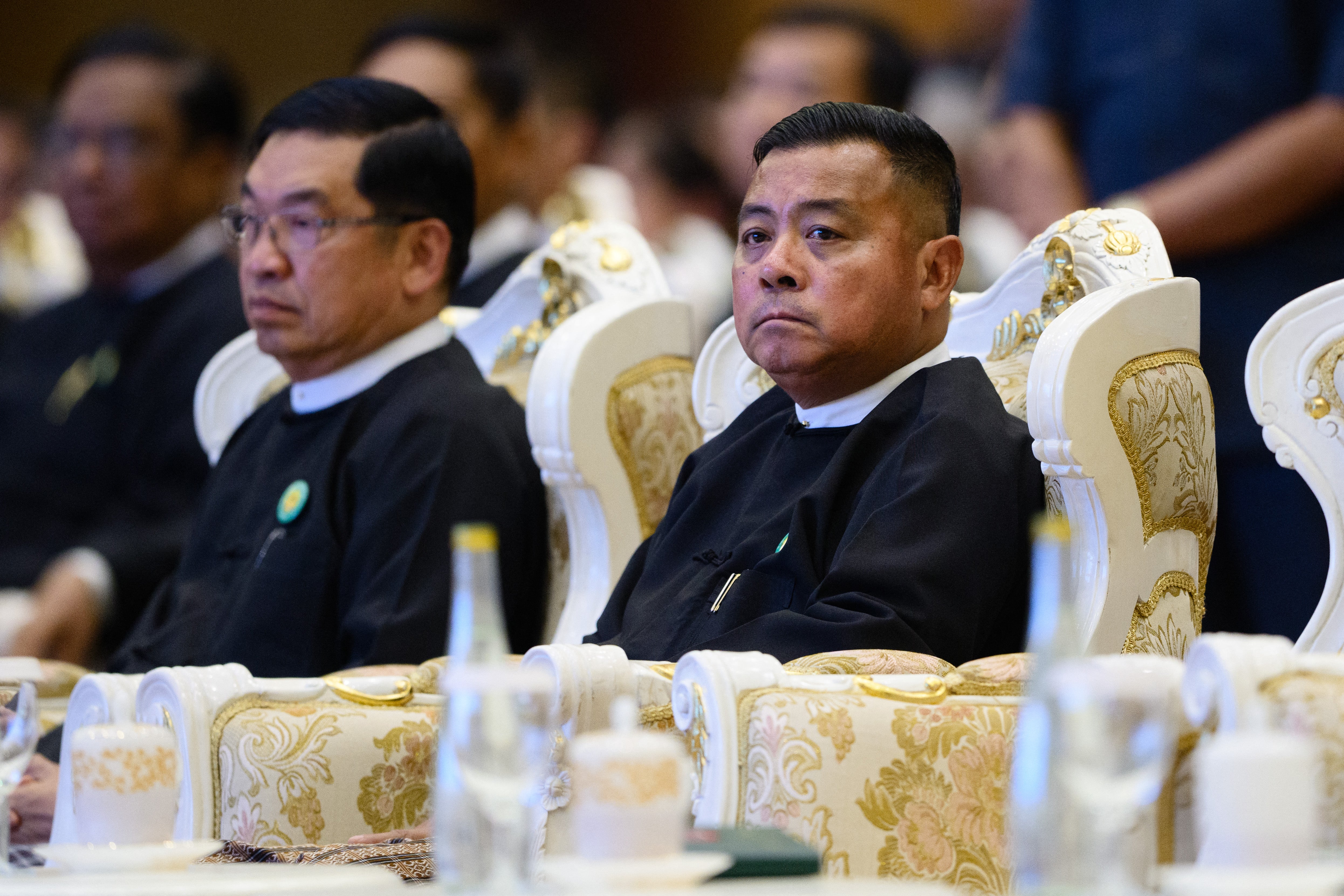
Among the loyalists is retired military officer and former UN ambassador Than Swe, who serves as junta foreign minister.
Mr Than has also since been part of efforts to rebuild diplomatic relationships with the Association of Southeast Asian Nations bloc that froze ties with the generals soon after the coup.
The fourth of five siblings born to a family from Myanmar's south, Mr Min read law at university in Yangon, then the country's capital.
In 1977, he passed out of the Defence Services Academy, the crucible of the officer corps, and made a steady ascent through the ranks. This included time as a commander in Myanmar's historically restive borderlands. The academy's motto – "The Triumphant Elites of the Future" – signals the institution's central role in shaping generations of military brass.
Most leave seeing the military as the self-appointed guardian of national unity, as well as of the rights of the majority Bamar ethnic group and the Buddhist religion many of them follow.
That sense of the generals as the country's ultimate protectors pushed Mr Min to take absolute control in February 2021, months after a military-backed party was crushed at polls by Suu Kyi's National League for Democracy, an official familiar with his thinking told Reuters. "He felt justified in doing the coup," the official said. "Suu Kyi was not listening to him, to his concerns."
Suu Kyi, now 80, is serving a 27-year sentence for offences including incitement, corruption and election fraud. She denies the charges.
The politician has spent previous bouts of detention in the relative comfort of house arrest. This time, the junta has not released specifics on her whereabouts or well-being, though it insists she is in good health.
Malaysian prime minister Anwar Ibrahim made a failed diplomatic push for the release of Suu Kyi last year, according to the foreign former official. "Min Aung Hlaing quickly closed the door on that," the person said. "I know that this was their red line."
Mr Anwar's office and a lawyer who previously represented Suu Kyi did not respond to requests for comment.
After casting his vote inside the heavily guarded capital of Naypyitaw on 28 December, a smiling Mr Min walked up to a gaggle of reporters, where he was asked if he planned to become president following the polls.
"I can't simply say that I want to do this or that. I am not a leader of a political party," he said. On Monday, Mr Min stepped down as the chief of Myanmar's armed forces to seek the presidency, while also appointing a staunch loyalist – former spymaster Ye Win Oo – to succeed him as the commander of the military.
Under the military-drafted constitution, the president wields significant executive power but does not have authority over the armed forces - although analysts say Mr Min’s selection of a successor will likely enable him to keep a firm grip for now.
The next generation of military leaders isn't likely to take a significantly different approach toward Suu Kyi or the resistance movement, said Maj Naung Yoe, who left the junta after the coup and now researches the civil war.
"There might be some who don't like the way the military is handling things and they don't like Min Aung Hlaing," he said. "But that does not mean that they like the revolution."
Myanmar junta chief who led coup against Suu Kyi elected president
Hundreds of thousands of Rohingya refugees in Bangladesh face food aid cuts
Former Myanmar spymaster to become military chief
Myanmar junta chief who led coup against Aung San Suu Kyi nominated for presidency
Everest guides accused of poisoning foreign climbers to force fake rescues
Bangladesh missed its last measles vaccine drive. Now dozens of children are dying



.png?w=600)




