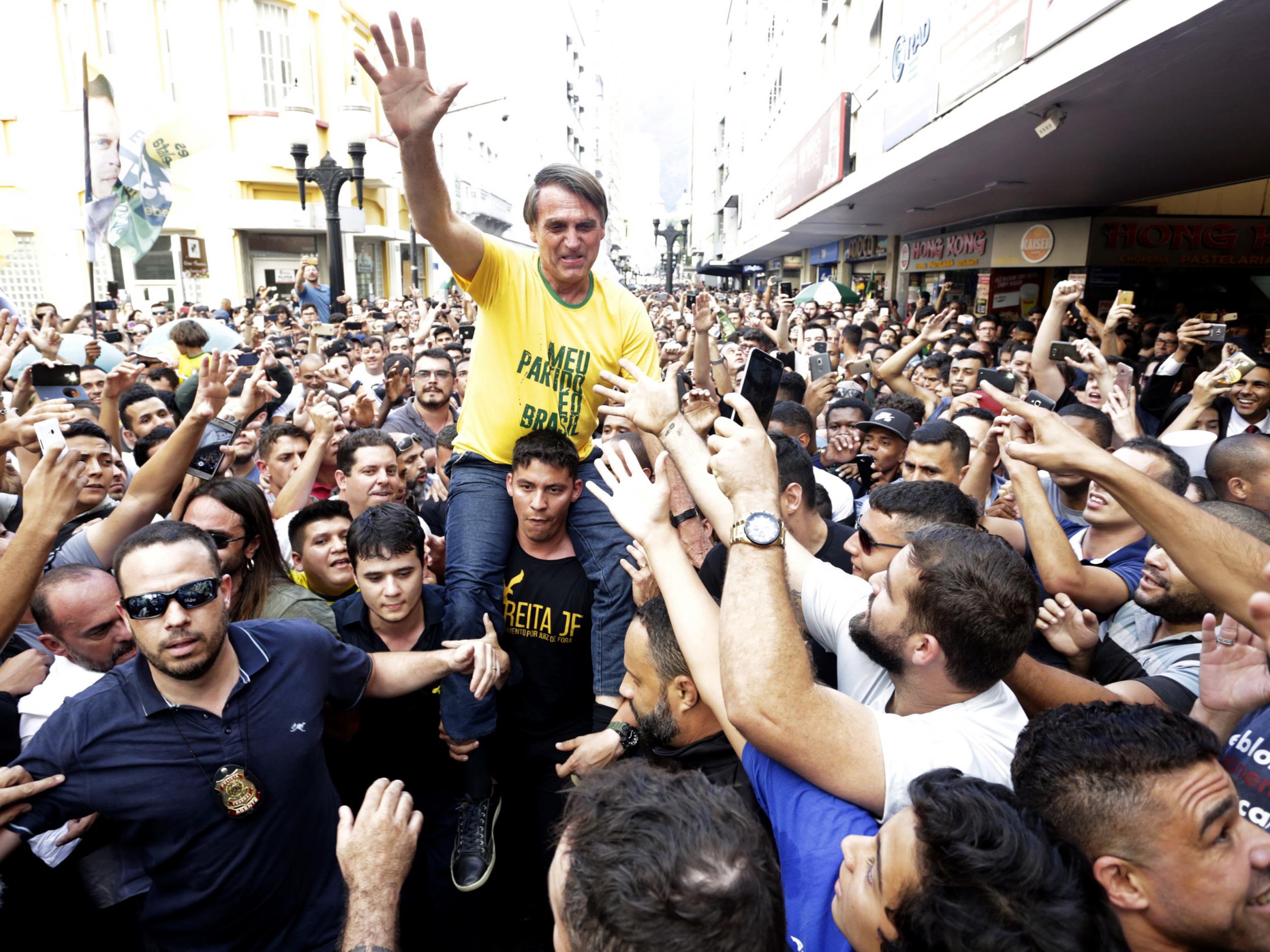
Jair Bolsonaro – the far-right congressman who became Brazil’s president-elect on Sunday – has been dubbed “Trump of the Tropics” by the Brazilian media for his outrageous views.
Just as Donald Trump’s detractors dismissed him as unelectable back in 2016, Mr Bolsonaro’s opponents believed the far-right figurehead would be too toxic to win.
The outsider congressman, representing the tiny Social Liberal Party, managed to win widespread support by promising to lock up crooked politicians and make it easier for police to shoot drug traffickers.
He won just over 55 per cent of the votes on Sunday.
The ex-army captain had expressed his support for torture, spoke fondly of Brazil’s past military dictatorship, and said socialists would have to go overseas or go to jail if he won.
Although his campaign tapped into a desire to crack down on rising crime and anger at the political class, many Brazilians remain sickened by Mr Bolsonaro’s promises to purge political opponents.
Human rights groups and defeated left-wing rival Fernando Haddad have warned of a possible crackdown on civil liberties as the president-elect assumes power.
Anti-Bolsonaro activists also loathe his long history of offensive remarks about women, immigrants, black Brazilians and gay people.
He twice told a female colleague in Congress she was too “ugly” to be raped, and said a dead son was preferable to a gay one.
In a speech made last year, Mr Bolsonaro spoke about a black settlement in Brazil founded by the descendants of slaves. “They do nothing. They are not even good for procreation,” he said.
In an interview with Playboy magazine in 2011, Bolsonaro said that he “would be incapable of loving a homosexual son.”
He added: “I would prefer my son to die in an accident than show up with a moustachioed man.”
The politician has direct experience inside the military dictatorship that ruled Brazil between 1964 and 1985.
The politician was raised during the military dictatorship that ruled Brazil between 1964 and 1985 and graduated from military academy in 1977, rising to the position of army captain by the time democracy returned in the mid-eighties.
The soldier was arrested in 1986 for signing an article criticising the post-dictatorship military salaries, before leaving the military to enter politics. He first won a seat in Congress in 1990.
The right-winger made law and order a crucial part of his platform during this year’s election campaign.
Although his Workers’ Party opponent Fernando enjoyed an early lead in the campaign, a late surge saw Mr Bolsonaro’s poll numbers rise by 15 per cent after he was stabbed on 6 September.
Despite a three-week stay in hospital, he took his authoritarian message directly to voters via Facebook and Twitter.
He also received endorsements from Brazilian football stars, including Ronaldinho, Cafu and Tottenham's Lucas Moura.
“Bolsonaro is the voice of people who want to speak but don’t feel they can because they fear being politically incorrect,” said Carlos Manhanelli, chairman of the Brazilian Association of Political Consultants.
“He presents himself as he is, and in the minds of voters that is authentic.”