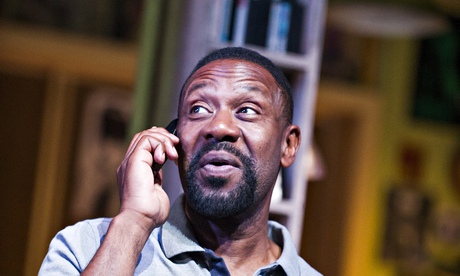
Janet Suzman claims that theatre is a white invention and only in the DNA of white people (Report, 9 December). The Tricycle Theatre is my local theatre in the middle of a multicultural area. When there is an Irish play the theatre is full of Irish people, when there is a black play with black actors (such as the recent The House That Will Not Stand) it is full of black people, and so on. I also go to the National Theatre, where there is a nearly exclusively white (and middle-aged) audience. But put on a play such as Elmina’s Kitchen by Kwame Kwei-Armah and suddenly there are lots of black people in the audience. When the subject matter is relevant, and when there are black or other minority ethnic actors and directors involved, you find audiences of all backgrounds.
Sean Baine
London
• Working in Leicester schools with Indian (Hindu, Muslim, Sikh) students, the immediacy of theatre presented few problems. Audience was a different matter. Taking productions into local theatre attracted few parents. Years ago the (then) Haymarket Theatre employed the poet Mahendra Solanki to encourage bookings from our new and growing Indian population with scant result. A beautiful new theatre was incorporated in the Peepul Centre located in the “Cultural Quarter”. Despite that, even Tara Arts and specially adapted productions attracted few local residents.
And so it appears to continue at the recently built Curve. Janet Suzman’s analysis of why theatre fails to attract a wider audience may be challenging but in my experience she certainly speaks from fact.
Peter Worrall
Leicester
• As a white, middle-aged man, I have always regarded drama as an invaluable means of increasing my appreciation of our diverse society. But if ethnic minority communities don’t relate strongly to theatre as an art form, let’s just admit it and get over it. There are many other ways in which people can express themselves and try to understand each other better. And what’s the point of the Arts Council threatening sanctions against theatre groups who don’t do sufficiently “diverse” work if it’s not very likely to put bums on seats? Running a theatre is tough enough already.
Alan Clark
London
• I recently went to see Rudy’s Rare Records at the Birmingham Rep and felt like I was the only white person in the audience.
Roger Halford
Solihull
• The salient point is not whether black people go to the theatre – but that all British citizens are taxed so that the government and councils can pour subsidies into theatres for a liberal elite to put on plays that no one (regardless of ethnicity) wants to go and see.
Paul Brazier
London
• As a teacher I regularly used to take my sixth formers – most of whom were Asian – to the London theatre, opera and ballet. As well as encouraging them to love the arts, I was also trying to dispel the myth that such places were not for the likes of them. But I couldn’t help noticing that even in productions like Athol Fugard, John Kani and Winston Ntshona’s The Island – a South African play about Robben Island with black actors – and a production of Twelfth Night set in India with Indian actors, the audience was still overwhelmingly white and middle class.
By all means let’s commission more Asian, Chinese and African-Caribbean theatre, but getting a more diverse audience to see it is another story.
Stan Labovitch
Windsor
• Janet Suzman makes the elementary mistake of assuming that whatever she doesn’t happen to know about doesn’t exist . She asserts that all theatre comes from the ancient Greeks. Many sophisticated plays were written in Sanskrit in India from about 200BC to 500AD, and are available in English translation. Many more are thought to have been lost.
John Wilson
London
• I am no expert on the origins of theatre, but if it is not free to examine critically our beliefs, customs, ideas and institutions, it is neutered. So my response to Meera Syal is to wonder whether some of the Asian ethnic and religious minorities are willing to accept this critical freedom. I am reminded of Behzti, the play which depicted a rape in a Sikh temple at the Birmingham Rep in 2004. Violent demonstrations forced it to close and the playwright fled into hiding.
Similarly, I doubt whether seriously critical drama involving Islam can be tolerated. As long as artistic freedom is compromised, it is not theatre that has a case to answer but those who are unable to entertain ideas that conflict with their beliefs.
Colin McCulloch
Reading