Either we’ve travelled back in time, or someone is playing tricks on us. The DJ in Broadcast, a bar and nightclub on Sauchiehall Street in Glasgow, bears an uncanny resemblance to Alan Rankine, the multi-instrumentalist with the matinee-idol looks who, along with outrageously gifted (and tragically unsung) vocalist Billy Mackenzie, formed one half of early-80s avant-pop duo Associates. His vinyl picks – the Human League’s Love Action, Tom Tom Club’s Wordy Rappinghood, Soft Cell’s Tainted Love, Simple Minds’s I Travel – certainly suggest someone intent on partying like it’s 1981. Has Rankine miraculously escaped the ravages of ageing? Because this suave young turntablist doesn’t look a day over 25.
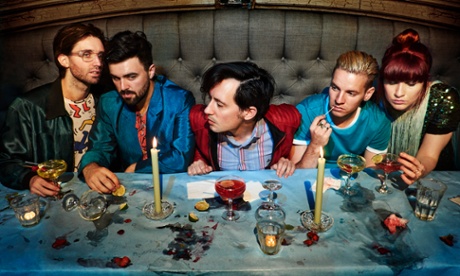
Turns out it’s Rankine’s son, Callum, and he’s here at the invitation of White, Glasgow’s hottest new band, who have just played a gig in the city, at Stereo, an underground dive heaving with hipsters. There, the warm-up music was Associates’ still-alien-sounding White Car in Germany and frontman Leo Condie dazzled the crowd with his overcoat in the burnished orange of David Bowie’s Low and magnificently mannered singing. Meanwhile, the rest of White – Hamish Fingland and his serrated funk guitar, Kirstin Lynn’s marvellous machine pulse – performed a set resembling a mixtape of early-80s “new pop”, that subversive amalgam of postpunk experimentation and pop ambition virtually dreamed up by music journalist Paul Morley.
Are they stuck in the past, or are new pop’s values still current?
“The only 80s thing about it is Leo’s voice, which is Billy Mackenzieish,” argues Finland in a fancy pizzeria the afternoon of the concert, discussing White’s astonishing debut single, Future Pleasures, which is so 1981/82 that on its release in July, people demanded to know how they convinced Trevor Horn to produce their first release (it was actually White bassist Lewis Andrew at the controls).
If the furious white funk and quasi-operatic warbles startle, so too does the fact that White formed – via a shared love of Associates – out of the ashes of Kassidy, hirsute folk-rockers at the opposite end of the aesthetic spectrum, whose only redeeming feature is that their singer once dated Lana Del Rey.
White aren’t ashamed of the Kassidy connection, but are keen to play down the 80s homage angle.
“We listen to a lot of LCD Soundsystem,” insists Condie, toying with his quiff. “Bands like Caribou and Jai Paul use 80s technology, and the guitar on Future Pleasures had as much to do with Nile Rodgers and Prince …
“We’re building a bridge between that 80s stuff we love and modern dance music,” he suggests. “A lot of dance music is groove-orientated and you’ve got to be on drugs to enjoy it. We want to combine that sound with proper written choruses, and not cheesy ones.” Condie cites Once in a Lifetime by Talking Heads, as well as Berlin-era Bowie, as examples of the sort of “singalong but weird” pop that he wants White to make.
As for Fingland – a blond, handsome ubermensch who appears to have stepped out of an early Spandau Ballet photo shoot – he has one ear cocked to the radical studio adventures of Tyler, the Creator and Flying Lotus. There’s another early-80s thing about White: their alignment with R&B production techniques and avowed loathing of “rockism”, the rote practices of your average indie/rock guitar band. Fingland lambasts White Stripes for their tired mimicry of rock’s original raw power, while Condie condemns cliched posturing.
“There are all these things you’re expected to do,” he moans, “like where the guitarist plays a solo and puts his foot on the monitor. It’s so predictable.”
Condie, a music graduate, brings considerable intelligence to bear on matters pop.
“Emotion in music is a construct,” he decides, happy to debate ideas of artifice versus authenticity till the cows come home (or the gig starts). “What people think of as ‘emotional’ actually adheres to a very rigid and specific set of criteri. A guy or a girl with a guitar and a whispery, breathy voice and lots of reverb – that is emotional to most people.”
He expounds on the neuroscience of music – “I’m quite a music theory person” – but what makes Future Pleasures and the equally luxurious new single Blush so thrilling is the way they combine the cerebral with a sort of derangement of the senses. It’s there in the way Condie’s exorbitant voice annihilates notions of “good singing” just as White exceed the boundaries of what is decently expected of a four-piece rock band. These aren’t tidy academic exercises, but eruptions of noise and feeling, only with catchy choruses. For the first time since Franz Ferdinand, here is an indie guitar band, Scottish or otherwise, with a realistic chance of becoming a pop group.
“l remember when Franz came along, it was really exciting in Glasgow,” recalls Condie who, like Alex Kapranos when he started, is a little older than your average newbie, with previous experience (he was in a band circa 2009 called the Low Miffs with Orange Juice’s Malcolm Ross). “And Take Me Out was amazing – the way it started, and then, 50 seconds later, it changed speed. We want to challenge people’s expectations like that.”
“That’s why Future Pleasures and now Blush are having an impact,” considers Fingland, who, if he has any nostalgia, it’s for the strange subterfuge of Alan Rankine adorning his barnet with Chinese cutlery and “playing” a chocolate guitar on Top of the Pops. “Because there isn’t any new music like ours out there. Radio 1 are playing it, and they never play new [guitar] music. We just want to go for it – more chocolate guitars and chopsticks in the hair!”
• The single Blush is out now on RCA.