Highlights from this edition of Checks and Balances include an executive order implementing a new job classification for about 8,000 federal workers, and a gubernatorial lawsuit in Kentucky against the state Senate and several cabinet officials.
In Washington
White House issues executive order classifying employees under Schedule Policy/Career for the first time
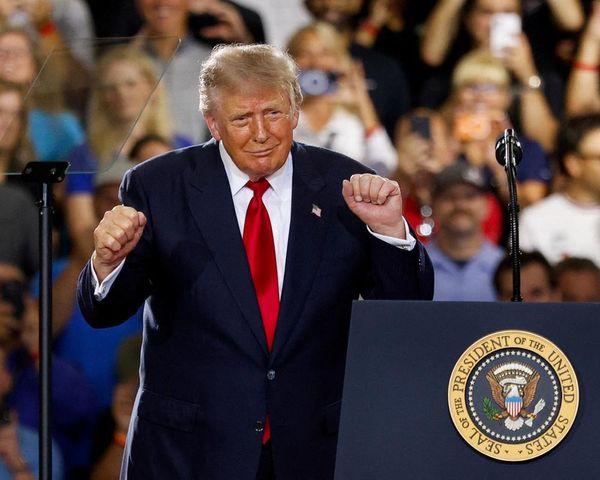
On June 3, President Donald Trump (R) issued an executive order implementing Schedule Policy/Career, a federal employee classification for thousands of employees serving in “confidential, policy-determining, policy-making, and policy-advocating roles (policy-influencing positions).” The new schedule removes certain civil service job protections for about 8,000 of these policy-influencing employees, making them easier to terminate. Trump created Schedule Policy/Career in a January 20, 2025 executive order. This order reinstated a 2020 Trump executive order which created a similar classification called Schedule F, with some modifications that included renaming the classification.
The June 3 order includes a 229-page appendix listing positions in specific agencies that will be subject to reclassification under the new schedule. Following the order, the Office of Personnel Management (OPM) issued guidance documents which identified about 8,000 existing positions within the federal workforce that will be reclassified under the new schedule.
By moving these positions to Schedule Policy/Career, the executive order makes these employees at-will, meaning that they “can be removed for misconduct or poor performance” and do not have the civil service protections that most federal employees, who serve under competitive service job classifications, have. This is similar to the Schedule C employee classification (created in 1956) and Schedule G, created by an executive order in 2025.
On April 28, an OPM memo identified Schedule C and G employees as exempt from a revised performance review process for employees in job classifications with civil service protections. The April 28 memo does not specifically address Schedule Policy/Career employees. A June 8 OPM memo details disciplinary procedures for employees being transferred to the new schedule.
What is the background?
Trump created Schedule Policy/Career with an executive order that Trump issued shortly after his inauguration on January 20, 2025. This executive order reinstated a 2020 executive order that Trump issued in his first term, which created a similar job classification called Schedule F.
President Joe Biden (D) revoked the 2020 Schedule F order in a 2021 executive order, which the 2025 Trump order revoked in turn. In addition to reinstating the 2020 order, the 2025 order renamed Schedule F to Schedule Policy/Career and made several changes to the 2020 structure, such as giving the president (rather than the director of OPM) final say over what positions can be reclassified as Schedule Policy/Career. The 2025 order also added language saying that “employees in… Schedule Policy/Career positions are not required to personally or politically support the current President or the policies of the current administration.”
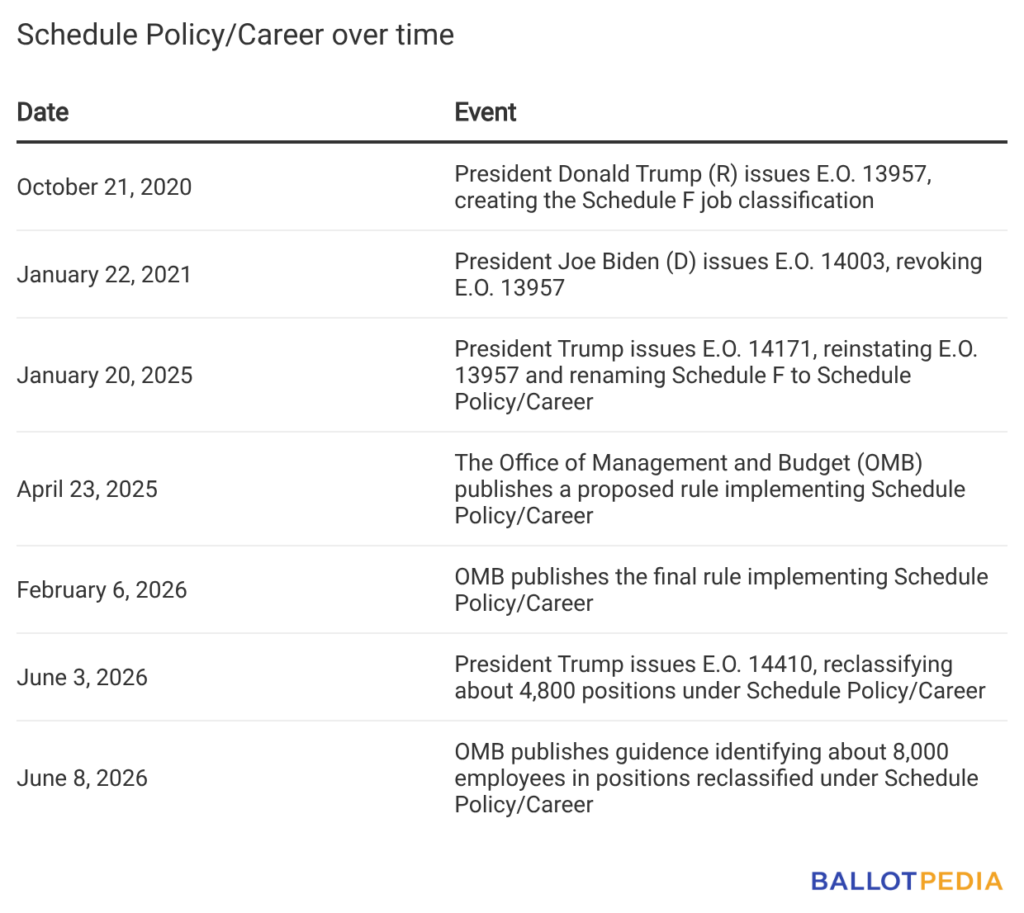
OPM published a proposed rule to implement the 2025 order on April 23, 2025, before publishing a final rule on February 6, 2026. While this rule was being finalized, OPM estimated that as many as 50,000 federal employees could be reclassified under Schedule Policy/Career. Trump’s June 3 executive order and implementing OPM guidance identify about 8,000 positions for reclassification. According to a White House fact sheet, 97% of these positions are at the senior GS-15 level. In an analysis of the June 3 order, University of Minnesota law professor Nick Bednar wrote that “this executive order likely captures the first set of positions transferred to Schedule Policy/Career — not the last.”
Some federal employee groups have criticized the reclassification. William Shackelford, president of the National Active and Retired Federal Employees Association (which is suing over the new schedule) said that “this action will undermine the effectiveness of the civil service in carrying out government operations on behalf of the American people.” American Federation of Government Employees president Everett Kelley said that “workers who once felt comfortable reporting waste, fraud, abuse and mismanagement at their place of employment because they were protected from retaliation will now be afraid for their jobs if they speak out.”
OPM director Scott Kupor said that “in order to effect the president’s policy priorities, we need people in these senior positions willing and capable of carrying out those directives… and you can have any political views–but if you allow them to interfere in your willingness to carry out lawful orders and directives, this is a mechanism for you to be removed, effectively at-will . . . There are zero loyalty tests in this.” Kupor also said that "this is very much about accountability… it's also about a restoration, in our mind, of the democratic process."
Want to learn more?
- Executive Order: Implementing Schedule Policy/Career in the Excepted Service (Donald Trump, 2026)
- Executive Order: Restoring Accountability to Policy-Influencing Positions Within the Federal Workforce (Donald Trump, 2025)
- Civil service
In the states
Kentucky governor sues state Attorney General, Treasurer, Senate over veto-overridden bill
On April 22, Kentucky Gov. Andy Beshear (D) filed a lawsuit against state Attorney General Russell Coleman (R), Treasurer Mark Metcalf (R), and the clerk of the state Senate over a new law that Beshear says is an unconstitutional infringement on gubernatorial powers. The Kentucky legislature overrode Beshear’s veto to enact House Bill 10 on April 14. Kentucky has a divided government, with a veto-proof Republican supermajority in both houses of the legislature. It is one of two states (along with Kansas) that have a Democratic governor and a Republican legislative supermajority.
The bill has a number of requirements. Within the 180 days before a gubernatorial inauguration:
- The Attorney General and Finance and Administration Cabinet Secretary must approve legal settlements of $1 million or more that involve the executive branch before they can go into effect.
- The Treasurer and Finance and Administration Cabinet Secretary must approve any noncompetitive contracts that the executive branch enters into.
- The Treasurer must approve gubernatorial travel expense reimbursements.
The bill also requires a 24-month probationary period for certain former state employees re-entering public service, that appointed cabinet officials receive Senate confirmation before taking office.
Beshear, joined by Finance and Administration Cabinet Secretary Holly M. Johnson and Personnel Cabinet Secretary Mary Elizabeth Bailey, say that each of these provisions in the law “violates the bedrock separation of powers provisions of Kentucky’s Constitution.” Earlier in 2026, Rep. John Hodgson (R), one of the bill’s co-sponsored, wrote that it would “strengthen accountability during gubernatorial transitions.”
What is the background?
House Bill (HB) 10 was introduced Jan. 16, with eight Republican and one Democratic sponsors. After committee amendments, it passed the Kentucky House of Representatives Feb. 18 with a party line vote of 78-18 (18 House Democrats, including the bill’s original Democratic sponsor, voted no). The bill passed the Kentucky Senate with amendments March 26, with a party-line 32-6 vote. After going through reconciliation in a conference committee, the Senate passed the bill and the House passed the bill on April 1 by a party-line 32-5 vote in the Senate and a party-line 72-17 vote in the House.
Gov. Beshear vetoed the bill April 13, along with over two dozen other bills, for a total of 32 vetoes in the two weeks before the end of the legislative term. In his attached veto message, Beshear objected to the provisions challenged in his subsequent lawsuit, along with public records retention provisions in the bill (which he has not challenged in court). The legislature overrode his veto April 14, with a party-line House vote of 79-19 and a party-line Senate vote of 32-6. The Kentucky legislature, which needs a simple majority in both houses to override a gubernatorial veto, also overrode 29 of the 32 vetoes that Beshear issued at the end of the term.
The Kentucky legislative session ended on April 15, and HB 10 went into effect on April 16. On April 22, Beshear sued in the Franklin Circuit Court, seeking an injunction to block most of the new law’s provisions. In early May, Franklin Circuit Court Judge Thomas Wingate ruled against Attorney General Coleman’s motion to dismiss the case, and gave more time to the parties to file additional motions in the case. The case is ongoing, as of June 16.
Scottie Ellis, a spokesperson for Beshear, said that the legislators who voted to enact the bill “ignore and violate the state constitution so they can take authority from a governor elected by the people and transfer it to someone from their own party.”
Bill co-sponsor Rep. John Hodgson (R) wrote after introducing the bill in January that “when a Governor is terming out, there is little political accountability for their actions in the final months in office, and there is both the temptation and the opportunity for making decisions not in the best interests of all Kentuckians, but for personal benefit.”
Want to learn more?
Featured commentary
Is a professionalized civil service compatible with recent Supreme Court precedent? University of Michigan law professor Christopher J. Walker makes what he calls the conservative case for a professionalized civil service. The structure of civil service hiring and firing established by the 1946 Administrative Procedure Act, he argues, remains compatible with the Roberts court's jurisprudence even if the Supreme Court strikes down the Humphrey’s Executor precedent this term. Click here to read the full article.
In the media:
- Bloomberg Law: Trump’s Swift Deregulation Strategy Falls Flat With Agencies
- Wall Street Journal: Inside Trump’s Takeover of the American Regulatory Machine
- Thomson Reuters: States’ Retreat From Judicial Deference Creates Leverage in Tax Disputes
Regulatory highlight
In this section, we highlight a few of the several regulations reviewed by the Office of Information and Regulatory Affairs (OIRA) each month and discuss an aspect of the federal Congressional Review Act (CRA), which is an increasingly used mechanism for repealing executive agency regulations. In this edition, we provide an update on how federal legislators have used the Congressional Review Act in the 119th Congress.
Notable regulations
- The Office of Information and Regulatory Affairs (OIRA) completed its review of a Department of Housing and Urban Development (HUD) interim final rule that reverted its regulations governing floodplain management and wetland protection to policies prior to an April 2024 final rule . HUD issued the interim final rule in compliance with Executive Order 14148 (2025) , which rescinded an executive order that served as the basis for the 2024 regulations.
- OIRA completed its review of a Centers for Medicare & Medicaid Services (CMS) interim final rule implementing the One Big Beautiful Bill Act's (OBBBA) community engagement requirement for Medicaid recipients. See Ballotpedia's coverage of Medicaid provisions in the OBBBA here .
- OIRA also completed its review of an Education Department final rule implementing the OBBBA's changes to the Pell Grant program. See Ballotpedia's coverage of the Pell Grant program here .
Congressional Review Act
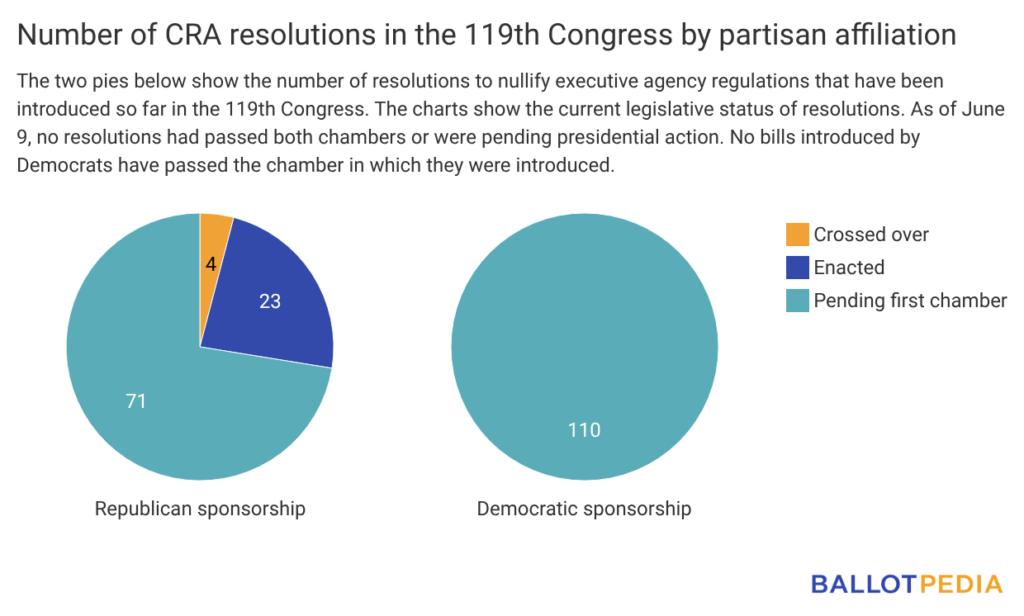
The Congressional Review Act (CRA) allows Congress to repeal executive agency rules with joint resolutions of disapproval. Under the CRA, Congress has 60 working days after a rule has been submitted to Congress to introduce a joint resolution of disapproval.
As of June 9, federal legislators have introduced 208 resolutions of disapproval to nullify agency regulations so far in the 119th Congress.
-
Want to learn more?
- Recission of the Floodplain Management and Protection of Wetlands; Minimum Property Standards for Flood Hazard Exposure; Building to the Federal Flood Risk Management Standard
- Medicaid Program; Community Engagement Requirement for Certain Individuals
- One Big Beautiful Bill Act: Pell Grants and Workforce Pell Grants
- Implementation of Medicaid provisions from the One Big Beautiful Bill Act (2025)
- The Pell Grant
- One Big Beautiful Bill Act
- Congressional Review Act
Pick of the news
Federal
Trump signs executive order on AI regulation. Trump signed an executive order on AI regulation June 2, after months of internal administration debate about the shape that such an order should take. The order is less restrictive on tech companies than earlier draft orders circulated in the media, centering around a voluntary program in which government officials have 30 days to review new AI models. New York Times
Latest Inspector General nominees have inspector general backgrounds. Recent nominees for Inspector General positions generally have more experience in inspector general offices and less experience as politically appointed officials, compared to nominees in 2025. Government Executive
Federal appeals court orders Veterans’ Affairs to continue collective bargaining agreements. On May 18, a three-judge panel of the First Circuit Court of Appeals upheld a lower-court injunction that the Department of Veterans’ Affairs reinstate collective bargaining agreements with worker unions representing about 300,000 employees. Federal News Network
Advisory panel recommends overhauling structure of FEMA. The FEMA Review Council, an advisory panel, issued a report May 7 which recommended changes to overhaul the structure of the Federal Emergency Management Agency (FEMA), such as increasing the leadership role of states in disaster management. Washington Post
Tech Force initiative has begun hiring. In a May 27 event on Capital Hill, Tech Force Director Kevin Hennecken said that the program had hired 200 employees so far, with onboarding of these new hires proceeding. Tech Force was first announced in December 2025 as an initiative to recruit tech talent to government service. FedScoop
State
Virginia governor vetoes public employee collective bargaining bills. Virginia Gov. Abigail Spanberger vetoed Senate Bill 378 and House Bill 1263 on May 14. These bills would have expanded on existing laws that permit public employees to organize unions. Spanberger, who spoke in favor of the bills in February, had proposed amended versions of the bills which the legislature did not take up. Virginia Mercury
North Carolina state employee group says auditor’s report shows pay-related workforce crisis. The State Employees Association of North Carolina released a dashboard arguing that a January report by the state auditor shows that low pay is the cause for state workforce shortfalls. The auditor’s report found that 8,845 positions within the state government workforce (11% of the total) were unfilled. NC Newsline
Georgia enacts bill restricting judicial deference. Earlier in May, Ballotpedia covered Georgia’s enactment of HB 1247, a bill which restricts the practice of judicial deference by state courts. Click here to read the full article.
Tennessee enacts REINS-style bill. Earlier in May, Ballotpedia covered Tennessee’s enactment of HB 1913, a REINS-style bill which requires legislative approval for proposed regulations exceeding a cost threshold. Click here to read the full article.
Legislative Tracking Update
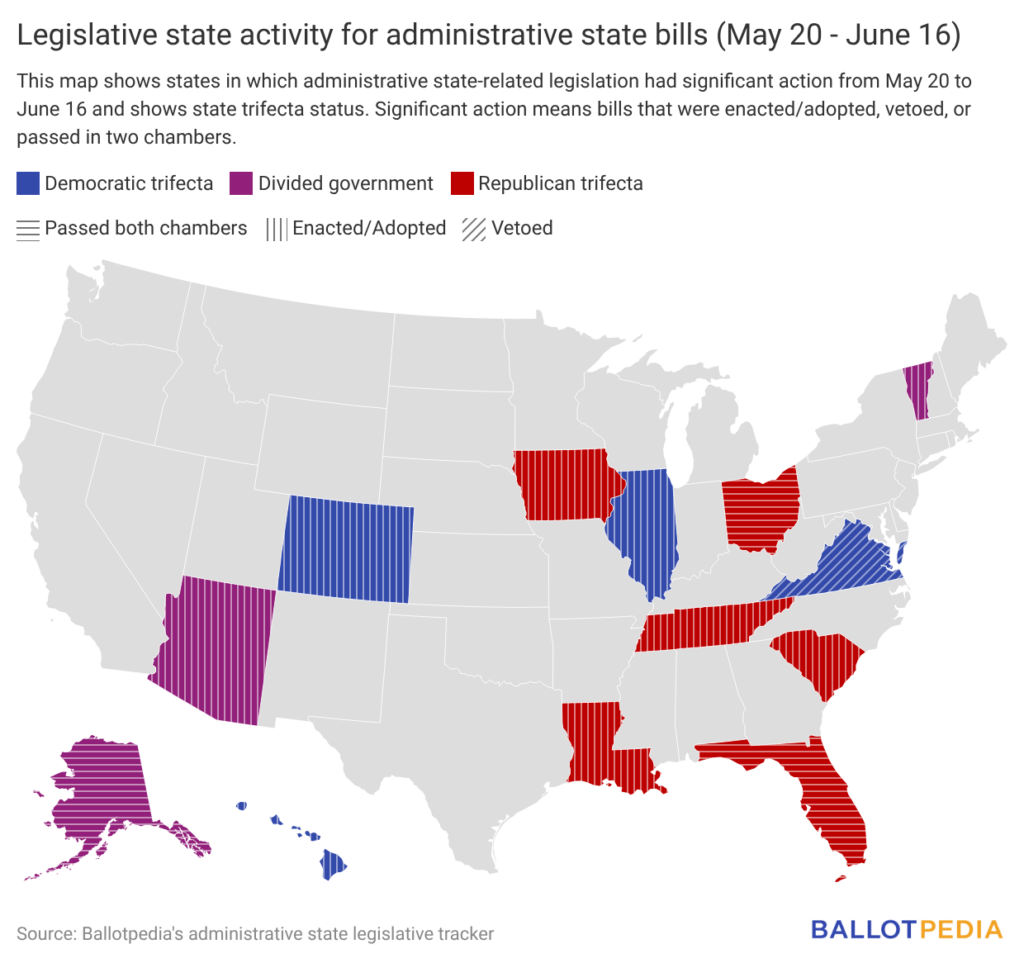
Since our last newsletter edition, Ballotpedia tracked significant legislative action (enactments, vetoes, and passage through both chambers) in 13 states on 34 bills related to the administrative state, as of June 16.
The Alaska legislature passed two bills. Arizona Gov. Katie Hobbs (D) signed one bill. Colorado Gov. Jared Polis (D) signed seven bills and the Colorado legislature passed three bills. The Florida legislature passed five bills. Hawaii Gov. Joshua Green (D) signed one bill. Iowa Gov. Kim Reynolds (R) signed one bill. Illinois Gov. J. B. Pritzker (D) signed one bill, and the Illinois legislature passed two bills. Louisiana Gov. Jeff Landry (R) signed two bills. The Ohio legislature passed one bill. South Carolina Gov. Henry McMaster (R) signed two bills. Tennessee Gov. Bill Lee (R) signed four bills. Virginia Gov. Abigail Spanberger (D) vetoed one bill. Vermont Gov. Phil Scott (R) signed one bill.
Ballotpedia tracked a total of 1,885 bills related to the administrative state in 2026, as of June 16.