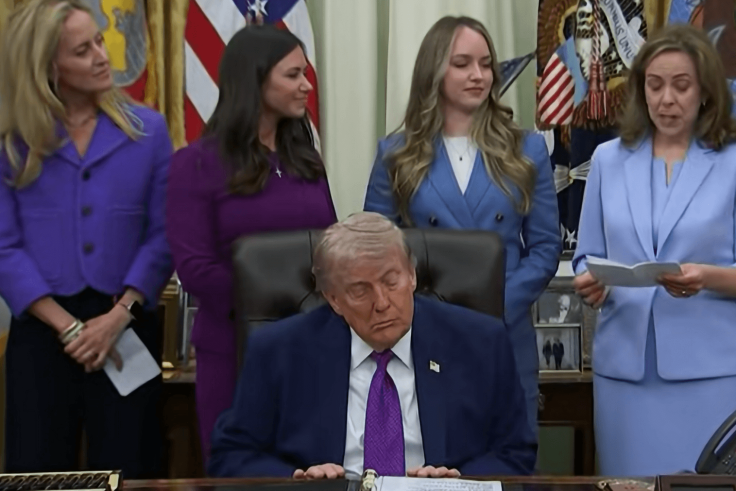
The White House has sparked a fierce viral controversy after lashing out at reporters for sharing images that allegedly show President Donald Trump dozing during an Oval Office event.
The administration's official social media arm, Rapid Response 47, triggered a wave of mockery on 11 May 2026 after insulting a journalist who posted footage of the 79-year-old President with his eyes closed.
Officials insisted the President was merely 'blinking' during the maternal health briefing, despite a widely circulated video appearing to show Trump's eyes shut for approximately 17 seconds.
The aggressive pushback has backfired, with critics and political opponents now weaponising the Trump sleeping photos as evidence of the very fatigue he once used to mock his predecessors.
The row erupted after Reuters published a series of stills from the morning event. While the news agency did not explicitly claim the president was asleep, social media users quickly noted his slumped posture and closed eyelids.
The White House's decision to personally attack reporters rather than ignore the speculation has ensured the 'blinking' defence remains the dominant political talking point in Washington.
Does this look like blinking to you morons? https://t.co/DmcS04QMS8
— Harry Sisson (@harryjsisson) May 11, 2026
White House's 'He Was Blinking' Response Sparks Backlash
The Reuters post itself reportedly did not accuse Trump of sleeping. However, the White House's official Rapid Response account responded anyway, writing: 'He was blinking, you absolute moron.'
That sharp response immediately shifted attention away from the policy event itself and toward the administration's handling of the criticism.
Soon after, clips from the event began circulating across X, TikTok, and other social platforms. One widely shared video appeared to show Trump keeping his eyes closed for roughly 17 seconds while aides standing nearby continued speaking.
The White House 'he was blinking' response quickly became a trending topic, with critics mocking the explanation and turning the phrase into a meme.
i can't believe this is really what they're going with lmao pic.twitter.com/sfQwEpkQIR
— Aaron Rupar (@atrupar) May 11, 2026
Ted Lieu Joins Viral Trump Sleeping Photos Controversy
Among the most prominent critics was Democratic Representative Ted Lieu, who amplified the controversy by reposting the clip online.
'Dear @RapidResponse47: That is a verrrrrrrrryyyyy long blink,' Lieu wrote alongside the video.
His post gained traction almost immediately, helping fuel broader online discussion about Trump sleeping in Oval Office appearances and the administration's reaction to the footage.
The controversy also revived one of Trump's most familiar political attacks. During both the 2020 and 2024 election cycles, Trump repeatedly mocked former President Joe Biden with the nickname 'Sleepy Joe.'
Now, critics argue the president is facing a version of the same criticism he once weaponized against Biden.
Dear @RapidResponse47: That is a verrrrrrrrryyyyy long blink.
— Ted Lieu (@tedlieu) May 11, 2026
pic.twitter.com/hf744367S4 https://t.co/ic1GIuZaCa
Trump 'Sleepy Joe' Hypocrisy Becomes Central Talking Point
The Trump 'Sleepy Joe' hypocrisy angle quickly became one of the most discussed aspects of the controversy online.
Social media users compiled previous moments in which Trump appeared fatigued during public events, including recent Oval Office appearances tied to the Presidential Fitness Test announcement and earlier events in March, February, and January.
Critics used those clips to argue that the administration's aggressive defence only intensified scrutiny.
Meanwhile, Trump himself has previously denied accusations that he falls asleep in public settings. Speaking about photos showing him with his eyes closed, Trump said photographers often capture him mid-blink.
'It's very relaxing to me,' Trump previously said. 'Sometimes they'll take a picture of me blinking, blinking, and they'll catch me with the blink.'
The president has also publicly stated that he gets very little sleep, a claim often reinforced by his late-night Truth Social activity and by journalists covering his schedule during campaign travel and international trips.
NEW! Trump Blinking Glasses. Blink like Trump for Just $99.99!
— Ron Shillman (@shillman1) May 11, 2026
(also useful for solar eclipses) pic.twitter.com/O2P3pv7u1T
Rapid Response 47 Trump Post Overshadows Maternal Health Event
Ironically, much of the public discussion surrounding the Oval Office gathering had little to do with maternal health policy itself.
Instead, the Rapid Response 47 Trump post became the dominant story, especially after critics accused the White House of unnecessarily escalating the situation with personal insults directed at reporters.
Political communication experts have long noted that defensive responses on social media can sometimes amplify controversies rather than contain them. In this case, the administration's forceful pushback appeared to draw even more attention to the images and video clips.
That dynamic helped transform what might have been a minor viral moment into a broader Trump sleeping photos controversy debated across cable news, social media, and political commentary platforms.
He was blinking, you absolute moron https://t.co/7gw3n7l8R3
— Rapid Response 47 (@RapidResponse47) May 11, 2026
Why The Story Keeps Gaining Attention
Part of the reason the story continues to spread is that it combines several elements that regularly drive political engagement online: viral video clips, media attacks, presidential optics, and accusations of hypocrisy.
The phrase 'He was blinking' has also become an easy slogan for critics to repeat and parody, especially after the 17-second clip circulated.
For Trump supporters, the backlash reflects what they see as relentless media scrutiny over ordinary moments. For critics, however, the White House response became the bigger issue, particularly the decision to attack reporters directly rather than simply dismiss the speculation.
Either way, the controversy has once again shown how quickly a single Oval Office image can dominate online political conversation.