I have a large plastic envelope filled with recipes collected over the years. Every now and then, I look through them for inspiration. Surprising how many meringue recipes I've saved. Plain chocolate and vanilla, elaborate creations and simple pavlovas.
The white fluff on the top of my mom's lemon meringue pie captured my attention early on. She fusses over perfect peaks, browned just so. Oh, the sweet, soft meringue is my favorite part of the pie. During a pastry chef's apprenticeship, I looked forward to blow-torching my meringue-covered baked Alaskas to perfect golden peaks. My penchant for meringue, especially crispy white fluffy mounds, means I stock store-bought meringue cookies for late-night sweet cravings.
So on a recent trip to Provence, France, I was thrilled to find ethereal, creamy-centered meringues the size of small footballs in nearly every pastry shop we entered (which was lots). We ate them out-of-hand and dusted the sugary crumbs from our coats with pleasure. When dining out, I indulged in vacherin, a beautiful meringue creation. Fantastique! Let's make these at home, I thought, for my sweethearts (or maybe just for me).
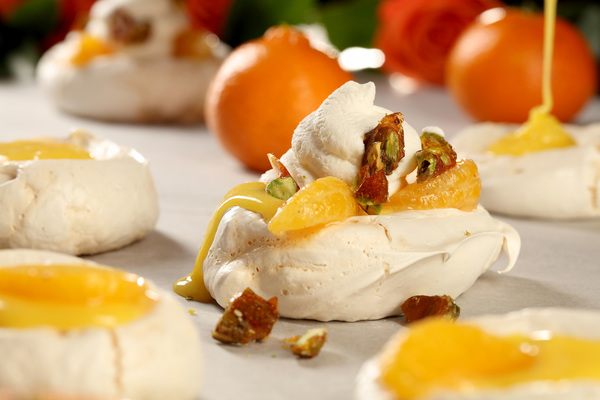
The word "vacherin" may be more familiar to you as a luscious French cheese than a dessert, but a vacherin also is a classic dessert of crisp meringue layered with cream and fruit. It's a stunning combination and easier to create at home than elaborate cakes or pies; meringues simply contain egg whites and sugar.
The secrets to perfectly baked, crisp yet soft meringues: beating in the right amount of sugar and a long slow bake.
I like meringues with a ratio of 3 to 4 tablespoons sugar per egg white; too much sugar and the meringues bake too dry for my taste. Some recipes call for confectioners' sugar, which makes the meringues light and crisp. Granulated sugar yields meringues with a somewhat soft center, and superfine sugar works well because it dissolves readily. Some recipes use a little bit of starch (such as potato starch in the vacherin that follows) to prevent shrinkage during baking.
I separate the eggs while they are cold, placing the yolks into a glass jar for later use (such as in the clementine curd recipe that follows). Put the egg whites into a clean glass or stainless steel bowl. Remember, fat and soap will interfere with the beaten whites, so be sure the bowl is clean and that no traces of yolk remain.
Once separated, the egg whites can be left to come to room temperature _ they'll beat to a slightly bigger volume. A hand mixer works well, but use a stand mixer if you have one _ you will be beating for a while. Start on low speed, then beat the egg whites until they get foamy and start to thicken. Gradually beat in the sugar by tipping it into the whites in a slow steady stream from the measuring cup. Continue beating until the whites thicken, stiffen and turn a glossy white, at least 5 minutes. When you lift the beaters out of the bowl, the whites should flop over in a beautiful soft peak. In my experience, it's better to slightly underbeat the meringue than overbeat and cause it to weep out liquid.
At this point, you could top your pie or baked Alaska with the meringue and brown it in an oven. For the vacherin dessert, meringue cookies or the simple pavlova that follows, the beaten whites get shaped on a baking sheet and baked in a low oven until crisp (but not browned).
The vacherins are shaped on circles drawn on parchment, so they are uniform. For the pavlova, named after the beloved Russian ballerina Anna Pavlova, the meringues are nest-shaped and free-form. In the Midwest, we call this fruit- and cream-topped meringue nest a schaum torte _ basically the same as a pavlova.
Crisp meringues can be stored in an airtight container up to a week. The chocolate meringues that follow make a great snack or a special dessert when topped with raspberry sorbet and chocolate sauce.
The second recipe uses the yolks with sweet clementine juice to create a curd _ a thickish pudding to serve over the crisp meringue. To save time, use store-bought lemon curd in its place, and add the leftover yolks to your scrambled eggs.