“This year’s Ballon d’Or nominees come from just five leagues – La Liga, the Bundesliga, the Premier League, Ligue 1 and Serie A,” writes Nick Happel. “Has there ever been a shortlist taken from fewer leagues? And what year produced the most widely spread shortlist?”
The good news for fans of egalitarianism in football is that 2014’s five-division Ballon d’Or shortlist is a positive league of nations compared with 2010, when only four countries (Spain, Italy, England and Germany) were represented. At least Ligue 1 has come to the party too this time.
Far more fun is a trawl through the Ballon d’Or archives on the ever estimable The Rec.Sport.Soccer Statistics Foundation site. Between the award’s inception in 1956 and 1989, the number of leagues represented each year dropped below double figures only twice – in 1966 (England, Portugal, West Germany, Hungary, Soviet Union, Italy, Belgium) and 1982 (Italy, France, West Germany, Soviet Union, Spain, Belgium, Sweden).
The high-water-mark, though, came a year after. Perhaps the absence of a major international tournament in 1983 meant the voters had fewer obvious candidates but, whatever the reason, the votes were spread far and wide.
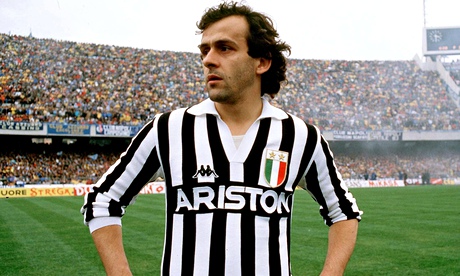
Michel Platini of Juventus won the award and Serie A was joined by 15 other leagues on the final leaderboard:
Italy Juventus (Michel Platini, Antonio Cabrini, Paolo Rossi, Zbigniew Boniek), AS Roma (Bruno Conti), Milan (Eric Gerets), Lazio (Michael Laudrup), Sampdoria (Liam Brady)
England Liverpool (Kenny Dalglish, Ian Rush), Manchester United (Bryan Robson, Norman Whiteside)
Denmark Vejle (Allan Simonsen)
Scotland Aberdeen (Gordon Strachan)
West Germany Hamburg (Felix Magath), Bayern Munich (Jean Marie Pfaff, Karl-Heinz Rummenigge, Søren Lerby), Werder Bremen (Rudi Völler)
Soviet Union Spartak Moscow (Rinat Dassaev, Fedor Cherenkov)
Holland Ajax (Jesper Olsen), Feyenoord (Ruud Gullit)
Portugal Porto (Fernando Gomes), Benfica (Carlos Manuel Santos)
Spain Barcelona (Bernd Schuster)
Belgium Anderlecht (Frankie Vercauteren, Morten Olsen, Erwin Vandenbergh)
France Bordeaux (Alain Giresse), PSG (Safet Susic),
Greece Iraklis (Vasilis Hatzipanagis)
Sweden Gothenburg (Glenn Hysen)
Romania FC Universitatea Craiova (Costica Stefanescu)
Bulgaria CSKA Sofia (Stoicho Mladenov)
Austria Austria Vienna (Tibor Nyilasi)
PLASTIC FANTASTIC
“As Maidstone United have been drawn away to Stevenage in the first round of the FA Cup, we have to wait at least another round to see an FA Cup match being played on an artificial pitch,” writes Vincent de Kreek. “Has there ever been an FA Cup match played on an artificial pitch before?”
Yes, Vincent, indeed there have. In fact there have been quarter-finals played on synthetical surfaces.
Here’s QPR taking on Crystal Palace in 1982 on Loftus Road’s Omniturf monstrosity:
Oldham’s plastic pitch helped them to an FA Cup semi-final in 1990:
And here’s Luton on the plastic fantastic in the 1985-86 sixth round:
OWN-GOAL SOUL
“In the A-League, Brisbane defender James Donachie has scored an own-goal in each of the season’s first two matches,” cheers Dean Kelly. “Has this season start ever been replicated or even ‘bettered’ elsewhere by another unfortunate soul before?”
Here’s Nick Orton with the details on an equally impressive feat from Filbert Street: “This isn’t quite two own-goals in the first two games of the season but Leicester’s Frank Sinclair scored a 90th-minute own-goal in the opening game of the 1999-2000 season that turned a 1-1 draw at Arsenal into a 2-1 defeat and then in the third game of the season he scored another 90th-minute own-goal that turned a 2-1 home win against Chelsea into a 2-2 draw.”
KNOWLEDGE ARCHIVE
“My wife and I have won international caps for the British Virgin Islands women’s and men’s football teams,” wrote Ian Jamieson back in 2007. “Are we the only such couple or are there any instances of other married couples getting international caps?”
Impressive a feat as it is, Ian, you are not the only members of this exclusive club. For instance, the Portsmouth defender Hermann Hreidarsson and his wife Ragna Lóa Stefánsdóttir - also a centre-back - both own a fancy collection of Icelandic caps. “I know some footballers’ wives are not very interested in football but Ragna is different,” he told the Sun. “I don’t know any other footballer who married a player!” He didn’t look very hard. According to reader Hrafnkell Kristjánsson, “Haraldur Ingólfsson, formerly with Akranes (and for a short spell Aberdeen), and his wife Jónína Víglundsdóttir both played for Iceland between 1992 and 1995.”
Staying in Scandinavia, Fredrik Andersson notes that “both Hans Eskilsson and Malin Swedberg played for Sweden. She played 78 times for Sweden while he is the less successful in the couple with eight caps. Today they are married with two kids and she is a pundit on Swedish TV.” And Zimbabwean reader Hurugu Pasvani offers Esrom Nyandoro and his wife Ruth Banda - “Nyandoro has been capped more than 30 times by the Warriors, while his wife, who has since retired from international football, has been capped by the Mighty Warriors more than 15 times.”
Another couple who share a collection of caps as well as a conjugal association are the former United States captain Claudio Reyna and his wife Danielle Egan, who has six US caps to her name. And north of the border, the Vancouver Whitecaps’ Alan Douglas writes that “Steve Kindel and Sara Maglio of the Whitecaps and Canada won four and six caps respectively during their careers”.
However, the highest-profile, nearest-miss example of an international footballing couple must be Ronaldo and Milene Domingues, who first got together after he spotted her on television. The Brazil striker eventually popped the question, while Milene broke the world keepy-uppy record, gave birth to baby Ronald (“My wife and I eat a lot at McDonald’s so we chose Ronald,” explained the toothy one) and was selected for Brazil’s 2003 women’s World Cup campaign. Sadly she never played, the pair divorced and she remains without an international cap to this day.
For thousands more questions and answers take a trip through the Knowledge archive.
Can you help?
“Last night against Forest my team Watford fielded a team with no British-born players in the starting line-up: Gomes; Paredes, Ekstrand, Bassong, Pudil; Tozser, Abdi, Munari; Forestieri, Vydra; Ighalo,” writes James Frankland. “Arsenal famously achieved this a couple of years ago but has there even been a team outside the Premier League that has fielded an entirely non-British starting 11?”
“Is this the first time a match has ever been delayed by snowball fight?” wonders Nathan Fisher.
“At the end of Thursday night’s Tottenham v Asteras Tripolis game the Spurs goalkeeper picked up the match ball to keep as he had scored a hat-trick during the game – the goalkeeper at that point, of course, being Harry Kane, following Hugo Lloris’ rush of blood and subsequent sending-off,” writes Mark Andrews. “Has a goalkeeper ever walked off with a hat-trick match ball before?”
“In today’s Angus derby, Arbroath won 5-1,” writes Mark Rae. “Their third goal was scored by goalkeeper David Crawford with a 75-yard wind-assisted free-kick, then 10 minutes later Montrose goalkeeper Lucas Birnstingl was sent off. Has there ever been another match where one keeper has scored and the other has been shown a red card?”
“Is Russell Brand the first celebrity fan to interrupt a TV interview with a football manager?” wonders Richard Sunn.
Send your questions and answers to knowledge@theguardian.com