
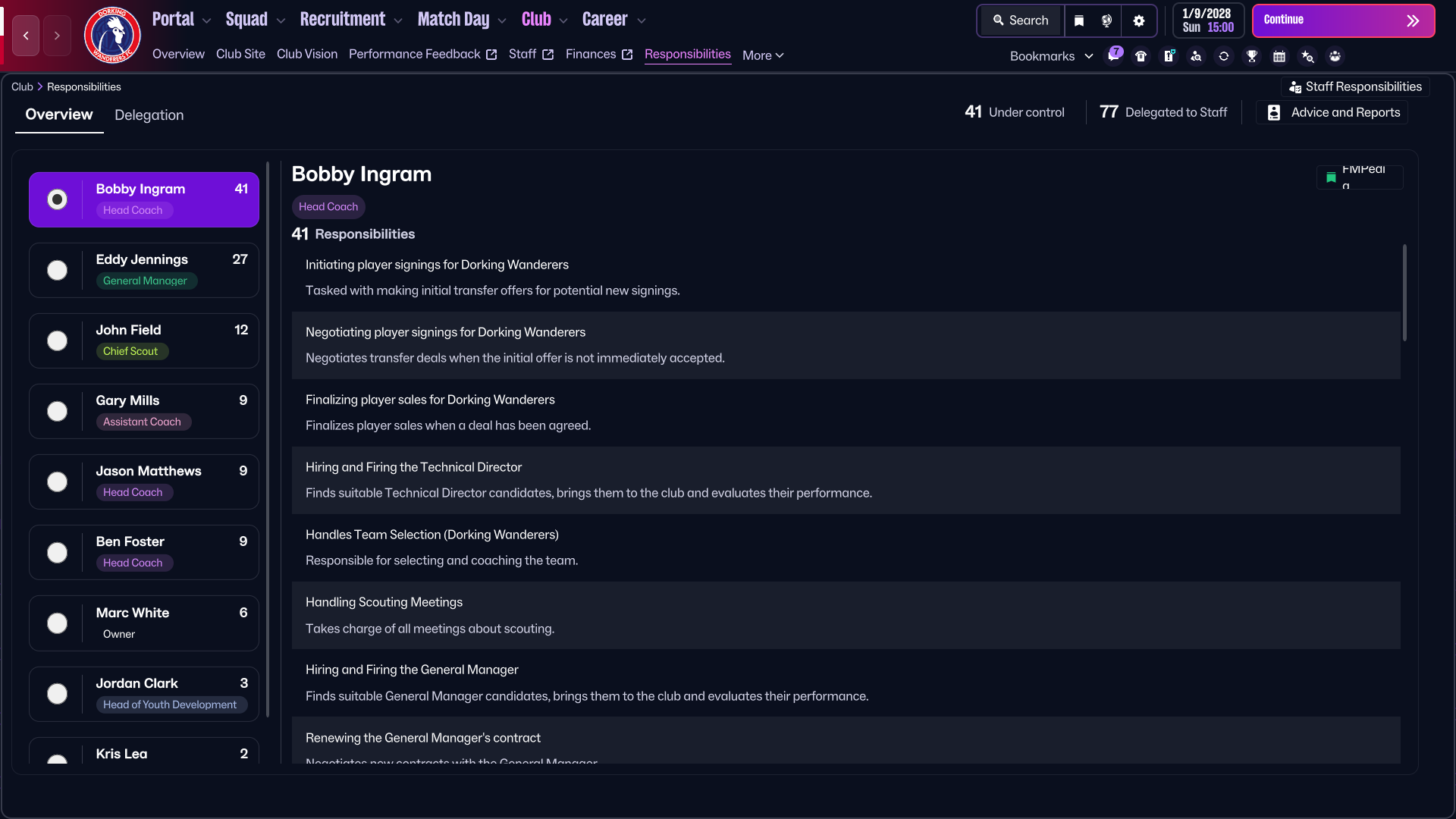

For many new Football Manager players, the realization that delegation is not just possible but encouraged can be a game-changer. For a game with so much to do, the idea of handling every single responsibility will lead to astronomically slow game progression.
Understanding that delegation is normal and beneficial is one thing, but understanding what to delegate is another. The bad news is that there is no “correct” set-up for delegation. The good news is there’s no “incorrect” one either, so read on to learn some tips and tricks for your own delegation to get the most out of the system and make your next Football Manager 26 season as fun and full of wins as possible.
Reasons To Delegate Responsibilities In Football Manager 26


Operation Sports App
Your ultimate companion for sports gaming. Access in-depth coverage, thoughtful discussion, and a community built around the games—and sports—you love.
Your ultimate sports gaming companion.

Knowing when to delegate or not is an inexact science, as there is no correct way to play Football Manager. Instead of a hard and fast list of what to delegate or not, it can be helpful to instead focus on three important things to keep in mind as you choose your responsibilities:
- You Don’t Understand It: The most important thing to realize when getting started with Football Manager, if you feel overwhelmed, is that there are no rules about what you have to do on your own. You can delegate as much or as little of your responsibilities as you need to succeed and have a good time. If you have too much you’re trying to wrap your head around, delegate some more work to others. This gives you time to come to grips with the systems you keep control of, and then you can add the confusing ones in as you understand things better and are better situated to see the impact of your actions to learn how to properly do the job.
- You Find It Boring: The most important thing to remember is that you’re playing a game, and the point of games is to enjoy yourself. If there is a part of virtual management you find tedious or uninteresting, then delegate it. You don’t have to spend your time doing tasks you don’t like to fit some imaginary platonic ideal of “proper” Football Manager. Anything can be the right thing to delegate if it’s ruining your enjoyment of the game.
- You Trust Your Staff: The most important thing to understand about delegation is you’re only as good as the staff you delegate to. If you’re assigning an important job out to someone else, that is fine, but it makes it more important to have good staff in place, as their ability to do the job well will be dictated by their capabilities, so don’t put too much on the plate of an incompetent assistant if you can help it.
Common Responsibilities To Delegate And Retain

I will reiterate that there are no “right” or “wrong” things to pass off to your staff. That noted, some elements are broadly considered safe to hand off, and others that are so integral to the operation of your team that you should strongly consider handling them yourself unless you have a very strong inclination not to do so:
Responsibilities Often Delegated
These are some of the most common responsibilities experienced players choose not to take on more often than not:
- Managing Friendlies: You do not need to be in the muck for these games and can instead rely on the reports to get any information you need while trusting an assistant to manage the side on match day.
- Attending Press Conferences: Most players find press interactions to be rote and repetitive, and not attending conferences is often one of the first decisions they make when delegating as a result.
- Squad Training Schedules: More often than not, you can trust your assistant manager to handle training if you can’t be bothered to do so. For some extra oversight, you can get reports to quickly check that nothing glaring is in the plans.
- Reserve and Youth Matches: As with friendlies, the cost-benefit analysis of managing these games is rarely worth it. Trust the reports and stick to deciding which senior players are available for them.
Responsibilities Often Managed By Gamers
These responsibilities are among some of the core ways you can influence your team, and delegating them can significantly reduce your ability to guide your team, so you should hold onto them outside of exceptional circumstances:
- Transfers In and Out: Tactics are all well and good, but if you don’t have players to execute them you don’t have much. Your transfer dealings allow you to shape your squad to move out the players not helping you reach your goals and bring in superior options to push on to the top.
- Contract Extensions: Once you have players at the club, you need to decide when to extend them and when to move them on. As with transfers, contract management is a critical component of squad building.
- Match Day Tactics: Now that your squad is settled, you need to tell them what to do. If you’re overwhelmed by tactics at first, instead of delegating, try using a pre-built tactic. This gives you a foundation, then you can tweak and adjust as the season plays out by seeing what works and what doesn’t, then adjusting accordingly.
- Individual Training Plans: If you have a bright prospect, it’s beneficial to take firmer control over their progression, and individual training is a great way to do that. Take the time to identify what you want from your players and set them up to develop in those areas.
How much use do you currently get out of your assistants? What are your favorite things to pass off to staff, and what areas would you never dream of trusting to anyone else when the chips are down and your club’s season is on the line?