This question is a complicated blend of environmental and social factors, and we can't simply compost ourselves in the back yard. There are legal requirements governing all sorts of facets such as the logistics of preparing, transporting and disposing of bodies, and the Coroner's Act regarding the investigation of death. There are laws if you'd like to bequeath your remains for organ donation or medical research.
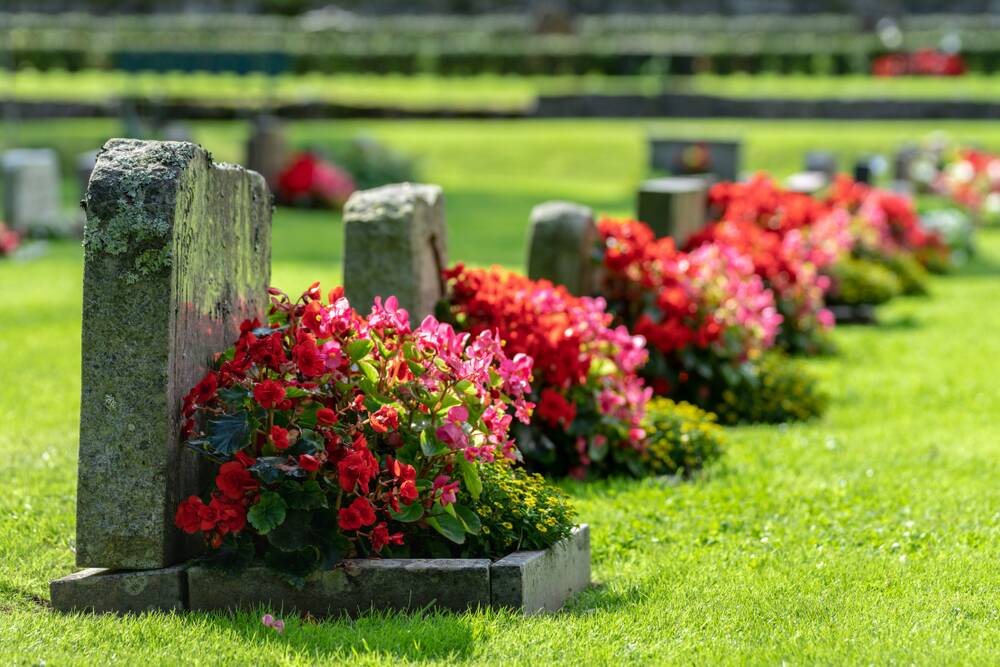
With the growth of cities, real estate is becoming scarce, and cemeteries overcrowded. In some places they resort to double-decker plots as a sort of high-rise development (perhaps that should be "low-rise"). Cemeteries take up space, but you could argue that they provide a place of quiet reflection away from shopping malls.
Aside from the space, a grave has to be sturdy so the ground doesn't slump, ruining the landscaping. Depending on the construction, a lot of material can be used building a grave, which is where decisions such as the type of timber used becomes important. In the United States it's estimated that each year, they bury enough metal to build the Golden Gate Bridge. A friendlier material is recycled timber. You can even buy a paper mache Egyptian sarcophagus.
Once buried, decomposition begins, and this is affected by the amount of oxygen. Deep burial is oxygen-poor, and generates more of the powerful greenhouse gas, methane. Shallow burial will contribute less than 30 kilograms of CO2. If the embalming fluid formaldehyde is used, that's an issue because it's carcinogenic.
The other option is cremation, but as you shuffle off your mortal greenhouse gasses, your parting gift is burning about 56 cubic metres of natural gas and four kilowatt-hours of electricity, for a total of about 110 kilograms CO2. That's roughly equivalent to the emissions created by one person over a month. Plus there's heavy metals such as mercury.
My preference is closer to what Jack McLaren describes in his minor classic, My Crowded Solitude. He observed Aboriginal people on Cape York around 1911:
...their custom of keeping the bodies of their dead for months before burying them... the body was bound tightly with jungle-canes ... and then wrapped in many thicknesses of paper-bark, and placed in a more or less secluded part of the camp...
That form of burial would have no discernable environmental impact, but perhaps a reusable shallow grave instead of a camp site.
Listen to the Fuzzy Logic Science Show at 11am Sundays on 2XX 98.3FM.
Send your questions to AskFuzzy@Zoho.com Twitter@FuzzyLogicSci