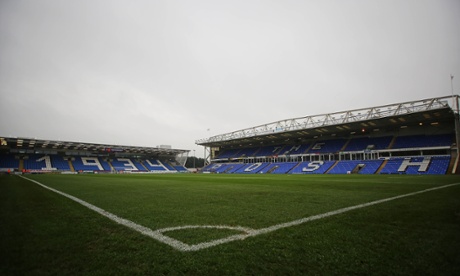
“Last week was the fourth anniversary of the last 0-0 draw at Peterborough United’s London Road ground,” wrote Keith Gilmour in January 2013. “Is this the best ground ever for guaranteed goals?”
Peterborough’s feat is indeed impressive: 146 games without a goalless draw anywhere, and no home stalemate since MK Dons visited on 20 January 2009. But according to the Opta stats, there are actually 15 other clubs to have been on longer runs since the Football League started – Aston Villa and West Ham United twice each.
After their first home game of the 1953-54 season, a 0-0 draw with Bury, Lincoln City went more than five years without being involved in another goalless draw. That’s 236 matches of guaranteed goalmouth action (and in that first season, only one home game brought fewer than two goals) before a trip to Leyton Orient ended the run in February 1959. It was actually another eight months before the home crowd witnessed a goalless draw, with the visit of Villa in October 1959 ending a six-year spell without any bore draws at Sincil Bank.
The run had long bumped Everton, who went 206 league games without a goalless draw, down into second after almost 60 years as the record holders. After a 0-0 draw with Stoke City in the second half of the first season of the English Football League (that’s 1888-89 for those at the back), Everton were not involved in another goalless draw until Wolverhampton Wanderers turned up on Halloween in 1896. (Well, there was one in the FA Cup semi-final replay in 1893, but as that was played on neutral territory, we’ll let them off.)
All in all, Everton’s home fans saw goals every other Saturday afternoon for almost eight years. That’s about the same as supporters of Bolton Wanderers, who had enjoyed the first eight seasons of the Football League before experiencing a goalless draw at home, against Blackburn Rovers at the start of the 1896-97 season. It was only their second on any pitch, with a first away 0-0 the previous season against Nottingham Forest.
The keenest minds among you will have noticed that all of this happened a fair old while back; there are few recent records to rival Posh. Crewe Alexandra went from November 1990 to April 1994 without a goalless draw at home (in fact a League Cup first-leg tie with West Ham was the only goalless match they played anywhere in that time). And if we’re prepared to ignore the Scottish League Cup (insert your own punchline here), Kilmarnock went from a Boxing Day 0-0 with Dunfermline in 2001 until a trip to Dundee United at the start of October 2005 without enduring a goalless tie – home fans didn’t see one until Dundee United visited Rugby Park in August 2006. The 139-game run still didn’t better Killie’s own record, set at 182 games between 1958 and 1964 under William Waddell.
Update: The run at London Road came to an end two months later when Ipswich came, shut up shop and left with a 0-0 draw, ending the remarkable feat at 150 games.
REFEREE’S REWARDS
“A few years ago in the Premiership, a referee pumped his fist with an exclamation of ‘yes!’ when a player scored a goal in a certain game,” wrote Ian Kerr back in 2006. “The referee later claimed that he was so pumped because he had allowed play to go on instead of blowing for a foul in the build-up, and was chuffed with his own free-flowing refereeing. So who was the ref? What teams were playing, and who scored the goal? And where is our friend the enthusiastic referee now?”
The nugget in question was Mike Reed, who knocked seven bells out of fresh air when Patrik Berger put Liverpool ahead against Leeds during their 3-1 win on 5 February 2000. Reed did indeed claim he was made-up with his own performance, having waved play on after Vladimir Smicer was fouled in the build-up, but the FA were not particularly enamoured with his public display of self-loving.
“Having considered the available information, we have issued a reprimand and a warning to Mike Reed,” warbled a spokesman. “While we understand the emotions involved, it is essential that match officials do not make gestures which could lead to misinterpretation. The impartiality of our officials must not be open to question. Mr Reed has been warned to keep his emotions under control in future or face further action.”
There are several other examples. “I recall seeing footage from the end of the 1971 FA Cup final after Arsenal had beaten Liverpool 2-1 after extra-time,” says Steve Hewlett. “When he blew the final whistle, I’m sure the referee Norman Burtenshaw fell to his knees, pumping his fists towards the heavens.” Burtenshaw claimed afterwards that he was simply celebrating the fact that the game hadn’t gone to a replay.
That excuse lost what little credence it had when, a few months later, he presided over Arsenal’s 6-2 battering of Benfica. Burtenshaw’s performance was so bad that he was mobbed by Benfica players, who tried to beat the crap out of him – a task that would clearly have taken a fairly long time. He’d had a chance to brush up on his self-defence skills a few years earlier, mind. When Aston Villa beat Millwall 2-1 in October 1967, the Den crowd were so incensed they stormed the pitch and surrounded Burtenshaw. He had to be carried from the pitch after being knocked unconscious.
The German referee Wolf-Dieter Ahlenfelder, by contrast, was knocked sideways by a few pre-match liveners. “It was 8 November 1975 when, in the Bundesliga, Werder Bremen played against Hannover 96,” scene-sets Eberhard Spohd. “The referee Ahlenfelder surprised everyone with some seriously strange decisions - including blowing for half-time after 29 minutes. A linesman indicated his mistake and Ahlenfelder played 16 minutes’ added time. Then, during the half-time interval, he stuck his tongue out at a photographer, and Bremen’s president Böhmert said: ‘For this show we could have charged a higher entrance fee.’ Ahlenfelder of course denied drinking alcohol, but later he admitted that he had ‘several Maltesers’ (a schnapps) before the match. And to make things really clear to the layman, he said: ‘We are men – we don’t drink Fanta.’”
POSH PLAYERS
“Who is the poshest person to play professional football in the modern era?” asked Michael Dunn back in April 2004.
There were several of you who emailed in to remind us of the likes of Seventies icons Forbes Phillipson-Masters and Peter Rhodes-Brown, who plied their trade for Southampton and Chelsea respectively. “Double-barrelled and playing football?” you asked incredulously.
And while we also doubt they would have negotiated an inner-city comprehensive too successfully, the last we heard Forbes was a painter and decorator managing a small reserve team in Dorset. Peter Rhodes-Brown must still have a plum in his mouth though – he’s now the match announcer at Oxford United’s Kassam Stadium.
Orhan Avsar suggested Oliver Bierhoff, German national hero and luminary of various clubs throughout Europe. He’s the son of a German energy giant and a well behaved sort of chap who took himself off to college too. He also put forward captain of Libya’s national side, Al-Saadi Gaddafi, on the basis of his family controlling vast amounts of oil. But though this means you are filthy rich, it does not in any way mean you are posh. Just look at Robbie Williams.
Graham Le Saux got some lengthy consideration, what with the posh name and big pink house in a nice expensive part of Surrey, but there were too many horror tackles on the books for Graham to be truly named a gent.
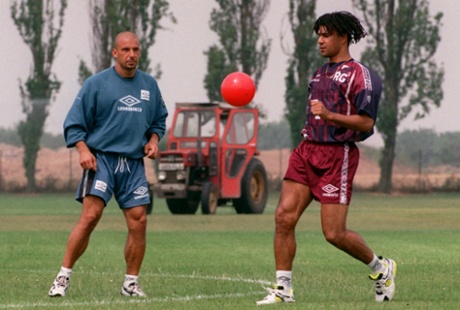
No, that title is reserved, so far, for footballing aristocrat Gianluca Vialli. Not just a great striker and an OK-ish manager, but the son of a self-made millionaire who was brought up with his four siblings in the 60-room Castello di Belgioioso in Cremona. That’s castle for anyone who does not speak Italian. And a big one at that.
“And that shirt, tie and V-neck sweater combo he used to sport in his post match interviews was not the attire of a commoner, surely?” said Garrett Murphy. Indeed.
DERBY DAY
“Why is a derby match called a derby,” wondered Alex McMillan in 2008. “And who do Derby play in their derby?”
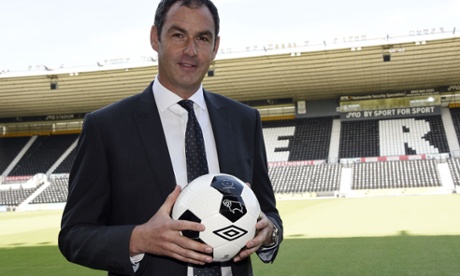
Derby County actually haven’t had a true derby to look forward to for more than 115 years, having merged with the city’s only other major side, Derby Midland, in 1891. Fixtures with Nottingham Forest have been considered the closest thing the team has to a local derby in the past, since the two teams’ home grounds are barely more than 15 miles apart, but Forest obviously already have their own city derby against Notts County.
As far as the word “derby” goes, we’ll hand over to word origin expert Michael Quinion, who explains on his excellent World Wide Words website how the term derived from the horse race known as the Derby Stakes.
“First run in 1780, [the Derby Stakes] was named after Edward Stanley, 12th Earl of Derby. It soon became established as the high point of the racing season as part of the meeting at Epsom in Surrey in early June. It became so important that other classic races were named after it, such as the Kentucky Derby.
“Derby day, the day of the race – always a Wednesday until very recently – became a hugely popular event, not just for the toffs but as a big day out for all Londoners, a public holiday in all but name. Great numbers of people drove or took the train down to Epsom, making a day of it with picnics and lots to drink. In 1906 George R Sims wrote: ‘With the arrival of Derby Day we have touched the greatest day of all in London; it may almost be said to be the Londoners’ greatest holiday - their outing or saturnalia’.
“At about the time George Sims was writing, the word moved into more general use to describe any highly popular and well-attended event. In particular, it came to be applied to a fixture between two local sides, first called a local Derby and then abbreviated. (In Britain we’ve tended to keep the full form, to avoid confusion with the Derby itself.)”
- Send your questions to knowledge@theguardian.com