“Francesco Totti is 38,” noted Michael last week. “At that age, he could easily have adult offspring (rather than eight-year-old Cristian and little sister Chanel). And, hypothetically, his adult offspring could have children of their own, too. So: does the Knowledge know of any players who became grandfathers while still active in the game?”
The most obvious place to start is Sir Stanley Matthews, who played his last game in April 1965 aged 50, the same year his grandson, Matthew Gough, was born. Alas, for the purposes of this question anyway, Matthew came into the world a couple of months later, making him ineligible. The oldest player to ever ‘play’ the game was Salvador Reyes Monteón, a Mexican forward who retired for the first time in 1972, but was ‘brought back’ by CD Guadalajara to play the first couple of minutes of their game against Pumas in 2008. He was aged 76 at the time, so you would probably think he had grandchildren, but alas the records on the lineage of former Mexican footballers are a little thin on the ground, and the Knowledge has hitherto been unable to establish if Salvador did indeed hand out the Werther’s Originals in his lifetime. He died in 2012.
The Knowledge is aware of a few confirmed candidates for the grandparent club. Well, more specifically some of the Knowledge’s readership are. “Arnor Gudjohnsen (father of Eidur) fits the bill,” says Malcolm Warburton. “He retired in 2001, Eidur’s eldest son (Sveinn Aron – now playing in the Icelandic League) was born in 1998.”
Claudio Kristeller writes: “1994 World Cup champion Raí became a grandfather in January 1999, at the age of 33. He would go on playing of the Brazilian first division for another year and a half.” And … “If I’m not mistaken,” Chris Willis begins, tentatively, “former Gillingham (and everyone else) goalkeeper Simon Royce became a grandfather while playing for Gillingham. Or it could just be terrace talk.”
SEMI-FINALISTS WHO FAILED TO MAKE THEIR PREVIOUS INTERNATIONAL TOURNAMENT
“I was in Prague last week,” bragged Mike Coxon. “And it brought back fond memories of the long, hot summer of 1996 and the great Czech Republic side that competed at the Euros – Poborsky, Berger, Nedved and, of course, Radek Bejbl. What struck me as strange about the tournament was that three of the semi-finalists (the Czechs, France and plucky little England) had failed to qualify for the World Cup two years earlier. Is there any other international tournament where as many or all of the semi-finalists have failed to qualify for the previous major tournament available to them?”
International tournaments can be, as you’re probably aware, something of a crapshoot, as the holders being unceremoniously binned at the first round in three of the last four World Cups might suggest. Therefore, teams not making one tournament then doing well in the next has happened perhaps more often than you might think, Mike.
Euro 2004 saw three semi-finalists who didn’t take part in the 2002 World Cup, specifically Holland, the Czech Republic and Greece, with Portugal the only team that made it to Japan and South Korea. While it isn’t quite the same in numbers, it’s nonetheless worth pointing out that Denmark, winners of the 1992 European Championship, didn’t qualify for the 1990 World Cup – of course, they didn’t actually qualify for the tournament they won either, but that’s by the by.
There were a few occurrences in the early years of the Copa América – or the South American Championship, as it was then called. Of the last four in the 1935 tournament, only Argentina competed at the 1934 World Cup (although holders Uruguay chose not to take part), while in 1939 none of the last five (it was a round-robin group stage to decide the winner) were at World Cup 1938. However, it’s probably only fair to really consider tournaments when there were four World Cup spots open to South American teams, which first occurred in 1966, in which case all semi-finalists have shown pretty good form.
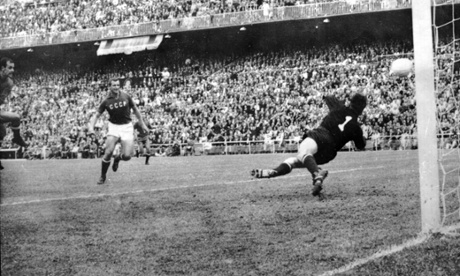
Instances in the World Cup are pretty rare, partly because of the consistent success of the South American teams, who don’t need to qualify for the Copa América, plus you generally have to be pretty good and consistent to reach the last four of the big one. However, it has happened once, in 1966 when only the Soviet Union took part in the 1964 European Championship, with England, West Germany and Portugal missing out. Of course, the caveat there is that only four teams actually took part in those nascent Euros, so again perhaps it is a little unfair.
Attention then turns to the Africa Cup of Nations and, mercifully, our friend and yours Phil has done much of the heavy lifting here. Sit back and enjoy – take it away, Phil …
“Like many people, I immediately thought the Africa Cup of Nations must be the answer to this question, but unlike most people, I actually went off and looked in to it! Don’t judge me. If we are cheating, the first Cup of Nations took place in 1957 and only Sudan, Egypt and Ethiopia took part (South Africa had been disqualified). No African teams were at the 1954 World Cup (Egypt lost a play-off/qualifier with Italy), so technically none of the qualifiers for the subsequent Cup of Nations had qualified for the World Cup. Given no African team appeared at the World Cup after the start of the Africa Cup of Nations until 1970, it is unfair to look at this until 1994 when three African nations qualified for the World Cup. Below is a list of qualifiers from Africa at the World Cup and semi-finalists in the subsequent Africa Cup of Nations.
• USA 1994 - Cameroon, Morocco, Nigeria / South Africa 1996 - South Africa, Ghana, Zambia, Tunisia
• France 1998 - Cameroon, Nigeria, Morocco, Tunisia, South Africa / Ghana/Nigeria 2000 - Cameroon, Tunisia, South Africa, Nigeria
• Korea/Japan 2002 - Senegal, Cameroon, Nigeria, South Africa, Tunisia / Tunisia 2004 - Nigeria, Mali, Tunisia, Morocco
• Germany 2006 - Angola, Ghana, Ivory Coast, Togo, Tunisia / Ghana 2008 - Ghana, Cameroon, Ivory Coast, Egypt
• South Africa 2010 - Algeria, Cameroon, Ghana, Ivory Coast, Nigeria, South Africa / Gabon/Equatorial Guinea 2012 - Zambia, Ghana, Mali, Ivory Coast
“So in 1996, all the semi-final teams had failed to qualify for the previous World Cup tournament, so not qualifying for USA 1994 looks to have been a blessing across Europe and Africa. At least two of the semi-finalists in all the other instances had been at the previous World Cup. Given the Africa Cup of Nations is every two years, I’m sure there are examples of semi-finalists who hadn’t qualified for the upcoming World Cup but, despite the above, I don’t have the time to check – although a quick glance at the 1998 tournament shows South Africa (did qualify for WC), Egypt, Congo and Burkina Faso (DNQ)!”
Luckily we’ve got nothing but time, so let’s take a look. In 2002 Cameroon, Senegal, Nigeria and Mali were the semi-finalists, with only the latter not making it to Japan and South Korea, but in 2006 only Ivory Coast of the last four were at the World Cup, champions Egypt as well as Nigeria and Senegal. In 2010 Egypt again won the Cup of Nations but again missed the big one, even though Ghana, Nigeria and Algeria did play at the World Cup in South Africa. The scheduling of the whole affair changed to have an extra tournament in 2013, and, for what it’s worth, Nigeria, Ghana, Burkina Faso and Mali were the top four, only the first two making it to Brazil.
The perhaps ‘less high-profile’ Asian Cup (to us in the west, at least) of course has a number of instances of this ‘phenomenon’ occurring, although three of the semi-finalists in the last edition in 2011 (Japan, Australia and South Korea) were at South Africa 2010, while finally Yossi Medina has a quick line about another tournament: “Another weird case was the 2000 Gold Cup, in which USA and Mexico didn’t reach the semi-finals so Canada, Trinidad and Tobago and Peru qualified to the semi-finals and didn’t reach the World Cup, while the fourth was Colombia.” So. Now you know.
THE LITTLEST HOMES
“Which English top-flight champions had the smallest ground at the time when they won the league?” ponders Roland Tye. “Might be worth dividing into pre- and post-war, dunno. I’m guessing Blackburn in the modern era.”
You guess quite correctly for the Premier League era, Roland, as Ewood Park is in more or less the same state as in 1995, and has a capacity of just over 31,000. Highbury is next on the list, which could fit 38,419 in when Arsenal last won the league (2004). Before that is trickier, obviously because of the changing nature of every ground and their capacities, and it’s probably best to stick to post-war, if only because it serves as a useful (if a little arbitrary) cut-off point for when records were reliable, each team had a settled home etc. The best guess we can give you is Portman Road, home of the 1961-62 champions Ipswich, is the smallest ground to call a post-war league title winner home, with a capacity of around 29,000.
Obviously, if someone can give us an advance on that, you know where to email.
KNOWLEDGE ARCHIVE
“Last week there were five Athens-based teams playing in European competition,” asked Michael Dunn a decade ago, in November 2004. “Olympiakos and Panathinaikos in the Champions League, and AEK Athens, Panionios and Egaleo in the Uefa Cup. Five teams in Europe from the same city: this has got to be a record hasn’t it?”
It has indeed, though it only equals the record set by five Moscow clubs in September 1996. On 10 September, in the Uefa Cup, CSKA Moscow were defeated 1-0 by Feyenoord, Torpedo Moscow were beaten 1-0 by Dinamo Tblisi, Spartak Moscow beat Silkeborg 3-2, and Dinamo Moscow had a goalless draw with Neuchatal Xamax of Switzerland. In the same week, on September 12 Lokomotiv Moscow beat NK Varteks of Croatia 1-0 in the Cup Winners’ Cup.
• For thousands more questions and answers take a trip through the Knowledge archive.
CAN YOU HELP?
“We always heard the statistic that Ryan Giggs was the only player to have scored in every Premier League season (until his final one),” writes Caoimhín O’Donnellan. “But I was wondering when was the last time he was not the only player to have scored in every Premier League season? Who had scored in every season from the beginning up until they left the division or retired or lost their goalscoring touch? Or who had scored in the most consecutive seasons at any stage before or after the birth of the Premier League?
“I was thinking about the early days of football, and it got me wondering which bright spark first said, ‘you know, if people are going to watch us we should charge them’?” wonders Mark Ireland. “Which was the first match to charge an entrance fee for supporters? And what size crowd did they get? Sounds like a tough question. Kudos if you can find an answer.”
“Last Saturday [8th Nov] almost looked like having a notable lack of goals in the 3pm kick-offs, before a late flurry,” says Toby Sandison. “I wondered what is the least goals to have been broadcast on a Saturday edition of Match of the Day?”
“Ajax goalkeeper Jasper Cillessen failed to save the 24th penalty of his career at the weekend, away at Cambuur,” begins James Deacon. “Are there any other international goalkeepers or top-flight goalkeepers that have such a poor record against spot-kicks? Although simplistic, if a penalty kick is one of five choices – top and bottom of either corner and the centre of the net, at what point does the failure to stop consecutive penalties became statistically outrageous?”
Send your questions and answers to knowledge@theguardian.com