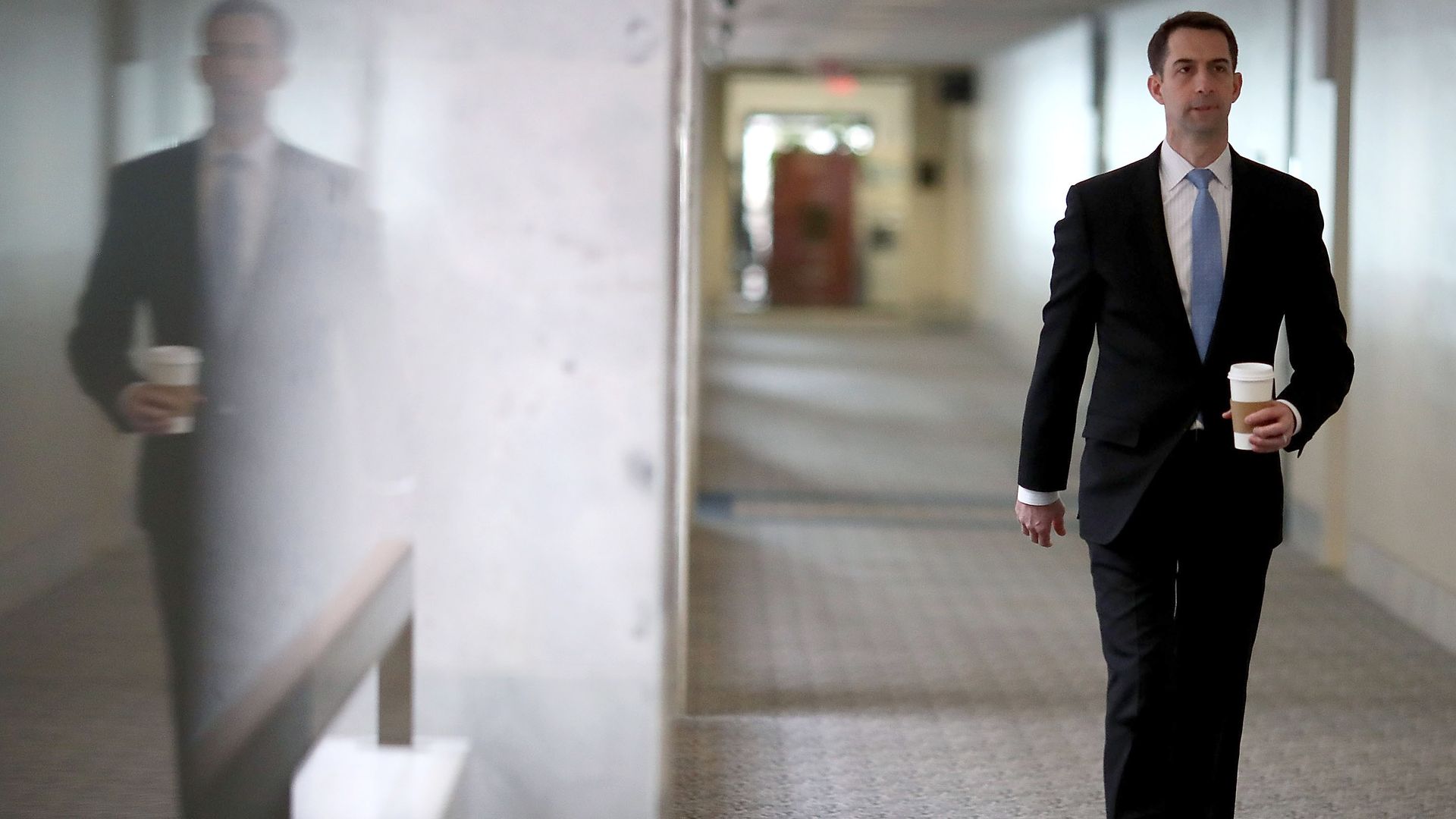
Sen. Tom Cotton praised President Trump's approach to Iran but differed with the president on North Korea and the standoff with China over telecom giant Huawei in an hour-long conversation with former acting CIA Director Michael Morell at the Atlantic Council's annual forum on Friday.
Why it matters: The hawkish Army veteran has President Trump's ear, and may well end up in his administration.
- On Saudi Arabia: Cotton says the kingdom's current turmoil results from "political instability in the Saudi model, insecurity because of Iran... as well as economic" pressures in the global oil market. He said the U.S.-Saudi relationship is "critical," and we shouldn't "sunder" it over the murder of Jamal Khashoggi.
- On North Korea: Cotton wants to see tighter enforcement of sanctions, disagrees with Trump's decision to cancel U.S.-South Korea military exercises, and says he "wouldn't let this drag on forever." In the meantime, he says, the U.S. should improve its defenses against North Korea missiles.
- On China: Cotton says China is a "unique adversary in the world" and is seeking to displace the U.S. in the long-term, but can't match Washington's network of alliances. He says Beijing's approach to its neighbors can boil down to "we're big, you're small."
- On Russia: Cotton says "Vladimir Putin doesn't think Russia lost the Cold War, they were just behind at half-time and catching up now." He says the U.S. needs to approach Putin "without making out that he's 10 feet tall, and recognizing they're a declining power."
On Huawei CFO Meng Wanzhou, held in Canada on charges related to U.S. sanctions, Cotton said: "I want to see her extradited, I want to see her face the full force of U.S. law." He said letting trade influence things (as Trump suggested) would send the "wrong signal" to China and U.S. allies.
One surprising thing: Asked whom he admires most in the history of U.S. foreign policy, Cotton chose John Quincy Adams, for shaping the Monroe Doctrine.