A few years ago I took a friend from continental Europe walking in Wharfedale. She had never been to northern England before, and the thing that made the biggest impression on her was the vast latticework of dry stone walls.
“There’s so many of them,” she said, expressing a mixture of awe at the skill involved and dismay at the uniformity she felt they imposed on the landscape. To me this is a landscape of clints, grykes, subterranean abysses and multicoloured meadows, but to a newcomer perhaps it is simply a world of walls.
In many parts of the Yorkshire Dales, walls emphatically inscribe the agricultural patchwork and state farming’s dominance over the landscape. But on closer inspection, the line between human and natural may be less clear cut than it first appears.
Skyreholme Beck Valley’s main feature is Trollers Gill, an intimately spectacular gorge, but what held my attention there recently was the profusion of living texture festooning the limestone walls nearby.
Looking closely, I thought I spotted cup lichens, like miniature corals, sprouting stalks from lettuce-patterned bases; pincushion-shaped clumps of sphagnum moss; dark stains of crinkled jelly lichen; bacterial growths; and a host of other species. Each stone was richly overgrown, each stretch of wall a reef supporting all manner of life forms.
Perhaps the most “famous”, or at least obscure, inhabitant of this region’s walls is Nowell’s limestone moss, which grows exclusively in the Yorkshire Dales, in just seven sites, and is so sparsely distributed the discovery of its spores in 2003 actually made the headlines. I have never seen this elusive moss, but later the scale would shift from close-up to cosmic, and give me a glimpse of another kind of rare spectacle.
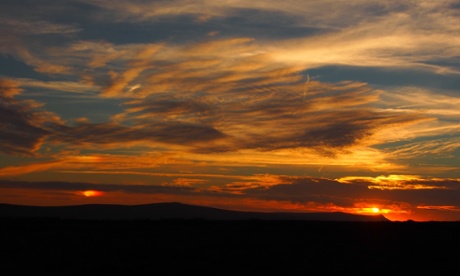
There seemed to be two suns setting over Pock Stones Moor. Later I discovered the twin was a “sun dog”, the illusion of phantom suns caused by light refracting in atmospheric ice. At the time, though, I didn’t know the method behind the magic. Even in this anthropogenic landscape, nature retains its power to enchant and enthrall.