Stargazers around the world will be greeted with a breathtaking solar eclipse on Friday – though it won’t be visible to all. Unless you’re Danish or had the foresight to make travel arrangements to a remote Norwegian archipelago (where hotels have been fully booked for the event since 2008), your view will be obstructed.
You won’t be able to see it at all from the United States, but the whole event will be live-streamed courtesy of the Slooh Community Observatory, starting at 4.30am ET (8.45am GMT).
It’s a rare celestial occurrence for a full solar eclipse to coincide with the 20 March vernal equinox, which marks the astrological start to spring for the northern hemisphere. The moon will also be at its closest to Earth – making for a supermoon that appears significantly larger than usual – but because Friday is also a new moon, it won’t be visible.
There will be one other solar eclipse on 13 September this year, but that will only be visible to stargazers in South Africa and Antarctica (and a solar eclipse on the equinox will only happen three more times this century).
Here’s a rundown of locations where lucky skywatchers will have the chance to witness the eclipse if the skies are clear (and remember, staring directly at the sun can severely damage your eyes):
1. The Faroe Islands and the Norwegian islands of Svalbard
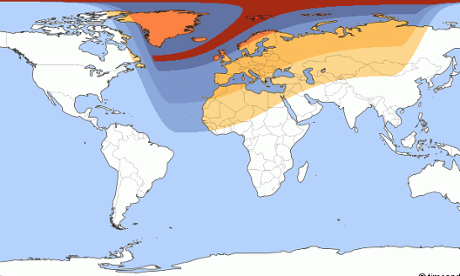
These far-flung islands are the only place to see the total solar eclipse, where the moon will completely obscure the sun for about two minutes starting at 9.41am local time. The eclipse will last about 2.5 hours total.
The islands are accessible by plane, but the mountainous terrain is infamously treacherous. The islands are located roughly between Iceland and Scotland, connected to the mainlands by ferries.
The islands have long been a destination for astronomers, owing to their low light pollution. The first enterprising guest booked a room 10 years in advance of Friday’s eclipse, according to CNN.
2. Europe and the UK
The eclipse will be at its deepest around 9.30am GMT in London and 9.35am GMT in Edinburgh. The UK won’t see another until 2090. The eclipse will begin south of Greenland at 9.13 GMT, passing over Iceland and the UK moving counterclockwise.
Engineers across Europe and the UK are also bracing for a serious test for the European electric grid caused by the eclipse. The loss of 85% of sunlight will cause a sudden loss of power equivalent to 8 to 10 coal power plants.
3. North and west Africa and the Middle East
Across a wide swath of northern Africa, between 40 and 90% of the eclipse will be visible. The maximum eclipse in Cairo will be at 9.47 GMT and 9.18 GMT in Tripoli.
4. Saint John’s in Newfoundland, Canada
A small number of Canadians will also be able to catch a glimpse at sunrise – the only place in North America that will be able to see the eclipse.