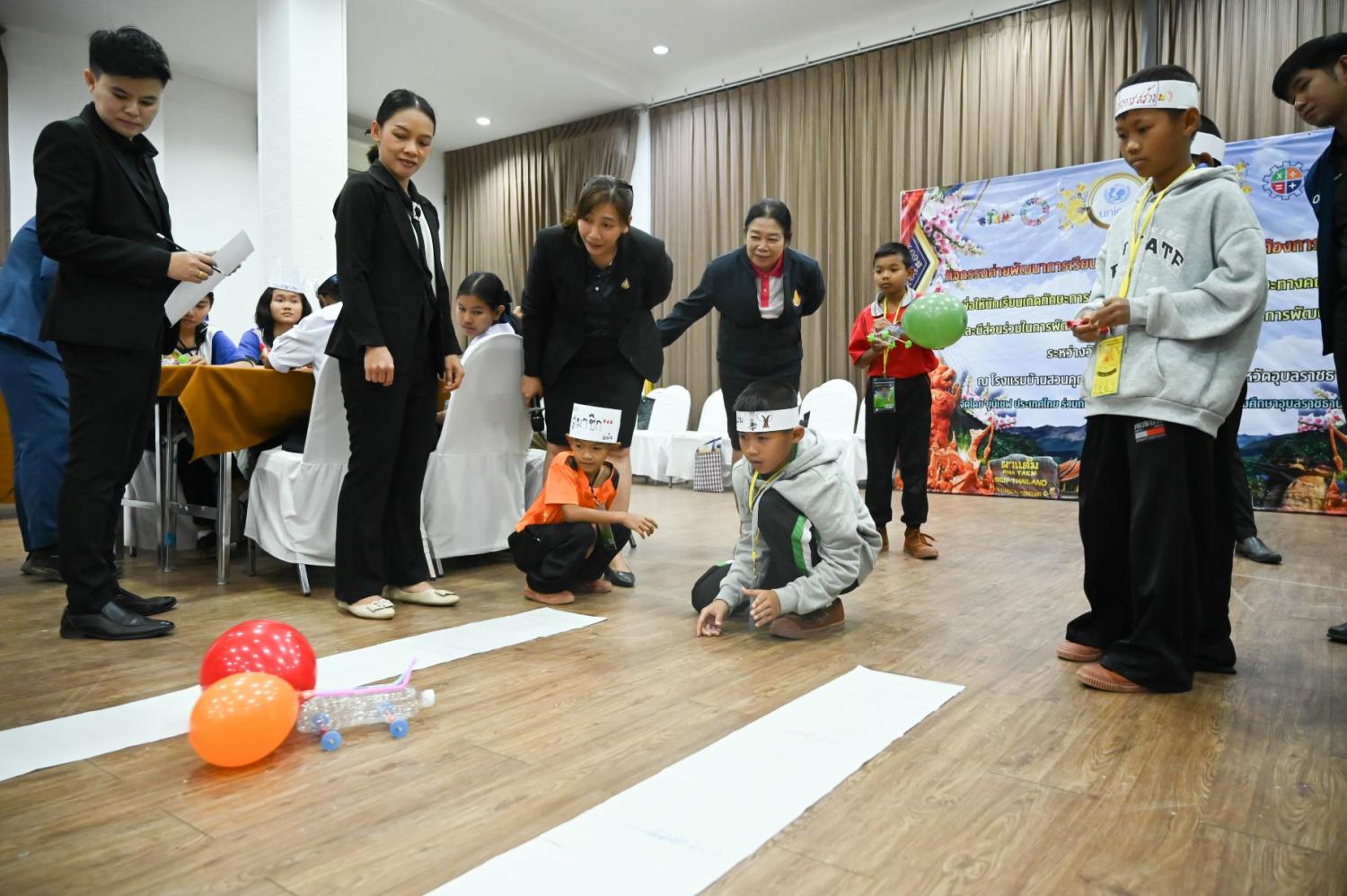
The challenge was simple -- build a "car" using a plastic bottle and make it move as fast and far as possible using a balloon.
Pornwipa Nonesung, 11, who has a hearing impairment, worked with her partner Pornmongkol Chanpetch using informal sign language to improve their makeshift vehicle. On its second launch, it moved much further than before, making Pornwipa break into a broad smile.
Around her, the hotel function room had been transformed into an integrated workshop space, buzzing with the cheerful sounds of 60 children, some with disabilities and some not, all absorbed in the same challenge. Creating the car was a science experiment in a day-long STEM workshop which taught scientific principles through practical application. It was also a lot of fun for all the students.
"STEM education is about helping children learn to observe, question, experiment and solve problems," says Chalita Thanakoop, education officer at Unicef Thailand. "It develops critical thinking and creativity."
Yet children with disabilities are often excluded from STEM learning, not because they cannot participate, but because the learning environment is rarely designed with them in mind.
For children with disabilities in Thailand, access to education remains an uphill battle. Only around 60% of children with disabilities are enrolled, while almost all children without disabilities attend school.
Attendance declines even further at higher levels of education, with around one in three children with disabilities aged five to 17 out of school, largely due to barriers that limit their participation in learning, according to the 2022 Survey on Disability in Thailand by the National Statistical Office and Unicef Thailand.
Thailand also continues to struggle with weak outcomes in mathematics and science, with performance in PISA consistently below OECD averages. The result is a double disadvantage -- many children facing barriers to inclusion are also not getting the full educational support they deserve.
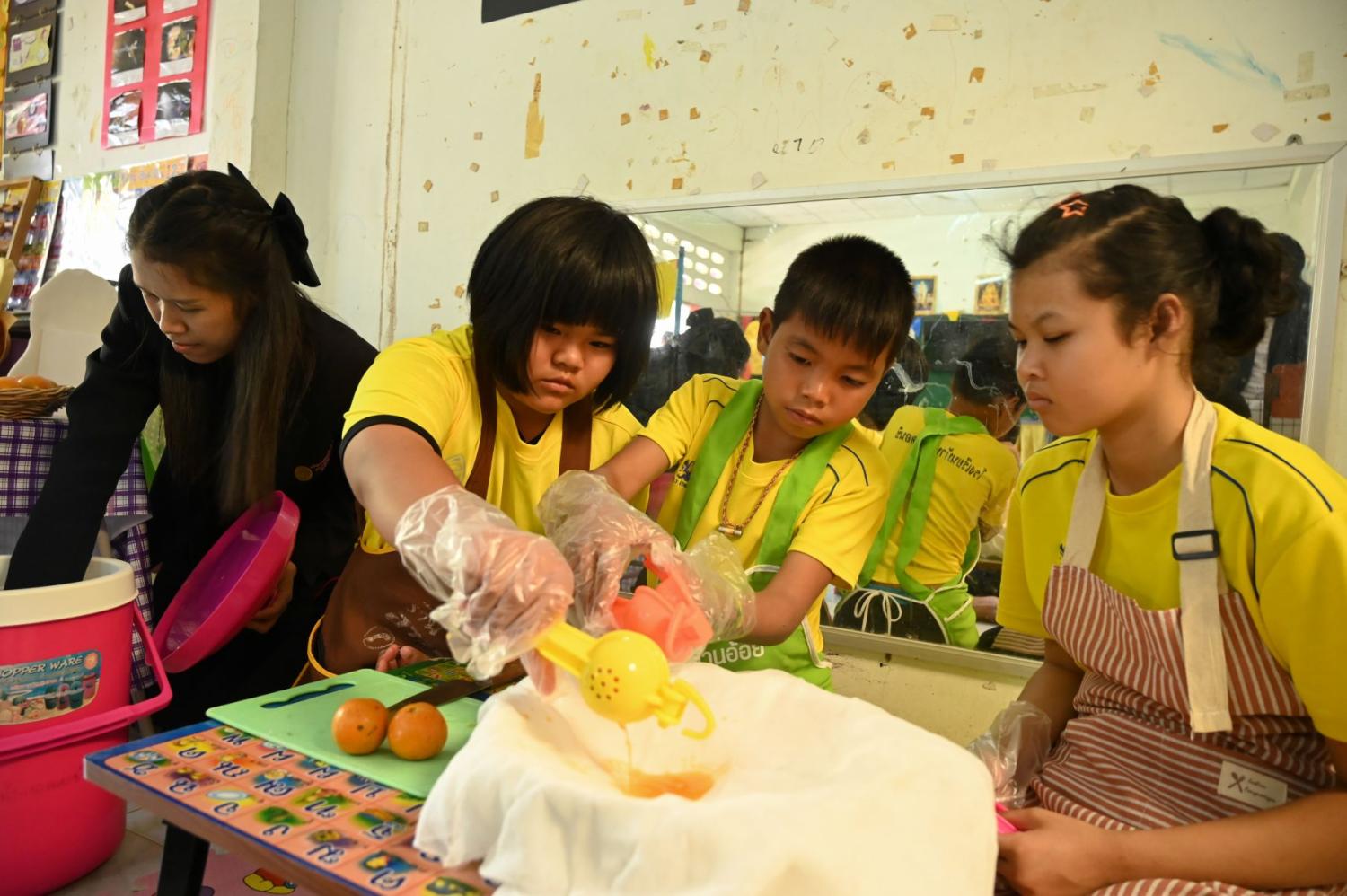
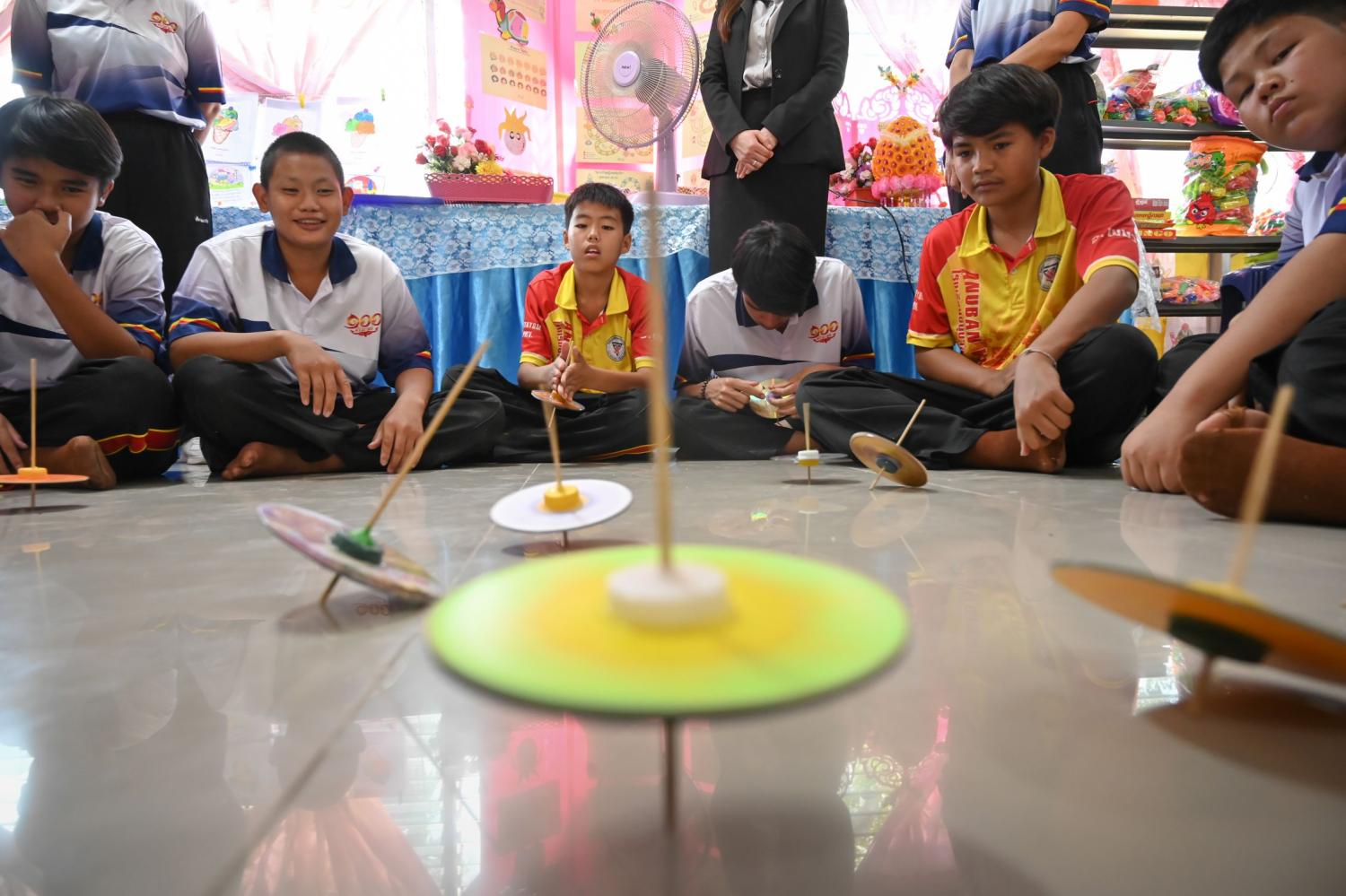
The one-day STEM camp recently held in Ubon Ratchathani brought together 60 children, including 20 with special needs. Activities were designed so all could participate, with an emphasis on thinking and hands-on projects.
"We don't expect the children to create something flawless," says Isarah Srisuno, an educational supervisor. "What matters is the thinking process and working together." He adds that many children came from remote areas and were experiencing the city, and in some cases a hotel, for the first time.
The camp is part of a Unicef-supported initiative across 141 inclusive schools in Ubon Ratchathani, which aims to demonstrate how inclusive teaching approaches can be integrated into mainstream classrooms, particularly in underserved and rural communities. Combining student activities with teacher training in inclusive STEM education, the initiative is expected to benefit more than 1,500 children with disabilities, 141 teachers and over 4,000 classmates.
Apinya Promwan, one of the teachers who attended, has been experimenting with STEM-based activities in her own classes for some time. She has noticed something consistent: children with special needs respond better to learning through doing than dry academic instruction.
"You can see it in their faces and their reactions," she says. "They smile and enjoy themselves when they learn through activities, because it feels like playing with friends."
She has adapted what she already knows about STEM training, mostly rooted in science, to subjects across the curriculum, weaving hands-on tasks into elective periods and skills sessions. The results have been extremely positive.
"If you focus too heavily on academics, children can struggle. But if they can make something -- especially if there is a little friendly competition and a small reward or some praise -- they love it."
She is also a believer in the value of learning together. Inclusive classrooms, she argues, benefit everyone: "Children encourage each other and help one another. And it is a mirror of the society they will grow up in, a society with many different kinds of people."
Natthakorn Buayai, a student from Ban Siri Khunhan School, captured the mood simply halfway through the day. "I'm happy to come and do activities with my friends."
Kanokwan Kongmak's daughter, Chutima Buayai, goes to Ban Yod Don Chi School, a participating school. "I'd like her to develop like a child without disabilities", she says. "If she studies only with children sharing the same disability all the time, she will imitate them and won't progress much."
Research consistently shows that inclusive learning environments benefit all students, not only children with disabilities, helping everyone develop cooperation, empathy and problem-solving skills alongside academic learning.
As for Pornwipa and Pornmongkol, they smiled often, offering frequent thumbs-up to anyone who asked if they enjoyed the day. Through an interpreter, it turned out that Pornwipa was particularly proud of the makeshift car they had built, while Pornmongkol was more taken with the spinning tops, the focus of another of the day's activities.
They didn't win first prize. Some other teams had thought to attach two balloons to their bottles, a solution the guidelines didn't explicitly prohibit. But for many children, the day was not only about science. It was about being included, being challenged and learning alongside peers as equals.
The two of them went home with something that cannot be measured in metres or seconds -- new knowledge, a day full of fun, and a handmade creation to show their families.