Schools have resumed classes after the lifting in all areas of the state of emergency, which had been declared to contain the spread of the novel coronavirus. At some schools, school lunches have also restarted. Although usually a pleasurable time for the students to eat together, the atmosphere has completely changed: Talking has been banned to prevent infection and the menu has become simple and easy to arrange on plates.
--Eating in silence
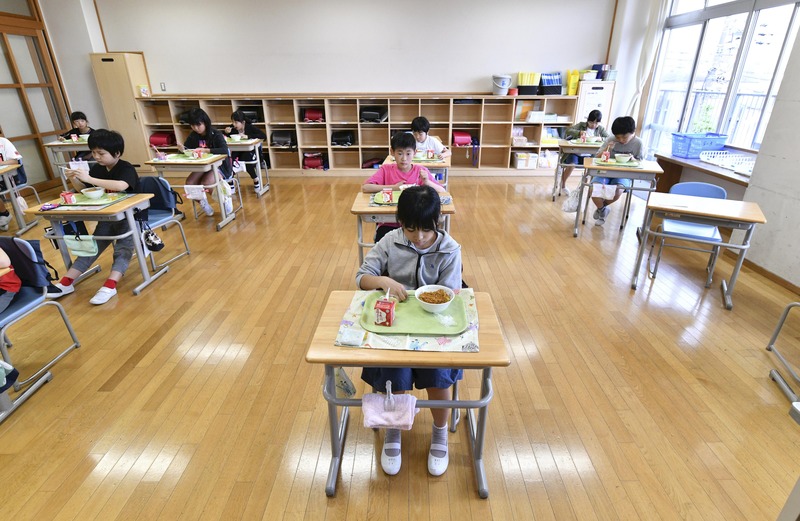
"Let's give our thanks to the people who prepare the meal and say 'itadakimasu' with our hearts" to begin the meal without speaking, said Eriko Ota, the 26-year-old teacher in charge of fifth graders in class No. 3 at Koyama Elementary School in Shinagawa Ward, Tokyo.
The school held classes for the first time in about three months on Monday, with 14 students attending her class.
The students faced forward and put their palms together in front of their chests. Then they started eating. There was no conversation and no smiles were seen on their faces. The only sound emanating from the classroom was that of spoons against bowls.
"In my 33 years of teaching, this is the first time," to experience this type of atmosphere, said Principal Yutaka Namoto, 56.
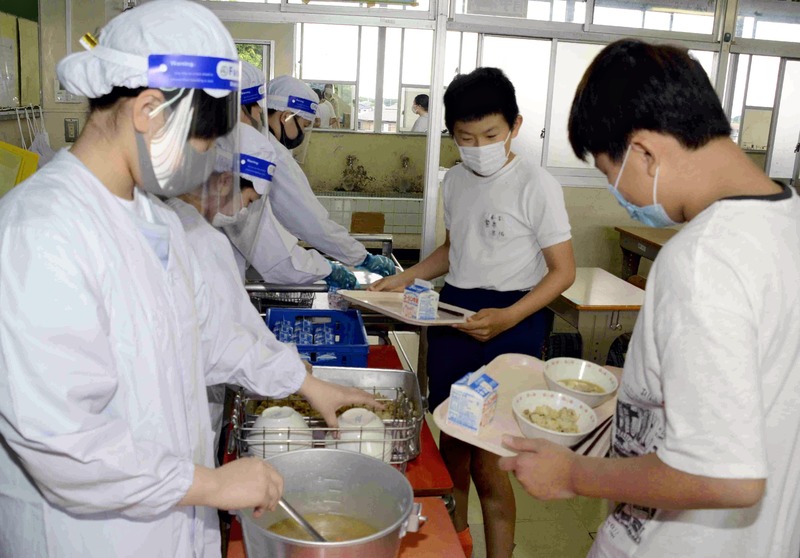
The menu on Monday was dry curry and fruit jelly, served with milk. Seven cooks plated the meals for 248 servings in advance in an effort to prevent infection. Previously, children on lunch duty used to serve the food for each meal. As the new process takes more time, one dish had to be reduced. There are no refills and lunchtime is 15 minutes shorter than before.
"I was surprised that the lunch was served in a completely different way," said 11-year-old Yui Sakurai. Then she smiled as she added, "But after such a long absence, school lunch was delicious."
--Only milk served
All 162 municipal elementary and junior high schools in Saitama City also resumed classes on Monday, with students split into morning and afternoon classes. However, as arranging food for about 100,000 students was not ready in time, "school lunch" was only a 200-milliliter carton of milk per pupil.
"I'm happy to drink milk," said a fifth-grade girl, "but I want to have a normal school lunch as soon as possible."
The city plans to add bread or rice balls next week and to have regular school lunches from June 15.
The Education, Culture, Sports, Science and Technology Ministry has drawn up guidelines for resuming school lunch, which can pose a high risk of infection. The guidelines give such examples as reducing the number of dishes as much as possible to reduce the number of serving opportunities; placing the food in lunch boxes or other containers while in the kitchen; and, if the above are difficult to implement, serving a light meal such as bread or milk can be an alternative.
--Seeing is believing
Kamoda Elementary School in Kochi City produced, with the help mainly of nutrition teachers who provide food education, a 7-minute DVD for children. It explains how to serve and eat meals to reduce the risk of infection.
In the video, teachers at the school put paint on their hands and serve dishes, with the paint adhering to many dishes, demonstrating how much these items are touched by various people. They also are shown chatting while eating, demonstrating how much food becomes scattered when doing so. Then they show how to wash hands and the new method of serving dishes by as few people as possible.
On the first day the school reopened, 728 children watched the DVD to gain an understanding of the situation. Other schools have also expressed interest in using the video.
Read more from The Japan News at https://japannews.yomiuri.co.jp/