Healthcare, education and employment are all rightly seen as basic to development – but underpinning all of these is energy. Indeed it’s difficult to see how, without power, communities in less developed areas can deliver these basics at all.
“Energy is an enabler,” says Thiyagarajan Velumail, global energy policy adviser at the United Nations Development Programme. “Without energy, schools do not function effectively, health centres will have limited capacity to provide services, energy-deprived communities will not attract good teachers and health workers, and employment opportunities will be limited because no enterprises can function or grow.”
Yet when the UN’s millennium development goals were set in 2000, energy didn’t feature. That has now been remedied, says Velumail: sustainable energy access will be one of the key UN sustainable development goals (SDGs) that will shape the global post-2015 development agenda.
Access to energy in the developing world has long been an issue. Velumail says that in terms of electricity alone, the global deficit – the size of the population without access to electricity – was 1.1 billion people in 2012.
The UN has established its Sustainable Energy for All (SE4All) Initiative to encourage businesses to support this challenge. Energy multinational Enel is a leading player in this project and Enel’s chief executive Francesco Starace was appointed to the SE4All board of directors last year. The company has been working to boost energy access in 10 countries with its ENabling ELectricity programme, launched in 2011. Involving more than 2.5 million people worldwide, Enabling Electricity works in both rural and urban areas and includes:
- Projects that guarantee access to energy
- Projects improving access to technology and infrastructure
- Projects that remove economic barriers in low income areas
- Initiatives to develop and share knowledge and professional skills to support the training of qualified local operators who can assist the growth of the electricity market in emerging economies.
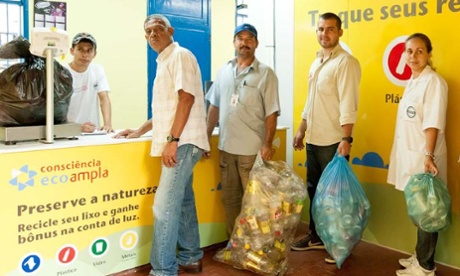
Enel’s Ecoelce and Ecoampla projects in Brazil, and the Ecochilectra project in Chile, aim to make legal electricity more accessible by giving discounts on bills to customers who recycle their waste. The customers bring recyclable items – including paper, glass, iron, aluminium, plastic and car batteries – to collection points and discounts are given in proportion to the quantity and type of waste.
Maria Cristina Papetti, head of sustainability projects and practice sharing at Enel, says: “It’s very effective. Since 2007, more than 430,000 families have benefited from the Ecoelce programme, and more than 18,500 tons of trash have been properly disposed of.”
One problem in countries where some households – typically the richer ones – do have electricity access is transmission and distribution losses due to theft. But both Velumail and Papetti stress that it’s not just poor people who are to blame for electricity theft. “Even the rich can do that, including industries and SMEs [small and medium-sized enterprises]”, says Velumail.
Papetti says: “Energy theft doesn’t have a direct correlation with poverty or low income. This is why Rio de Janeiro has a different behaviour from Ceará (the north east region of Brazil), for example, which has a very low income per capita but has a low rate of loss of energy because of theft.”
How do people steal from the grid? In different ways, Papetti says – including illegal connection to the network, or by illegally changing the meters.
Enel’s projects give incentives to people not to steal energy. One place this has worked well is in the Reta Velha district in Rio de Janeiro, Brazil. In 2013, the district had a grid loss rate of 73.4% out of its population of around 5,300.
As part of its Ecoampla project, Enel analysed critical points of need for energy, such as schools, hospitals, and churches. It then worked with a local NGO to set up a mobile office to resolve people’s direct needs; replaced old domestic appliances with newer, more efficient equipment; installed electricity meters; and began an e-invoicing process.
Enel also secured lower tariffs from the government for two years and is planning to invest in community building initiatives. It also encourages clients to sell their waste to recyclers.
Papetti said: “As a result of the project, besides the marked benefits produced in the community, the grid loss rate in Reta Velha has fallen by 66 percentage points in a year, to stand at the end of 2014 at 7.4%, one of the lowest levels in the region.”
Stealing and misusing electricity can be dangerous, and improving safety is a key benefit of the programmes. Papetti says: “ We promote the conscious consumption of energy, avoiding waste for the misuse of it, such as using appliances improperly, keeping unsafe electrical installations or stealing energy. We aim to inform the customer and make their appliances more efficient, so that they can consume sustainably.”
Alongside projects like this, work to educate people, especially young people, is going to be crucial to the global goal of sustainable access to energy.
The PlayEnergy programme, run by Enel, works with schools in nine countries across the world: Italy, Spain, Romania, Russia, Guatemala, Chile, Panama, Costa Rica and Brazil. It has been teaching pupils about sustainable energy for 12 years.
Papetti says: “In all schools the project promotes the scientific approach, the attention to the environment and the need for an intelligent and responsible use of electricity. Speaking about energy with young people means spreading a culture of shared responsibility based on scientific facts but also taking care of their own future, their career, their world.”
In the near future, the UN and its partner companies hope, such programmes can start to deliver the energy that will make a palpable difference to the lives of the billion or so people without power today – change that is desperately needed. “Access to energy is essential to economic and human development,” says Velumail. “Lack of energy access and its impact on health, education and income continue to be a significant cause of chronic poverty in developing countries.”
Content on this page is paid for and produced to a brief agreed with Enel, sponsor of the energy access hub at the Guardian Global Development Professionals Network.