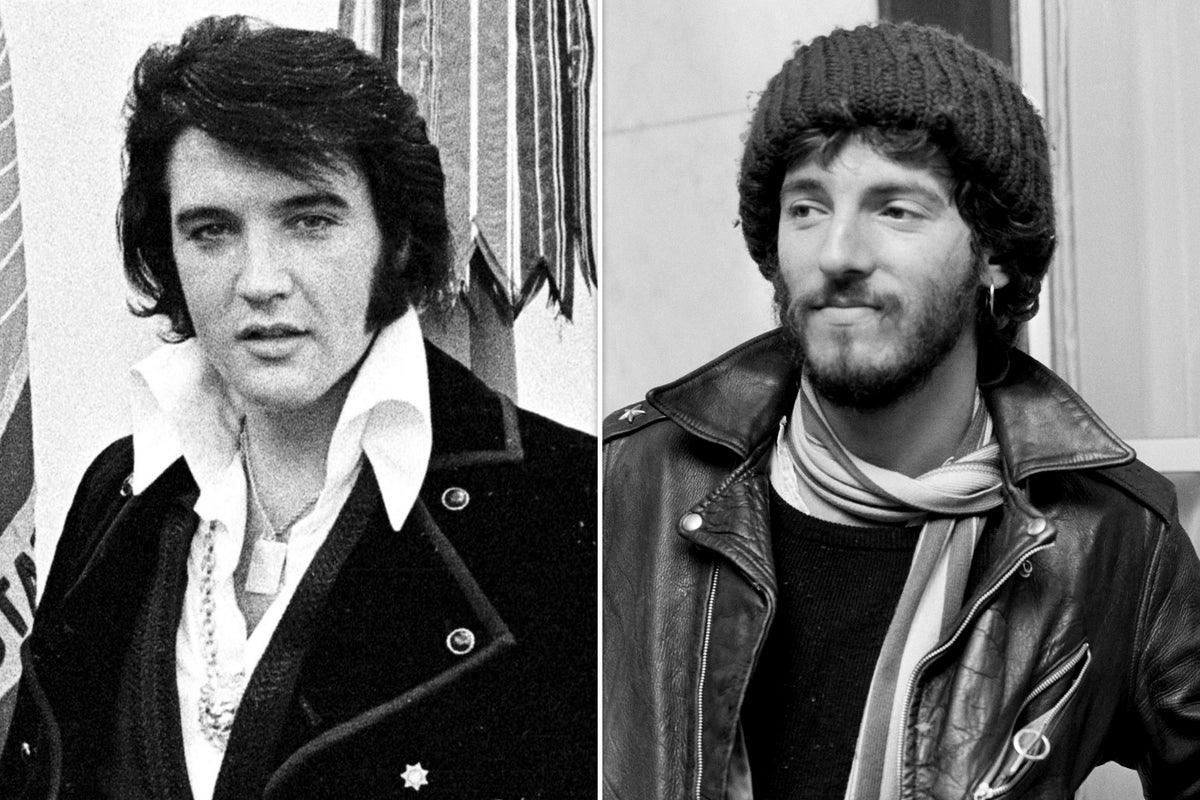
Peer closely at the cover of Born to Run – Eric Meola’s enduring, black-and-white portrait of Bruce Springsteen as he leans against his bandmate, sax player Clarence Clemons – and you’ll notice a button clipped to the singer’s Fender Telecaster guitar strap. Small and easily missed amid all that leather, it reads: “Elvis the King, King’s Court, Elvis Presley Fan Club of NYC.” It’s no great secret that from a young age the Boss had worshipped the King. So on the night of 29 April 1976, 50 years ago today, the then 26-year-old decided to demonstrate exactly how much.
It was 3am. Springsteen had just played a show in Memphis – another stop on his Born to Run tour, the eight-month crusade that had turned a scrawny, scrappy bar-room poet from New Jersey into a cover star on both Time and Newsweek. Fizzing with post-gig adrenaline, he hailed a taxi and asked to be taken to an all-night diner. “Yeah, there's one right out by Elvis's house,” the driver replied, as Springsteen later recalled on The Graham Norton Show. “Elvis’s house?!” he said. “You know where Elvis lives? Take us there, right now.”
Coming along for the ride was Steve Van Zandt, fellow E Street Band guitarist, fellow Elvis obsessive. As the cab pulled up outside Graceland on Elvis Presley Boulevard, the driver offered a word of counsel. “They’ve got big dogs over there,” Springsteen remembered him saying. “Don’t go over that wall.” At the end of the driveway, a light shone in an upstairs window. Springsteen looked at Van Zandt. “Steve,” he said, “I’m going in.”
Springsteen has told the story from stages for years, usually as an introduction to “Follow That Dream”, his haunting rearrangement of an Elvis deep cut. And follow it he did, this young pretender, flush with his first great fame, sprinting across the immaculate lawn in the Memphis dark, propelled by hero worship and the reckless momentum of youth.
He was seven years old when he first saw Presley on The Ed Sullivan Show, shaking and swivelling his way through “Hound Dog”, “Don’t Be Cruel” and “Love Me Tender”. “It was the evening I realised a white man could make magic,” he once told a SXSW crowd in a keynote address, “that you did not have to be constrained by your upbringing, by the way you looked, or by the social context that oppressed you. You could call upon your own powers of imagination, and you could create a transformative self.”
Fast-forward to 1976 and Elvis was on the wane. Just as Springsteen had caught fire, his vignettes of blue-collar longing and highway romanticism burning up the radio, so the King was palpably struggling. Hollowed out by prescription drug dependency and nine gruelling tours in a single calendar year, he was running on legend alone. The performances still sold out; the Las Vegas residency was now in its eighth year. But gone was the seductive, lascivious electricity of the man who had snake-hipped his way into the world’s consciousness – replaced by a figure clinging to the microphone stand, forgetting his lyrics and slurring his words.
Not that any of this put Springsteen off. Having evaded the dogs, he was soon at the front door. A gentleman answered; the exchange was brief. “Is Elvis home?” Springsteen asked. He was not – the King, he was informed, was in Lake Tahoe. Still, Springsteen had one more card to play. “You can tell him,” he recalled, “that Bruce Springsteen was here – and he may not know who that is, but I was just on the cover of Time and Newsweek.” Unimpressed, the guard politely escorted him to the gate. “That’s as close as I ever got to Elvis Presley,” Springsteen said.

Well, not quite. He did see him from afar at a show in Philadelphia, Presley focusing not on his rollicking rock’n’roll hits but on gospel songs and ballads that felt, Springsteen noted, “closest to Elvis’s heart”, such as “How Great Thou Art” and “American Trilogy”. Moved by what he saw that night, Springsteen wrote a track that he hoped would help his hero rediscover flashes of his old flame. He called it “Fire”. A demo was allegedly sent to Graceland, but Elvis died on 16 August 1977, aged 42, before it could have arrived.
Recorded in New York that December by rockabilly singer Robert Gordon – with Link Wray on lead guitar and Springsteen himself on uncredited piano – “Fire” eventually reached The Pointer Sisters, who took it to No 2 on the US charts in 1979. The King had at least known of Springsteen, and approved of him. “He liked Springsteen,” his childhood friend George “GK” Klein later confirmed on SiriusXM’s Elvis Radio. “He came on the scene real quick and hard and heavy, and Elvis liked him because he was a rock’n’roller.”
“I couldn’t imagine anyone not wanting to be Elvis Presley,” Springsteen said. Fifty years on from gatecrashing Graceland, he remains among the handful of that era’s giants still crafting sophisticated hymns of depth and illumination; still delivering three-hour shifts of blazing rock’n’roll. This was a man born to run – even from Elvis’s guard dogs.