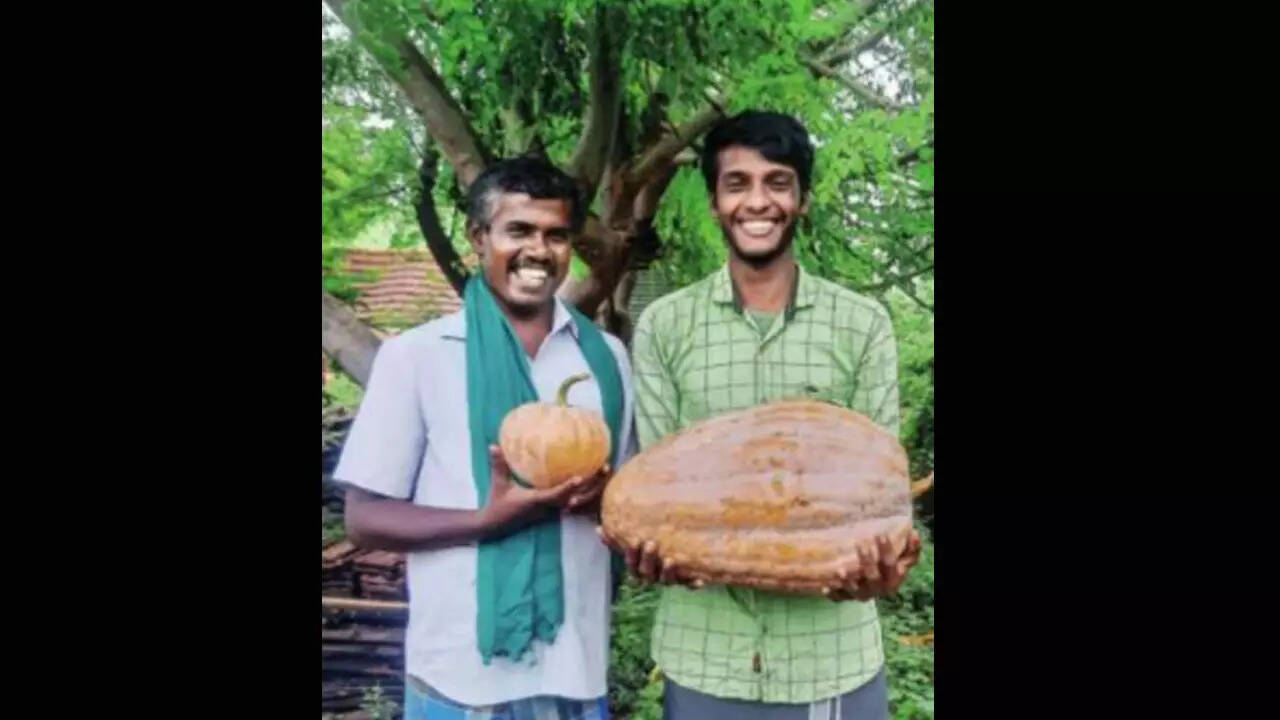
CHENNAI: As the youngest farmer in his family, 22-year-old Suresh Kumar takes pride in being the agent of change. He started organic farming on three acres of their seven-acre land at Dharapuram in Tirupur in 2019, and is inspiring everyone at home to make the switch.
Suresh is among a growing community of farmers and farming enthusiasts ignited by the vision of Ra Sundar, a young man from Puducherry, who has created a seed revolution of long-lost and rarely known native vegetables that score high on gut, heart and soil health. Sundar’s community, Uzhuthu Unn, has 500 members who include students, professionals, homemakers and small-time farmers who have revived indigenous vegetable varieties like Udumalai Samba (a variety of brinjal) and Vetrilai Valli Kizhangu (pink yam) that they grow organically in their gardens.
“There are at least 400 varieties of vegetables that used to naturally grow in 100 local varieties of soil found in different parts and terrain of Tamil Nadu. They needed no repetitive sowing, chemicals or pesticides. They naturally and abundantly produced vegetables that were healthy and nutritious,” says Sundar. “With time of course, foreign seeds were introduced, all vegetables began to be grown everywhere, the soil lost its fertility and small-time farmers struggled,” he says.
Sundar’s interest in organic farming and indigenous produce started as legwork for his documentary film project for the visual communication course he was pursuing at Pondicherry University Community College. This was around 2016. His fascination for the vision of leaders like Nammalvar and Nel Jayaraman took him deeper into the journey than he had initially planned, and fuelled him to introduce a barter system of native vegetable seeds that began with less than a dozen people.
“I took seeds from my own garden and distributed about five to six varieties for free, on the condition that once the vegetables came, they would bring back and distribute more seeds to more people,” says Sundar.
Today, he’s reaching out to at least 4,000 people a year. “The seed was held sacred in traditional agricultural practices. Its place was at the temple’s kalasam (a top placed at the temple tower) or the altar at home, unlike today, when it can be bought off a shelf or university lab. ”In addition to involving people in the benefits of naturally growing produce that is locally supported by their soil, Sundar has also set up gardens inside schools and colleges to pass the baton on to the younger generation.
“In Jawadhu Hills, a school we had set up a farm for, grew their vegetables and took them to the village locals. Farmers trained by us are setting up their own seed banks. They’re also learning about ways to leave fewer footprints and cultivate healthier lifestyles. This makes them the heart of this movement. ”