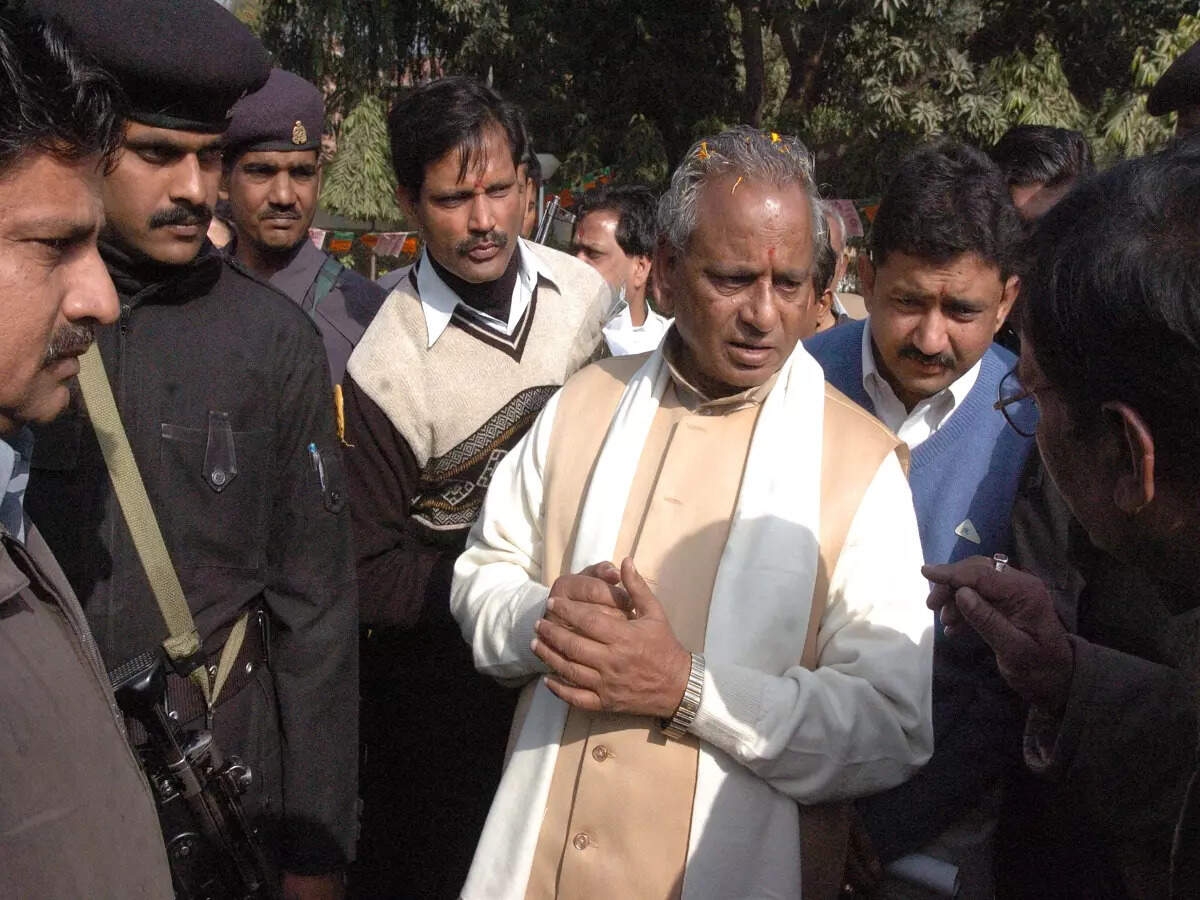
LUCKNOW: “Mai Kalyan Singh bol raha hoon.” It was his unmistakable baritone from the other side of the landline. No doubt, it was him. But still, unbelievable. After all, no chief minister calls up an unknown newspaper deskie early in the morning. That was the last week of September 1999. Mobile phones had arrived but still beyond one’s reach.
So, here was I, holding the telephone receiver and not sure what to say. He solved my problem. “Apki khabar ke liye dhanyawad (thanks for your reports),” he said. I was now getting it. He was talking about the stories I wrote after an election trip with him to Rohilkhand region of the state – Bareilly, Kheri and Rampur – two days ago.
Lok Sabha polls were just a month away and I had been assigned the task to accompany Chief Minister Kalyan Singh on his chopper tour. The then TOI-Lucknow editor had a very unorthodox way of deploying his reporters. Any other editor would hardly have thought of sending the junior-most sport desk sub-editor on a campaign trail with the CM.
That our chopper, on way back, had to force-land between two farm fields in Hardoi due to bad weather is a different long story. But what’s relevant here is that I covered his four rallies and wrote two reports – one on the rallies and the other on our narrow escape – which had appeared in the newspaper a day earlier.
“He probably liked it,” I thought. But so many reporters accompany him and write about election rallies. Does the CM call each one of them?
Did he call me to encourage as I was too young a reporter to accompany a CM on an election tour?
I was grappling with random thoughts while he was still on the call.
“Ye King Lear ki kya kahani hai (What’s the King Lear’s story?),” he suddenly asked. Now, I got it. He was talking about my story ‘King Lear continues to haunt Kalyan Singh’ which appeared that day (a day after the rally reports) and was based on his informal conversation with me during the day-long tour.
This story was not on my menu. It took birth after my editor asked about the trip and whether I could strike a conversation with the CM.
That was the time Kalyan’s ties with BJP’s central leadership had started straining. He believed that a section of state BJP leaders was conspiring against him and trying to tarnish his image. He also appeared peeved by the way the Central leadership was treating its tallest leader in the state.
So, he was full of angst and talked a lot about it. I had feared that after finding a rookie reporter accompanying him, he won’t open up. But that was not the case.
“How did he sound?” the editor asked.
“Bitter and helpless,” I said and then gave a few glimpses of Kalyan’s state of mind.
“Write it,” he advised.
“But it’s all informal conversation. He might not like it,” I tried to reason.
“We will find a way to present it. He won’t be quoted,” he said.
So, I started scratching my memory. Since Kalyan was talking casually, I didn’t find it appropriate to take notes.
The story that I wrote was about his resentment against his own top leaders, of course, by ascribing ‘people close to him’ and how it might impact BJP’s performance in the Lok Sabha elections.
The King Lear analogy, however, was not mine. It was my editor who did it while editing. When he showed me the final copy, I found it fabulous. So, it appeared the next day as front page flyer in TOI, Lucknow, and pushed the protagonist to reach out to me asking about the King Lear’s story (The CM office had asked for my telephone number from our chief of bureau, I came to know later).
Although he was asking me, I was sure the CM had already discussed the story with his staff and the comparison with the tragic hero made him angry. But, still I gathered courage and tried to make it as simple as possible.
“It’s the story of a king who is betrayed by his own people and loses his kingdom,” I said. The effort here was also to justify the headline of my report.
“Ekdum sahi. Aapne bilkul theek likha (You have written absolutely right),” he said emphatically, ending my trepidation, and hung up after thanking me again.
Two month later, in November 1999, he was removed as the UP chief minister.


.png?w=600)