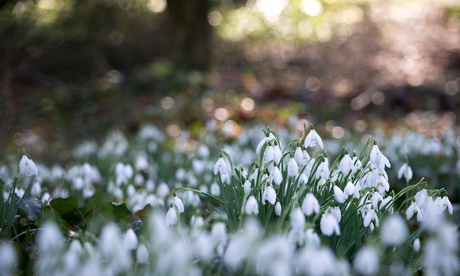
In the past week alone, the London borough of Enfield has taken top honours in two separate surveys. But put away the party poppers and re-cork that Cava. The first was a nationwide investigation by Which? to find the borough with the worst food hygiene. The second totted up annual road fatalities – Enfield tied for first place with Croydon.
Neither victory came as a massive shock. When I first went there a few years ago, we’d only parked for a few minutes before the windscreen was shot up with an air rifle (luckily, we didn’t stop for lunch). But don’t be too discouraged. The risk of death by gun or gastroenteritis is well worth it for a visit to Myddelton House, former home of legendary gardener EA Bowles, now in the ownership of Lee Valley council. Even since the swanky refit of the visitor centre a couple of years ago it remains totally free to visit: eight acres of cheery planting with a friendly coffee shop and some lovely 200-year-old lead ostriches.
We went there on Saturday and it was great even beneath drizzle, daffs popping out, aconites studding the grass. Plus, of course, loads and loads of snowdrops of all different varieties. We tried to identify them, but without expert eyes – and in the perishing cold – we gave up. Why no labels? Wouldn’t they be useful?
Leafing through a plant catalogue back home the reason became obvious. The Wizard, with its distinctive green petal splodge, is £50 a pop. Marginally more affordable is Trymposter (shorter stem, smaller blob, £45), while those in search of a bargain should head for the Spindlestone Surprise (£42 for two). In her book on bulbs, Anna Pavord confirms that snowdrops “attract a particularly fanatical band of admirers”, and to be a real buff you need top vision and a solid pair of mittens. And a healthy wallet, too.
Hence the lack of labels, for the only other thing an enterprising thief would need is a trowel. Yet it still seems to me an especially weird fetish, collecting these genetically modified titches. Not only are the variations infinitesimal, they’re pointless: this is a flower for which bog standard is obviously best; the sort that you can pick up for 20p each at the local garden centre. They’re simple, elegant, unsplashy. And, given that the best snowdrop is achieved en masse, there’s no need to remortgage.
Gardeners’ worldviews
A few hundred yards down the road, a rather less abashed approach to outdoor labelling. Capel Manor is a horticultural college whose sample gardens you can look round for a small fee as the M25 roars away beside you. There are all the ones you’d expect – cottage, Victorian, Mediterranean – but also a Japanese rock garden featuring 175 tonnes of Macclesfield granite and, just round the corner, the upwardly mobile garden – pine decking, glass partitions, big thistles, whopping tub.
It’s rare to see anything quite so frankly targeted. I had a look for a nouveau riche (lots of climbers, a bit prickly) and a downwardly mobile (binbag border, pot of vomit), but no luck. A gap in the market there, perhaps.
Raving about Rossiter
A colleague was off to interview Ralph Fiennes. I suggested he ask about his obvious love for Leonard Rossiter, whose style, delivery and even look he evidently apes. The question wasn’t well met, and as it turns out other film journalists, as well as Fiennes himself, appear to find the comparison unflattering. This I find baffling. Watching Rossiter in Rising Damp repeats as a child was a revelation. Apart from functioning as an intro to the classier likes of Kubrick (he was in 2001: A Space Odyssey and Barry Lyndon) and Brecht (he was apparently an amazing Arturo Ui), the shows themselves are astonishing.
Few mid-70s sitcoms still stand up. Fawlty Towers does because it more than doubled the number of edits per episode. Rising Damp, though its plot and politics may creak and heave a bit, clips along on account of Rossiter’s machine gun delivery. That he continues to inspire more than 30 years after his death is testament to his talent. Why act otherwise?