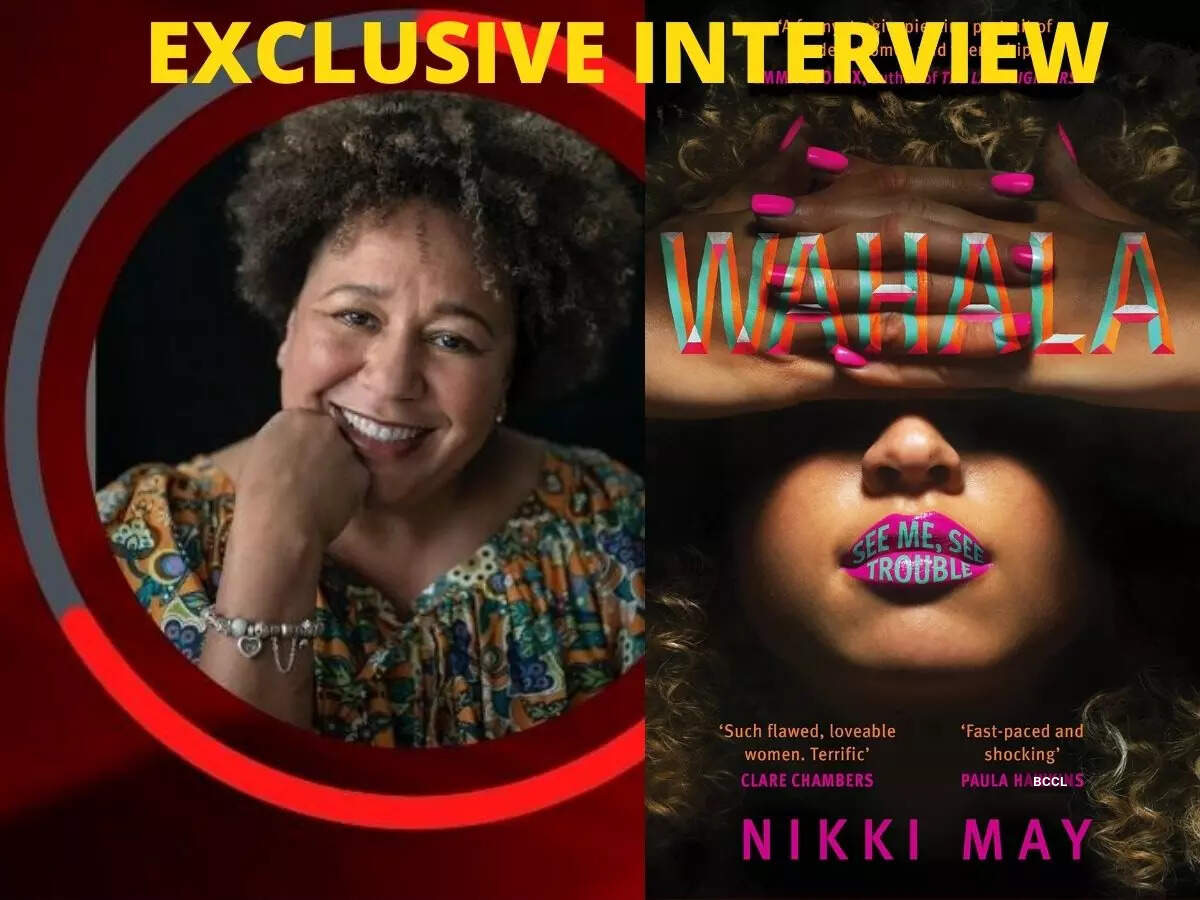
Anglo-Nigerian author Nikki May's debut book 'Wahala', which means trouble in Nigerian, was released in January 2022 and it became a huge hit among readers. So much so that the book will now be adapted into a TV series. In this interview with us, author Nikki May tells us more about writing 'Wahala', the pressure of having a hit debut book, her next novel 'Brown Girl In The Ring', her favourite books and authors, and more. Excerpts from the exclusive interview:
1. Tell us about your debut book 'Wahala' and how did you come up with the story?
My debut novel 'Wahala', which means trouble, and other people have compared it to 'Sex and the City' but I think it is slightly more diverse than it. 'Wahala' is a modern take on friendship, family and culture and it is underpinned by a rather epic revenge twist. It centers on three 30-something friends living in London and like me they share a mix Nigerian-British heritage.
So there is Ronke-- she is a dentist, she is dating Kayode, and she desperately wants him to be “the one”. She wants a happy-ever-after, 2.2 kids, and a nice home. Her friends aren't so sure that Kayode is the right guy. Then there is Boo-- she has everything Ronke wants. A kind husband, she has a gorgeous daughter, she's got a lovely home, a great job. But Boo isn't happy with her life-- she is frustrated with it and she wants more but she isn't sure what that more is. Simi is the golden girl-- she works in fashion, her life seems perfect on the surface. But Simi is very good at keeping secrets. So nobody realises that she is crippled with imposter syndrome. Her husband thinks they are trying fo a baby; Simi is not. So when rich and glamorous Isobel explodes into this group, at first it seems she is bringing the best in the friends but Isobel is a wrecking ball and her causing all the Wahala, the trouble, propels the narrative to a shocking twist at the end.
I came up with this idea after a long loud lunch with friends at a Nigerian restaurant in London. In fact the opening scene of the book is quite similar to that lunch in that restaurant, except there was no Isobel. As I travelled back home, out of my Nigerian me and into my English me, I started to think about how these two cultures live inside me and occasionally they both collide. And that's how the story started.

2. The main characters in your novel are Anglo-Nigerian and they all feel that the grass is greener on the other side-- which is relatable for women across cultures. So how did you come up with the characters-- are they inspired from people you know in real-life?
I think being a woman is a very complicated thing, wherever you are. So I really like your idea that the story is relatable to women across cultures. Being a woman, people have opinions on your hair, body, career, relationship status, even your reproductive organs-- it is typical. But I think when you come are mixed-race or come from a different culture these issues can be even more pronounced. For instance, in the book Ronke is 30 and not married. In the West it is not a big deal; in Nigeria it is!
Then you have Simi who doesn't want children. In the West people question the idea of women not wanting children; in Nigeria people would think you are either barren, mad, or cursed, or all three! So I think when you have a mixed culture these issues become more complicated, stressful, and more difficult to get across. That gave me inspiration on how to make this story slightly different from others because I think women everywhere are battling problems, this (being of mixed-race) is like an added layer of pressure on my characters.
The book is not autobiographical; I'm not like Isobel! (jokes) But I did borrow things from my life, my friends, and in general. I think a lot of fiction is like this. So I did drop out of medical school and my father was horrified! I later joined an advertising agency and it took my father years to come to terms to it. It was a very difficult part of my life. I remember feeling ashamed and embarrassed, like a failure. I think it is similar in India-- education is seen as this most important thing. One degree is not enough, you need a masters degree and a PhD and it shouldn't be in Arts but in proper subject like Accountancy, Law or Meds. So that's something I borrowed from people I know in this book.

3. Which character do you relate to the most from your book 'Wahala' and why?
I think it is Simi. The funny part is that everybody wants to be Ronke, the nice girl. But if I'm honest I think writing Simi was difficult because it felt like self-analysis. The imposter syndrome, the shame of dropping out of school, the wearing a happy confident veneer-- I have been through all of it.
4. So was writing also a cathartic process for you in a way?
In a way... It was also a difficult process because I had to think about issues which I hadn't thought about much. For example colourism and racism, there are always there but I never sat and thought about it earlier. Also for instance, another thing I borrowed was Ronke's white maternal grandparents who didn't want anything to do with her. My maternal grandparents were very similar. They never had anything to do with me or my siblings; growing-up I never though much about it. You don't miss something you don't know. But writing the book made me think and question about it. So bits of it were cathartic, and bits of it made me think... Also writing a book is very tough!
5. Your book 'Wahala' has been compared to 'Big Little Lies' and 'Sex and the City'. And it's your debut book! Does it put a lot of pressure on you as a writer, especially when you are writing your next book?
It's not a little bit of pressure but a lot of pressure! (laughs) There is huge expectation and sometimes it is crushing... A quality that most writers have is self-doubt. So you're sitting and thinking 'Really people will read and find out it isn't as good as they think it is?'...
And then there is also book two pressure! Writing book two is more difficult because you are writing book one for yourself. But for book two I have a deadline and a weight of expectation because of my debut book. So be careful what you wish for-- it can add an extra layer of pressure!

6. 'Wahala' is being made into a TV series. Tell us a bit more about it.
So 'Wahala' is being made into a TV series by the BBC and it's the most exciting thing that has ever happened to me in my life... I'm not involved in the TV series but they are being very collaborative. So they are keeping me informed; I'll see the script but I don't make the decisions. But in some ways I'm glad about that-- firstly writing a book is hard and I can't even imagine writing a screenplay...
I'm actually liking the book-to-screen process. I don't have to do anything as I have already done my job writing the book. It will take me some time to believe seeing the credit 'Based on a novel by Nikki May' on screen! Also, if it is terrible I can say 'Not my fault' and if it is wonderful I can say 'It's all down to me!' (jokes)
7. Are you planning to write a sequel to 'Wahala'?
Well never say never but I think 'Wahala' is done. So my second book is completely different but it does have people like me (of mixed race) in it. I think it is nice to reflect yourself in your writings.
8. Would you like to tell us about your next book?
I have written the first draft of it. My next book is called 'Brown Girl In The Ring'. The protagonist is a brown girl in Lagos. I'm setting it where I grew up because I think it is easier to write about things I know. So she lives in the house I grew up in when I was there. She is happy living a lovely life. Then something terrible happens and she has to come and live in England with her English family at a house called 'The Ring'. And hence the name of the book, 'Brown Girl in a Ring'. Obviously it is going to bump into class and prejudice because the truth is as soon as you have a character of colour you have to bump into those issues. But bits of the story is set in Nigeria, bits in London; we start when she is 10 years old and it goes on for another 25 years. At it's heart is a story of friendship, love and coming-of-age.
9. What are your top five book recommendations?
1. 'Station Eleven' by Emily St. John Mandel
2. 'The Stranding' by Kate Sawyer
3. 'Big Little Lies' by Liane Moriarty. It is true that when I was writing 'Wahala' my aim was to try and write a brown 'Big Little Lies' and so when people use that comparison I'm quite happy
4. 'How to Kidnap the Rich' by Rahul Raina
5. 'The Mysterious Affair at Styles' by Agatha Christie
10. And lastly, how will you complete the sentence, "I write because..."
Because I have to. I think I have always written. This is my first attempt at writing fiction but I wrote poetry when I was a teenager, I'm always writing. I think writing is my way of getting things out of my head and dealing with them.
So I think I write because I have to and I always write. Whether I'm being published is just the icing on the cake not the reason why I do it.
READ MORE: