Almost from its inception, photography was used as a way to remember and venerate the dead. In Victorian times, families posed for memorial portraits in which a recently deceased child sat, propped up between surviving siblings, or a newly dead father, held upright by invisible supports, stood surrounded by symbolic props from his life. Though the resulting portraits now look macabre, they were cherished by grieving family members for the way they conveyed the essence of their loved ones.
When I Was Six by Phillip Toledano is a book of remembrance for his sister, who died 40 years ago, when she was nine years old. It is an attempt to evoke the essence of a young girl who, for a long time, he was aware of primarily as a profound absence. “I have only two memories of my sister,” he writes in the opening jet-black pages of the book. “Kicking the door of her room, screaming, ‘I wish you were dead!’ Two policeman at our door, tall and official. Telling us there had been an accident…”
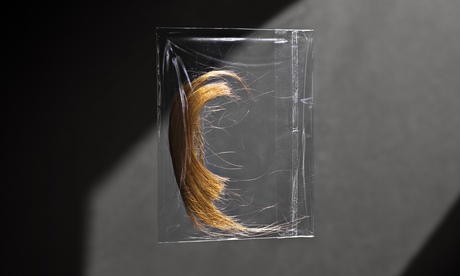
When I Was Six is a work of imagination, but also of excavation – of hidden objects, of buried memories, of the layers of silence and sadness that settle like silt on a loss that is beyond articulation. It is a book that merges words and images both old and new, found and created. Many of those images are of objects that Toledano found in boxes secreted in the attic of his parents’ house, boxes of mementoes created, and then hidden away, by his mother as if awaiting discovery after her own death. The small things that belonged to his sister – a check dress still in its box, a lock of her hair sealed in a small polythene bag, a personalised pencil, a fan letter written in crayon, but never sent, to Donny Osmond – comprise one narrative of remembering. He photographs them in an almost forensic way, as evidence of her interrupted life and as almost sacred objects invested with huge personal meaning.
Toledano threads another, more impressionist, narrative through the book, too, evoking another vast, empty world into which he escaped in his sister’s absence: a world of space travel, distant planets and far-flung galaxies – places that seemed impossibly out of reach and beyond his understanding. Like death, in fact.
When I Was Six is a book that could probably not have been made while Toledano’s parents were still alive. It is hard to know what they would have thought of his bringing into the public eye the small, sad things his mother hid away, unable to look at them but still cherishing them. For him, though, the process has been a healing one.
The penultimate photograph is a poignant snapshot from another, lost, time: a young boy and his slightly older sister on holiday, dressed in their bright summer clothes against a pale blue sky. It is a casually intimate snapshot in which he is staring impatiently at the camera and she is standing beside him, but with her eyes closed. Then, a last melancholy monochrome image of clouds and sky. “When I found the box, I found my sister,” he writes. “But I also found myself.”