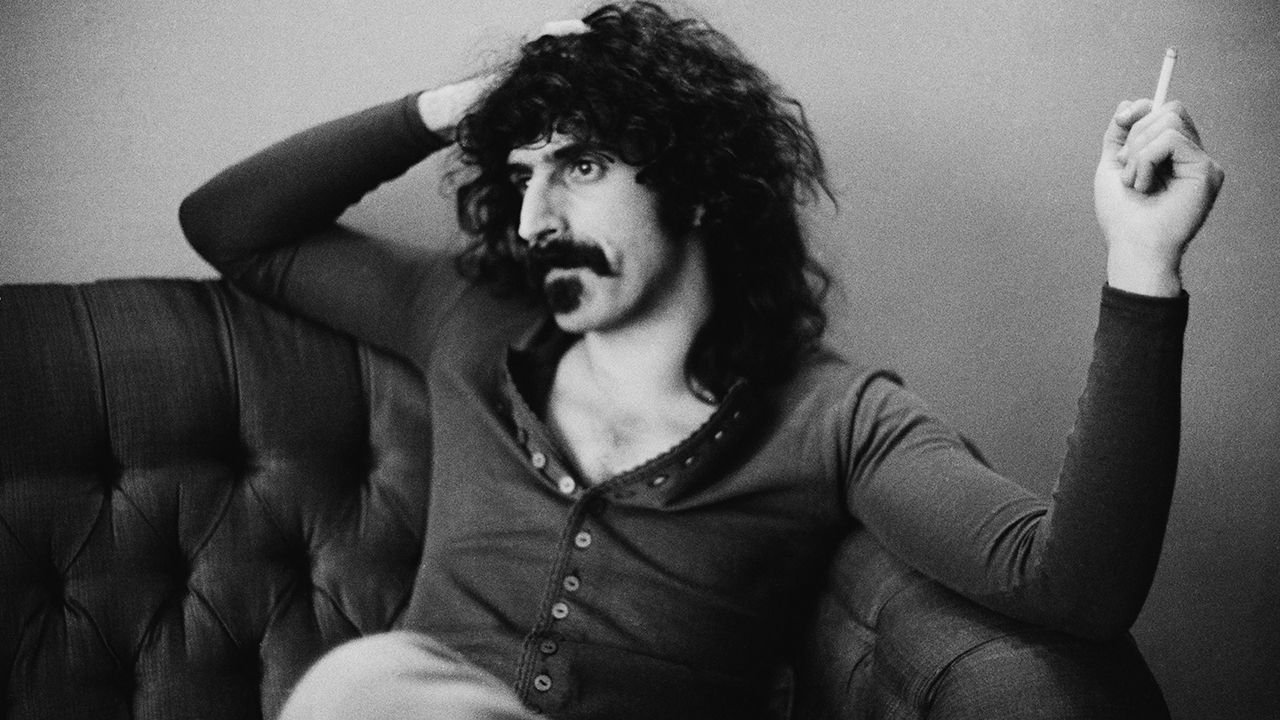
In 2013 – 20 years after his death – Frank Zappa’s widow Gail and son Dweezil told Prog about the life and legacy of the musician/composer who embraced the avant-garde while paying homage to early rock’n’roll, and mocked the mainstream while indulging in his own scatological silliness.
In 1967 Tony Palmer was an up-and-coming BBC documentary director. Four years earlier he’d given John Lennon an incognito tour of Cambridge, and the Beatle had written down his phone number on a slip of paper and said, “If you’re ever in London, give me a call.” At the resulting dinner, Lennon handed over another piece of paper.
“Now you’re making TV programmes, it’s your duty to make a show about all the musicians who either can’t get onto the BBC ,or don’t want to do Juke Box Jury or Top Of The Pops,” he told Palmer. On the paper was a list of names, and Frank Zappa was at the top.
Aired in 1968, resulting documentary All My Loving was one of the first credible attempts to examine pop music as a means of social commentary and a vehicle for opposition to the political orthodoxies of the day. Palmer – who later worked with Zappa on the movie version of 200 Motels – thought him one of the most intelligent and articulate rock musicians he’d come across.
It’s tempting to view the bands participating in the documentary as all being part of some liberal consensus about the ills of the day and potential solutions. Yet even at that relatively early stage in his career, Zappa was largely removed from contemporaries such as The Beatles, Cream and The Who both musically and politically.
A famous contrarian, Zappa was utterly scathing of the Summer Of Love, the corporate manipulation of youth and the manifestations of ‘hippie,’ the so-called alternative culture that proliferated at the time. “Pop music is sitting there pretending it’s going to grow and, at any minute, turn into something,” he said in 1967.
That year he’d recorded Who Needs The Peace Corps?, his scorching satire on the scene and the drug culture in general: ‘Every town must have a place where phony hippies meet / Psychedelic dungeons popping up on every street…’
In the years that have passed since his death from prostate cancer in 1993, Zappa’s music has resonated just as much as it did in his lifetime, thanks to an ongoing series of back-catalogue reissues and a steady release of archive material from his family’s extensive vaults. Since 2006, his son Dweezil has fronted Zappa Plays Zappa, touring with a mission to bring his father’s music not only to diehard fans but to a new generation of listeners.
In 2012 there were large-scale orchestral presentations of 200 Motels on both sides of the Atlantic. And in an irony Zappa would have relished, an orchestral score of his was performed at 2013’s Proms at the Royal Albert Hall – the venue which had banned him in 1971 on the grounds that his graphic rock’n’roll was an affront to taste and decency.
“The fact that Frank is described as a rock’n’roll artist is about as Dada as you could get,” says his widow, Gail Zappa. “There was no other classification for what he did at the time he emerged, so that’s what they called him. If you look at what he did in rock’n’roll and compare that with his orchestral music, you’ll find the same kinds of changes; the same kinds of experimental versions of what’s possible with an orchestra and what’s happening with rock’n’roll instrumentation. For Frank there was no difference – he used the same compositional technique throughout.”
For the teenage Frank in mid-1950s California, a life-changing moment came the day he haggled with a record store owner for an album by Edgard Varèse, containing the composition Ionisation. Zappa had read about the piece and was intrigued. The New Yorker’s Alex Ross described Varèse and other ultra-modernist composers of the day as pursuing a kind of “radical dissonance,”quoting Varèse as saying he wasn’t searching for the Holy Grail so much as “the bomb that would make the musical world explode and thereby let in all sounds, sounds which up to now have been called noises.”
Varèse’s Ionisation exploded in Zappa’s world of rhythm and blues and school-dance gigs as a drummer, and threw him into an odd and abrasive percussive landscape. He was transfixed by the indefinable timbre and texture within the piece. Perplexing as it was, it was also an environment in which he felt at home – where he knew he belonged.
Zappa recounted that, for months on end, Ionisation held him spellbound. Hijacking the family’s record player he immersed himself in Varèse’s world while his mother, as he put it, “looked at me like I was out of my fucking mind.”
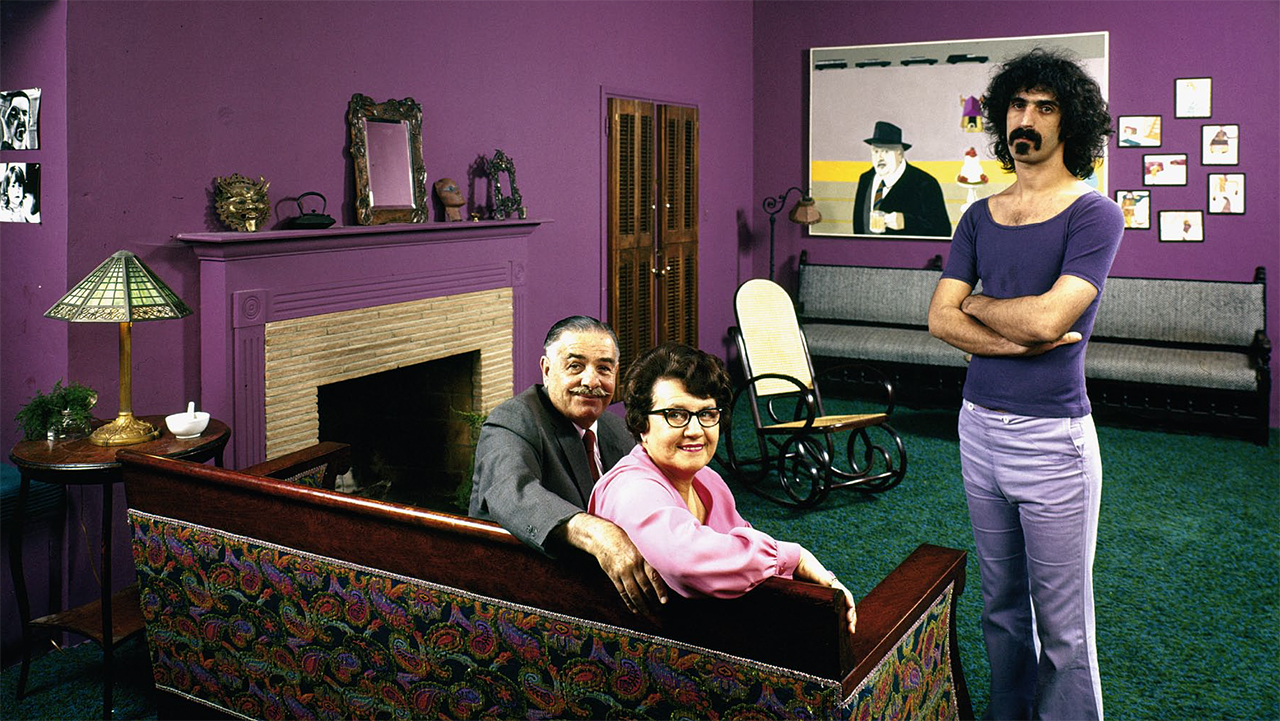
There’s a picture from 1970 of Zappa and his parents, Francis and Rosemary, posed for an edition of Life Magazine. They sit on a sofa in his plush LA home, looking out of place next to their now-famous son, who stands apart. Even allowing for the artificiality, it expresses a distance between parents and celebrated offspring. “I would not say that they were close,” says Gail, who married Frank in 1967.
“I think on the one hand you have a very strong Sicilian sensibility surrounding Frank’s father, whose whole background was among people who were Sicilian or Italian. Frank grew up in that world, but I don’t think he was in sync with culture that’s very drawn from tradition.
When I first heard stuff he didn’t write my first thought was, ‘Where’s the rest of it? Where are the other instruments? Where’s the detail?’”
Dweezil Zappa
“Frank knew from a very early age that he wasn’t going to buy into those concepts. By the time he was nine he’d already invented a way of expressing himself that he was very comfortable with. It didn’t matter what other people thought – he was going to go ahead and do his own thing.”
She suspects that, though his parents didn’t know what to make of his success and notoriety, Zappa probably got his penchant for marketing from his father. “When Frank gave the family car back to his parents so his brother could have it, his father tried to sell it as ‘formerly driven by Frank Zappa.’ What they got for it, I have no idea!”
There’s a deep irony in the way Zappa has been placed as an icon of stoner culture – something which he despised. It irritated him during his lifetime and rankles Dweezil today. “Rolling Stone printed an illustration of Frank with a lit joint,” he says. “But he was clearly not a guy who was involved in drugs – he was always telling people not to do drugs. They had to make a drawing of him because no such photo like that would ever exist.
“It’s just dumb; like they’re trying to perpetuate this myth. It’s real easy for people who don’t know anything about his music to say, ‘He’s the wacky guy with the kids with the wacky names – he must have been on drugs!’ But it’s irresponsible of Rolling Stone to perpetuate that myth. The truth is exactly the opposite.”
One thing I know from my years on this planet is that there are no ex-Zappa fans
Gail Zappa
One imagines that, as such an incredibly driven individual, working and touring more or less full-time must have taken a toll on family life. “What is a normal family life? I don’t know,” Gail responds. “People often ask me what Frank and I talked about; and I guarantee you the word ‘mortgage’ never came up.”
Dweezil, born in 1969, the year Frank recorded the landmark Hot Rats, confirms his father was exceptionally driven. “As an 11-year-old kid he went to the library and taught himself about wrtiing music from books. He didn’t have formal training as a composer or conductor, so he came up with his own auto-didactic style. Throughout his life he was a busy guy, but you have to imagine how somebody can make 80 albums in less than 40 years and have the kind of variety of music that’s written.
“He still had the ability to focus on things and adapt to life as a father – it’s not like we didn’t get any time with him whatsoever. Every family has their own sense of what’s normal. We didn’t have a celebrity privileged lifestyle; it wasn’t anything like that. When he was touring and making records, it wasn’t like he was this massively well-known celebrity.”
Exposure to Frank’s unconventional music from an early age undoubtedly impacted on Dweezil’s own musical tastes. “I grew up listening only to my dad’s music as a kid. I didn’t really hear anything else until I was about 11 or 12 years old. When I did hear that other stuff, my first thought was, ‘Where’s the rest of it? Where are all the other instruments? Where’s all the detail?’”
Attention to detail very much exercised the composer. Countless anecdotes attest to how, in his quest for perfection, he’d rub people up the wrong way. Not known to suffer fools gladly, was he a hard man to please? “Not necessarily,” Dweezil says, “but he knew what was possible. When people were cutting corners or not giving their best effort, he’d be disappointed and frustrated.”
The range of his output was, of course, bafflingly diverse. There’s Zappa the doo-wop singer; the contemporary classical composer; the jazz-rock maestro; the avant-garde modernista; the blues player par excellence; the full-on satirist; the rock guitarist’s guitarist; the purveyor of knockabout adolescent silliness and forensically detailed pastiche, as well as sounds and styles which resist easy categorisation. If his back catalogue lay on the psychiatrist’s couch, it would be easy to diagnose a multiple personality condition.
Yet as contrasting and cussedly awkward as a lot of it is, it never sounds like anyone else. Some of the subject matter and humour has dated, but the bulk of his output still burns with a fierce brilliance. “Not only is his music contemporary,” says Dweezil, “it’s from the future!”
“One thing I know from my years on this planet is that there are no ex-Zappa fans,” says Gail. “Once you get it, you’re in for the duration.”