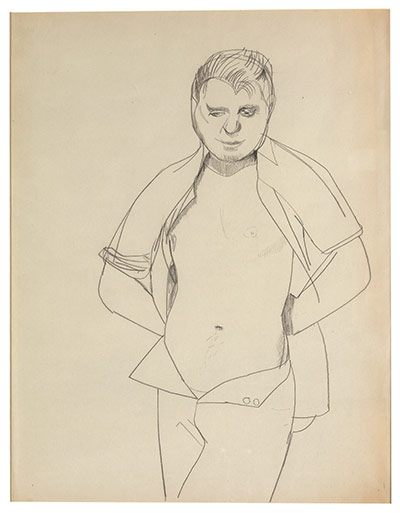
Freud and Bacon were close friends at the time of this drawing, and the very minimal line shows the narcissistic side of this complex painter who suggested opening the trouser fly to reveal his hips. Freud said the artist should make real 'to others his innermost feelings about all that he cares for'
Photograph: Private Collection, London/Lucian Freud Archive

Looking at alternate styles – cubist, abstract expressionist or realist – Hockney's title and similar works make a joke of the options facing a young artist. Here he foregrounds his own attraction to the flatness of Egyptian art as a way of avoiding linear perspective. Hockney's breakthrough came when he began following RB Kitaj's advice and brought his personal interests into his pictures, which at the time included children's art, graffiti and film Photograph: British Council Collection / David Hockney
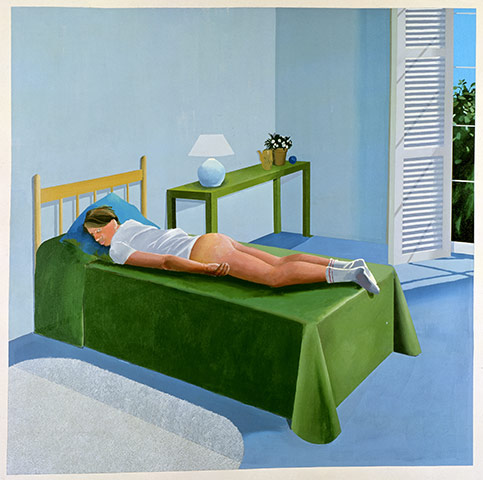
This is one of Hockney's iconic Californian interiors. His reclining figure is painted so carefully and affectionately, but the image becomes more strange and daring as you consider the odd perspective of the furniture, the hardened folds of the bedcover and the glimpse of brilliant turquoise in the bright sky Photograph: David Hockney
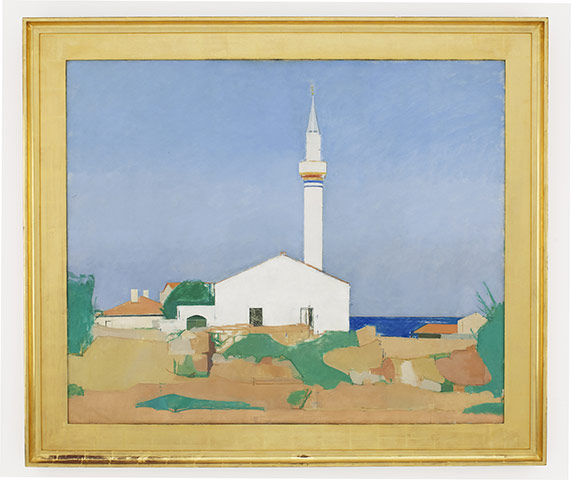
Uglow spent the summer of 1966 in a semi-deserted village on the west coast of Turkey painting this mosque every morning. A mark was placed on the side of the tower to try to establish the relative scale of the vegetation and architecture as translated to a sequence of odd, flat shapes surrounded by radiant blue sky Photograph: Collection of Ethne Rudd / The Estate of Euan Uglow, Courtesy of Browse & Darby
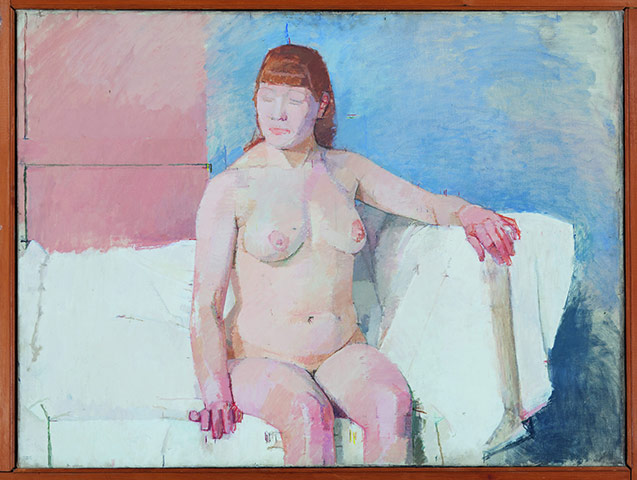
Uglow explained that every artist has a different way of making an image. In his case it was by working from life; he was most moved by observing a certain light on the contours of a living subject. He translated his sitters from three into two dimensions using detailed measuring, but the result transcends this method, and his work is invariably quiet and yet distinctive and authoritative Photograph: Private Collection / The Estate of Euan Uglow
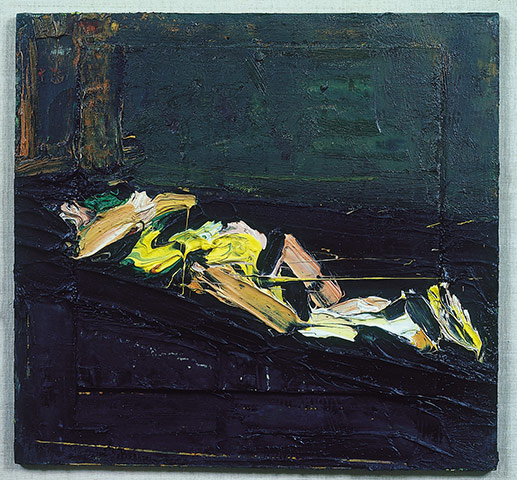
A second, larger sheet was originally attached to this board to extend the dark space around the woman lying on her stomach. Individual strokes show how it might be to touch each plane of her body. The result is a talismanic record of a particular person Photograph: Private Collection, N.Y. / Frank Auerbach
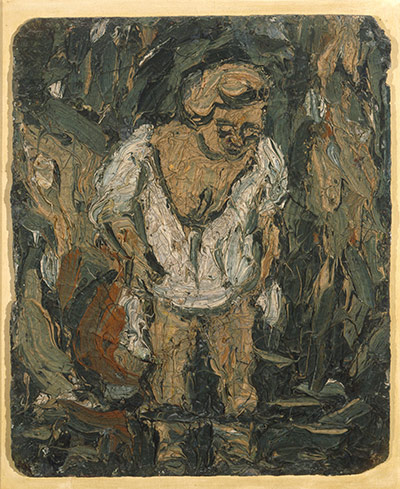
The National Gallery has long been considered a book in which artists learn to read (as Cézanne said about the Louvre). For Kossoff, his attraction to the gallery began with Rembrandt. But this painting is not an attempt to emulate the original: the woman is interpreted as a living, vulnerable person, unselfconsciously standing in water, her inner life more important than the source Photograph: Private Collection, London / Leon Kossoff

Andrews chose the subject of the reception for the first chancellor of the new University of East Anglia since 'all human life would be there, from Lord Lieutenant of the County to rude mechanics'. This collaged background with individual figures inserted and over-painted work derived from 'hundreds of photographs of groups grinning'. The artist was interested in the notion that the ego was not a thing but a concept, ideas related to the writings of RD Laing
Photograph: Nortfolk Museums Castle Museum / The Estate of Michael Andrews, Courtesy James Hyman Fine Art

As a student at the Royal College in the early 1960s, Caulfield began using house paint on board, preferring a flat application and bright colours. His ambition was to endow the discredited genres of painting – still life and interiors – with the unease and complications of contemporary life Photograph: All rights reserved DACS 2011. Courtesy Pallant House Gallery , Chichester, UK
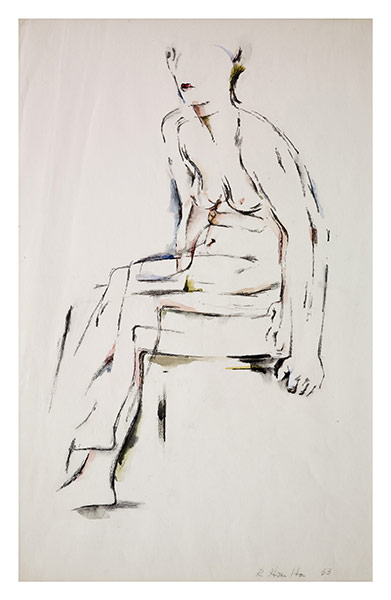
While studying at the Slade and then into the early 1950s, Hamilton experimented with making his own variations of the life-room subject of the nude. His repeated silhouettes reference Marcel Duchamp's Nude Descending a Staircase, with a hint of advertising glamour in the red lips. After 1956, Hamilton began preferring images gathered from film and magazines that were already two-dimensionalised Photograph: The Estate of Richard Hamilton Pallant House Gallery, Chicester (Wilson loan, 2006.)