Peter John had reached the departure gate for his flight to Ethiopia when the plane was cancelled due to a technical problem. The airline paid him the compensation due under EC regulations but he could not claim a refund for the ticket there and then. Why? Because he had booked it through online agent Expedia.
“Obtaining a refund from Expedia proved impossible,” he says. “I called customer services numerous times and they failed to get back to me, put me on hold for half an hour then disconnected me and said they’d escalate the complaint, then ignored me.” After five months he was still awaiting his £631.
Expedia, which promptly authorised the refund when the Observer intervened, blamed the airline for delays in passing on the fare but admitted it had let John down and apologised with a £200 voucher. “This was an extremely rare incident and is not a typical reflection of our service,” a spokesman says.
John’s ordeal illustrates the pitfalls of using a third-party agent to book flights. When things go according to plan, these websites can be a boon to the DIY traveller, offering price comparisons across a range of airlines and deals that often work out cheaper than booking directly through the carrier. It is when flights are cancelled or delayed, or there is a hitch with the bookings process, that customers too often find themselves shunted between agent and airline for redress.
When Ahmed Hussein booked five tickets via Opodo for a flight to Dubai, he was told the transaction had not gone through and he could rebook over the phone through Opodo’s stablemate eDreams. Later he discovered he had been charged for both transactions.
Opodo told him the airline had the money and he would have to claim from them; the airline insisted that since he had booked through Opodo they could not deal with him. “I therefore have a double booking for the same travellers on the same flight and neither Opodo nor the airline is willing to refund me the £2,140 I overpaid,” Hussein says.
Scott Salter faced an identical battle when an error on Opodo’s website caused him to be debited twice for a flight to New York. He was told to cancel the superfluous booking with the airline and send confirmation of this to Opodo for a refund: “When I call customer services I am kept on hold, then the call drops and my emails are not replied to.”
Opodo says both cases were being dealt with before media involvement, although both passengers received their refunds – and Salter £60 in compensation for the “inconvenience” – a week after this paper intervened.
Since few people plough through the terms and conditions before buying a service, most are unaware that when booking a flight through an online agent their contract is often with the airline, not the agent. However, airlines tend to insist complaints are directed through the booking agent, leaving some customers reliant on faceless intermediaries who tend to be more interested in sales than resolutions.
“If you are buying a flight only, booking direct through the airline resolves a lot of these problems, even if it costs a bit more,” says Andrew Leakey, head of dispute resolution at Stephensons solicitors. “If you use an agent you have to study the terms and conditions to establish whether it is them or the airline that is responsible should problems arise.
“If it’s the airline and the agent won’t help, write to the former stating that you require the specified sum by a specified date or else you will take them to court. If the terms and conditions aren’t clear and neither will co-operate, you will have to cite both as defendants if you decide to bring a small claim against them.”
The agent is also supposed to pass on details of schedule changes or cancellations, meaning that crucial information has to filter through two companies before it reaches the passenger – if it reaches them at all.
Bianca Rampat had reached the check-in for her return flight from Vietnam when she discovered it had been cancelled and the next flight out was in six days. She had received no warning from the booking agent Travel Trolley, which insisted it had not been notified by Vietnam Airlines.
Steven Craig was told by his booking agent, Bravofly, that his return flight from Marrakech was cancelled, but only after it had booked him on an alternative flight home which landed a day before he was due to depart for Morocco. Bravofly, a Swiss agency which has just bought Lastminute.com, blamed the airline for automatically reissuing tickets which, it claimed, it could not amend or refund for “operational reasons”.
Customers left out of pocket by a breach of contract can usually invoke section 75 of the Consumer Credit Act and claim a refund from their credit card issuer. Few realise that if a travel agent won’t pay for a rescheduled or cancelled flight, they are unprotected as transactions booked through third parties are not covered by the act because the money is paid to the agent contracted to supply the ticket, not the flight.
“There is a misconception that if you pay by credit card you’re covered should things go wrong, but this is not always the case,” says Kerem Alev, a contract law specialist at Cubism Law. “If you buy a ticket direct through an airline, you claim under section 75. But if you use an agent you are only covered if it’s a principal agent who is selling tickets on behalf of an airline rather than merely uploading air fares on to a website without any control over them – and that distinction can be very murky.”
Three years ago the government tightened up protection for trips booked through third-party agents by extending the Air Travel Organisers’ Licensing scheme (Atol) to non-package holidays. An Atol certificate entitles customers to alternative travel or a refund if an airline, agent or hotel goes bust, but this only applies if you book a flight plus accommodation or car hire from the same agent at the same time. If you’ve just paid for a flight, you are left to bear the loss without the safety net of the Consumer Credit Act.
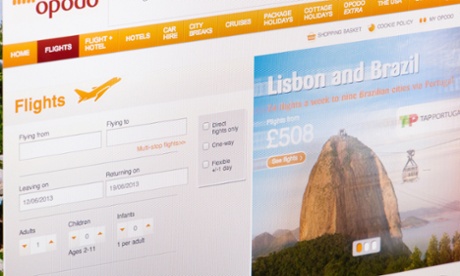
The risks are increased if you use one of the vaunted advantages of comparison websites and book an itinerary involving more than one airline. This can work out a good deal cheaper than a direct route with a single carrier. But the saving can become costly if a delay or cancellation on one leg of the journey causes you to miss a connecting flight with a different company. That second company has no obligation to refund the unused ticket, nor is it liable to compensate you, and the first airline is not responsible for any losses incurred by the missed connection if that is with a different carrier.
Most transactions through agents proceed smoothly, but complaints from customers who have hit a brick wall trying to get what they paid for have been clogging the Observer’s inbox. Erroneous debits and desultory communications are the most common grievances, and too often it seems that the larger the company, the more impenetrable its customer services.
Expedia said 89% of customers who reviewed its service on feefo.com rated it “good” or “excellent”, and it was voted Britain’s favourite online travel agency and best flight booking company in the British Travel Awards. “On occasions where we receive customer complaints we take these extremely seriously,” a spokesman says.
Bravofly says it offers 24/7 customer service as customer satisfaction is a priority. “We always work hard with our airline partners to resolve any requirements they might have,” a spokesman says.
Opodo says its average handling time for valid repayment claims is 3.5 working days, and that 99.98% of claims this year to date have been resolved.
FLIGHT CHECK
Minimise the risks of being left high and dry by following this simple checklist:
■ Use a member of the Association of British Travel Agents. Its code of conduct requires agents to help resolve customer issues and an arbitration scheme steps in if this doesn’t happen satisfactorily.
■ Book accommodation or car hire at the same time as the flight so you are protected by Atol, and make sure you receive the online Atol certificate.
■ Avoid itineraries with more than one airline in favour of a through route with a single carrier so you can claim a refund for the whole journey if delays cause you to miss a connection.
■ Booking directly through an airline removes reliance on an intermediary if things go wrong, but these transactions are not Atol-protected.
■ Scheduled airline failure insurance is offered by many agents if you are not Atol protected when an airline goes bust.
■ Read the terms and conditions before you book to establish if your contract is with the agent or the airline – and check extra costs in terms and conditions. Some agents charge fees for, say, amending a booking, on top of any charges levied by the airline.