India's Minister of Education, Dharmendra Pradhan, was forced to resign last week due to protests that rocked the country resulting from the ministry's decision to cancel administration of the national medical school entrance exam.
The protests were led by a campaign calling itself the Cockroach Janta (People's) Party. How a powerful government minister came to be ousted by a movement affiliating itself with a despised insect is a tale of the contemporary social change movement, the power of creative protest, and the growing force of youth frustration over economic inequality and lack of opportunity.
Political observers in Thailand may wonder whether the Indian protests will have any impact on the ongoing civil service exam scandal.
India's National Eligibility Entrance Test (NEET) is a highly competitive exam that students spend years preparing for, as it represents a steep and narrow path for entry into the professional ranks that can be an economic and societal lifeline for millions of young people.
When news broke that the exam answers had been leaked, the ministry hastily cancelled the exam despite having administered it as scheduled in previous years when the answers had been leaked. This decision came as such a blow that at least 21 students who had been registered for the exam committed suicide.
The outcry from the student community was swift and strong. Chief Justice Surya Kant responded by characterising them as "cockroaches" who are unemployed and merely want to criticise.
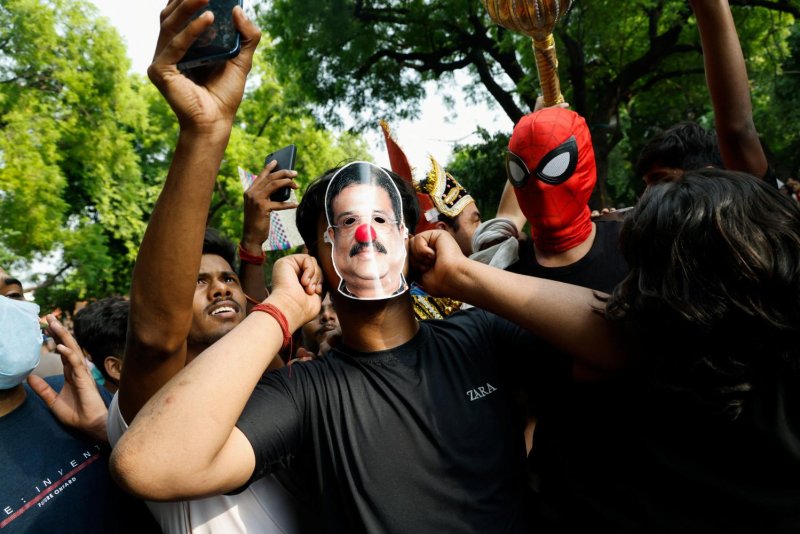
Rather than run away from the insults, protesters took a page from social media trolling and embraced the moniker, transforming themselves into the satirical Cockroach Party.
With clever signs and cockroach face masks, they took to the streets. Those images went viral, and they were soon joined by tens of thousands for public protests. What started as pushback over an exam cancellation grew into opposition against a corrupt system that doles out unequal opportunity for advancement. Students demanded Mr Pradhan's resignation and, within a few weeks, they got it.
Emboldened, the movement now has the broader Modi government in its sights. Similarly, the massive No Kings movement in the US represents a popular energy that could be used to counter election deniers if they refuse to certify results of the midterms this November.
The student protesters' decision to align themselves with the reviled, yet resilient, insect caused me to recall my first trip to Southeast Asia many years ago. I was in Indonesia, where Teater Koma's Opera Kecoa, or Cockroach Opera, had just been banned amid controversy.
The play tells the story of a group of economically precarious people living on the margins in a Jakarta slum. It carries pointed criticism of a corrupt government that keeps these struggling individuals in dire straits, and it became an instant audience hit. The repressive Suharto regime apparently saw a political threat in its sly satirical jokes, and they moved to shut down the production in Bandung. This led to weeks of heated press coverage and public criticism over government censorship. But that ban was not the play's demise. It has been staged several subsequent times in Indonesia, where it remains the most popular offering of the renowned theatre group.
The cockroaches in India's student movement and Indonesia's noted drama are both survivors, as is their namesake. Though the cockroach cannot survive a nuclear blast, a common urban myth, it can withstand 20 times more radiation than a human, making it superhuman in a sense. But their most resilient attribute is their adaptability to a harsh environment. The cockroach's primary survival trait is its ability to hide among debris, like the denizens of Opera Kecoa, living among the ruins.
In both instances, these cockroaches represent people who have been pushed down so low by circumstance that they have nowhere else to go. This illustrates how politically dangerous someone with nothing left to lose can be. Recall Mohamed Bouazizi, the impoverished Tunisian street vendor forced into debt to buy his wares and systematically harassed by the police, whose self-immolation launched the Arab Spring that ultimately toppled governments.
The challenge for political and social change movements, however, is motivating those who still have something to lose to join them. There are countless individuals who suffer erosion of rights under a repressive regime and personally oppose the system, yet who fear losing the meagre measures of security they have been afforded under the regime too much to take action against it.
So, what then is the tipping point of public resistance needed to achieve change? By examining data from 1900 to 2006, political scientists at Harvard who study democratic resistance have found that no peaceful civil resistance campaign has failed to unseat repressive regimes once it has reached active participation by 3.5% of the population.
In the case of India, that means a little over 51 million people would need to join the ranks of public protest, a tall order to be sure. There are two factors weighing in support of this calculation that must make Mr Modi nervous. The original student protest quickly morphed into a broader representation of civil society, including diverse professional and middle-class participation. Most significantly, more than half the population in India is under 25 years old, so the demands of youth cannot be ignored for long without consequences.
As governments around the globe make rightward turns and many democracies slide towards authoritarianism, the role of the people in achieving change comes into stark relief. In deciding whether to join opposition efforts, maybe individuals will take inspiration from the cockroach -- small and maligned, yet stronger than imagined.
Sally Tyler is the author of 'The Durian Chronicles: Reflections on the US and Southeast Asia in the Trump Era'.