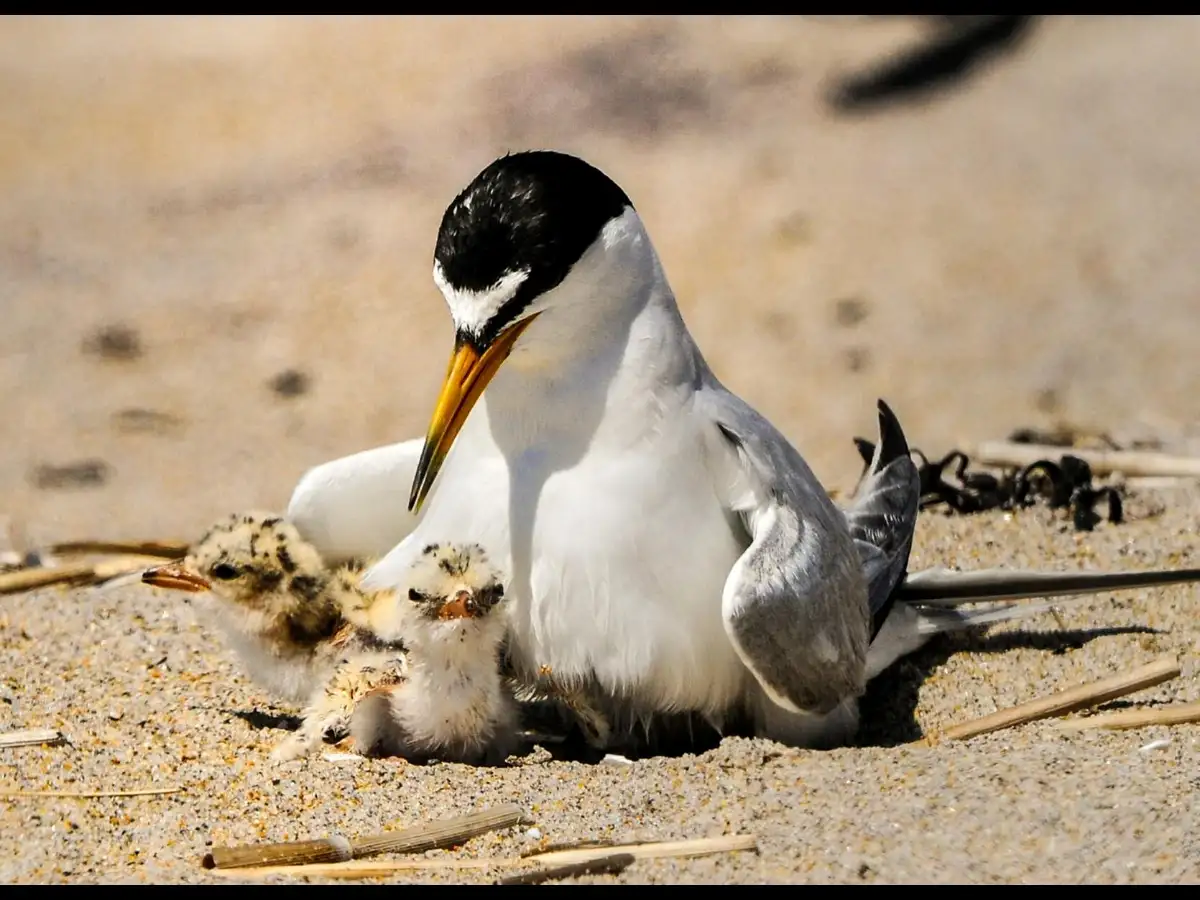
When a tropical cyclone approaches, sea turtles are often among the first animals people think about. Their nests lie beneath the sand, their breeding season overlaps with storm season, and powerful waves can reshape the beaches where they lay their eggs.
But turtles are not the only coastal animals facing that threat. In July 2026, tropical cyclone Bertha swept across the US Gulf Coast and affected nesting areas on Pensacola Beach, where Least Terns, the world’s smallest terns, and Black Skimmers were raising their young.
According to Audubon Florida, whose Pensacola Beach seabird monitor documented the storm’s effects, seawater reached beyond the usual shoreline and into areas where nesting birds are found. Nesting areas were inundated, eggs were displaced or covered by sand, and young chicks that had not yet learned to fly were particularly vulnerable.
For these birds, the danger comes from a simple fact: they raise their young directly on the beach.
The overlooked victims of coastal storms
Sea turtles are often the symbol of how vulnerable beach wildlife can be during storms. But coastal birds face a similar problem, particularly species that depend on open stretches of sand to breed.
Least Terns and Black Skimmers spend part of the year along Florida’s Gulf Coast establishing nesting colonies. From April through August, they lay eggs and raise chicks on beaches and other sandy areas.
Their nests are remarkably basic. Rather than building nests in trees, vegetation or elevated locations, the birds create shallow depressions in the sand known as scrapes.
For the Least Tern, this minimalist approach is paired with excellent camouflage.
The world’s smallest tern hides its eggs in plain sight
According to the Cornell Lab of Ornithology, the Least Tern is the smallest tern species in the world, with a body mass comparable to that of a mockingbird. Everything about the bird is distinctive, from its bright yellow bill and black-and-white head pattern to its slender wings and forked tail.
During breeding season, Least Terns become a noisy presence around their colonies. Adults fly over the nesting area, hover briefly and dive into the water to catch small fish.
But their eggs are far less conspicuous. The speckled eggs can blend almost seamlessly into the surrounding sand. Combined with the shallow scrape in which they are laid, the camouflage helps make the eggs difficult for predators to spot.
It is an effective survival strategy until water reaches the colony.
Camouflage cannot protect a nest
A Least Tern nest is designed to disappear into its surroundings, not to withstand a storm surge. Because the eggs are laid directly on the beach, there is little physical barrier between them and advancing seawater.
That vulnerability became clear after the July storm on Pensacola Beach.
Audubon Florida reported that seawater moved beyond the usual shoreline, affecting areas occupied by nesting birds. The water inundated nesting areas, displacing or covering eggs with sand.
Chicks were particularly vulnerable if they had not yet developed the ability to fly. For a bird that depends on a shallow scrape for protection, there is little that can be done when the beach itself becomes covered by water.
Black Skimmers face the same exposure
Black Skimmers, which also nest directly on sandy beaches, face a similar challenge. The birds are known for their unusual feeding technique. They fly close to the water's surface, with their long lower mandible touching the water, allowing them to detect fish by touch.
But when it comes to raising young, they rely on the same kind of exposed beach environment as Least Terns.
Their nesting colonies can be established on barrier islands and ocean beaches, where the birds lay their eggs directly on the sand. The July storm showed how quickly those nesting grounds can become vulnerable when seawater moves inland.
Storm season arrives while the nursery is still open
The timing creates an unavoidable problem for Florida’s coastal birds. Their breeding season overlaps with hurricane season.
From April through August, Least Terns and Black Skimmers can be establishing colonies, incubating eggs and raising chicks. Florida’s hurricane season begins in June and continues through November.
That means tropical systems can arrive while the birds are still caring for their young. Heavy rain, strong winds and storm surge can disrupt colonies that have taken weeks to establish. The July 2026 storm Bertha, was a reminder of that overlap.