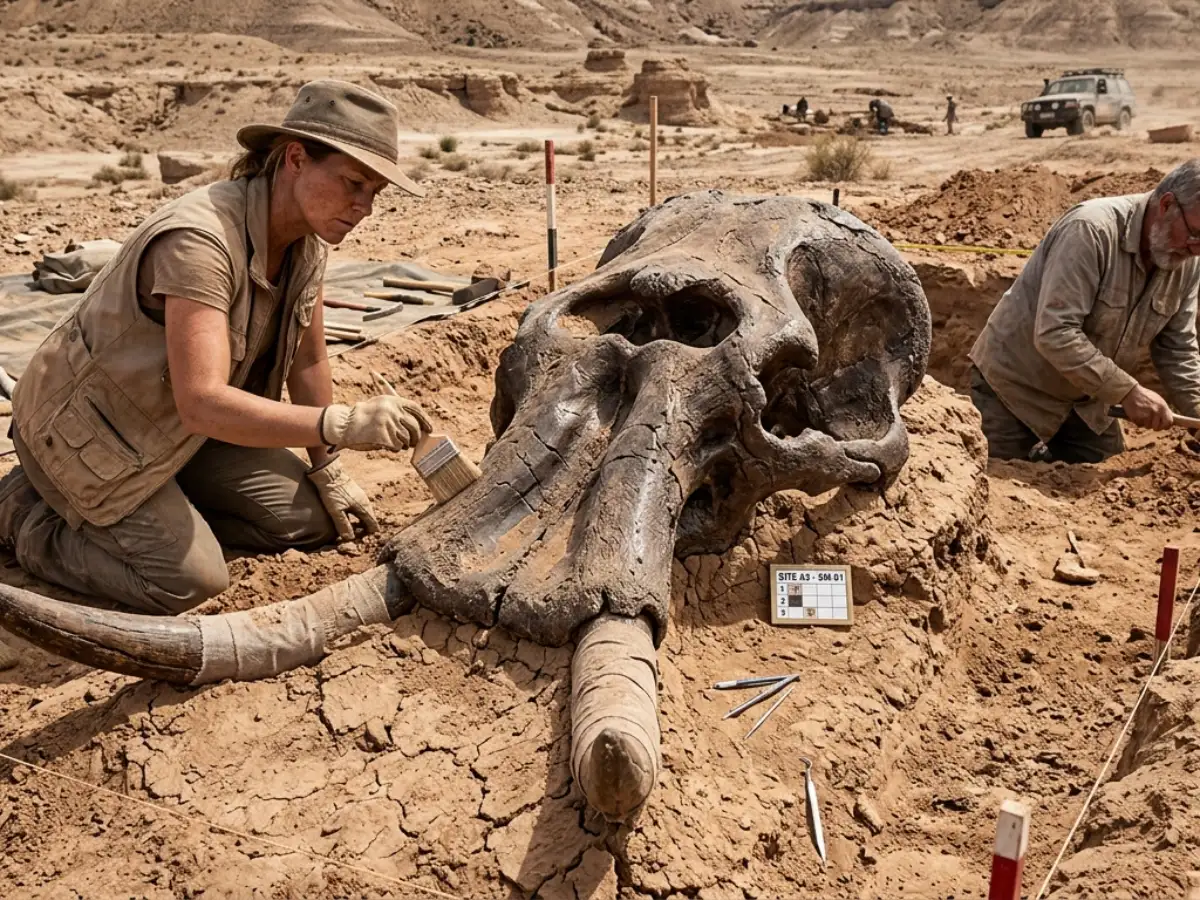
Some fossil finds have been made through systematic digging and study for years, while others have been made by sheer chance. On one occasion in 2016, 9-year-old Jude Sparks found himself hiking with his family around Las Cruces, New Mexico, where he stumbled upon a fossil embedded in the desert floor. Upon closer inspection, the object had features that did not seem typical of any rock he knew.
His parents saw part of a jawbone and a tusk poking out of the ground. According to a Smithsonian Magazine article, the mysterious object turned out to be a skull fragment from a 1.2-million-year-old stegomastodon, now preserved in the desert's sands. The significance of this find was that stegomastodons are colossal prehistoric relatives of elephants and mammoths.
They were massive herbivorous creatures that wandered parts of North America during the Ice Age and Pleistocene Epoch. According to Britannica and Smithsonian sources on the discovery, this is a crucial find among the fossils of ancient beasts of the American Southwest.
What makes the discovery so memorable is that the situation began as an unremarkable one. The Sparks family was not hunting for fossils and did not have any intention of being part of a research expedition. Instead, it was just by accident that Jude fell on the fossil, which happens to be one of the most valuable things anyone could stumble upon: the fossilized bones of a creature that lived a million years ago.
As noted in the Smithsonian Magazine article, the family immediately knew that the discovery was significant enough to warrant calling in experts, who proceeded to remove the fossil safely from the area. In essence, it brings into light a lesson that paleontologists sometimes quietly admit to knowing: that big discoveries do not happen exclusively when the professionals get involved.
The fossil belonged to a giant relative of elephants and mammoths
The remains were determined to be those of a stegomastodon, which is an extinct member of the proboscidea order that roamed North and Central America during the Pliocene and early Pleistocene. Though usually categorized in one’s mind along with such related species as the mammoth and mastodon, the stegomastodon actually belonged to its own evolutionary branch within the larger order.
As Britannica and Smithsonian’s education site indicate, the stegomastodon featured long tusks and had a similar build to the elephant, though it was distinct anatomically in its skull and tooth structure. The significance of this discovery for scientists stems from the fact that fossils of proboscideans allow scientists to determine more about ancient environmental and migration patterns. The presence of skulls, in particular, allows scientists to learn more about species classification, dentition, growth stage, and dietary habits, even in partial form.
In line with what is stated above, it is worth noting that the excavation unearthed the partial skull of an animal with some parts of the tusks well preserved within the sediment. Experts from New Mexico State University, as well as other affiliated institutions, have since worked on the fossils in terms of studying the entire fossil history of the area. In any case, the discovery has also shown just how much there still is to discover in terms of paleontology in the American Southwest.
It has been observed that the American Southwest features many areas with exposed sediment layers formed due to the flow of rivers and lakes, as well as volcanic eruptions and climatic changes throughout the millions of years past. In some cases, the fossils are found when they erode out of these sediments as a result of natural elements such as wind and rainfall, exposing them.
The discovery resonates because it makes deep time feel unexpectedly close
Another factor that makes this story so popular is its ability to encompass millions of years of history in a single, human-length period. It was in the form of a young boy walking in the desert who stumbled on something, looked at the ground, and realized he had just come upon an organism dating back more than a million years. The stark contrast between these two periods of time almost seems like a fantasy. In fact, according to Smithsonian Magazine, this find became one of the most well-known instances of a discovery by accident in the state of New Mexico as a direct result of this contrast between past and present.
Moreover, in an understated manner, the narrative questions the conventional belief that all great scientific breakthroughs are made within the confines of official laboratories. It must be noted that most of the time, fossil finds start with people with no particular expertise spotting odd formations in rocks and then alerting the concerned authorities. Paleontology is essentially about making observations and, sometimes, the very first person who recognizes the formation to be unusual is neither a trained nor a professional scientist.
Yet, researchers stress the significance of a systematic process of excavation and documentation when it comes to the matter of fossilization. Digging up bones casually could destroy important clues regarding the specimen's age, burial conditions, and geological environment. In the particular incident from New Mexico, paleontologists conducted a proper excavation and documented the specimen after receiving a responsible report from the family members who found the specimen. As it turns out, one might discover some prehistoric history in the most unexpected places.