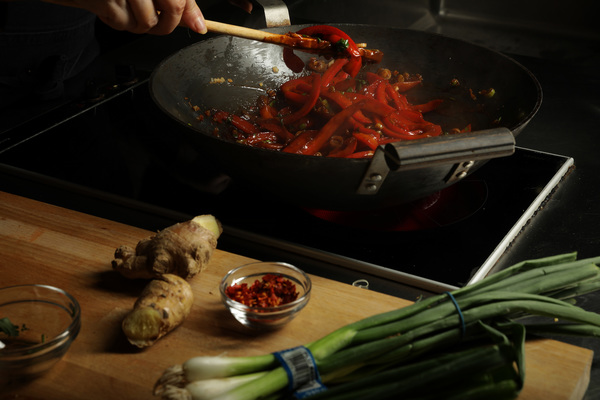
Call me a stupid American (you wouldn't be the first), but, whenever I'm cooking Asian dishes, that great Muppet stand-up comedian, Fozzie Bear, is never far from my mind. As I'm tossing stir-fried vegetables in my iconic, round-bottom Asian cooking vessel, Mr. F. Bear's signature tagline sits ready on my tongue tip: "Wokka wokka."
Oh, stop rolling your eyes. What are you, Jerry Lewis' ghost?
(What, too soon?)
Anyway, it's time to take a quick look at the wok and understand its many wokkish iterations. And then, stir-fry for everyone!
Wokka wokka!
WHY YOU NEED TO LEARN THIS
Let's get something straight: You absolutely can produce a jim-dandy stir-fry in a regular saute pan. Still, there's nothing like the rounded bowl of a proper wok to facilitate that way-cool, arcing vegetable toss you've been dying to master since Jacques Pepin's prom night.
Plus, cooking implements that are so closely associated with specific cultures will trigger flavor and ingredient ideas that your regular pots and pans may not. Get out your wok and automatically your brain will drift easily to Asian flavor profiles and thoughts of crisp, quickly cooked vegetables and meats.
After all, it's not wokket science.
Seriously, what did I just say about the eye-rolling?
THE STEPS YOU TAKE
First, let's get you a good wok. I recommend hand-hammered carbon steel. Hand-hammered for that certain "not-made-by-job-killing-robots" je ne sais quoi. Carbon steel for its sturdy, light weight and its quick, even heating. Most important, though, is how it develops that layer of deep-space black, polymerized oil that forms on the inside surface and prevents food from sticking. (More on that below.)
Whatever you do, for the love of criminy cripes, avoid like your ex at dollar beer night those nonstick woks. For one thing, nonstick surfaces can crack and chip like foundation makeup on the Bride of Frankenstein. Worse, those crazy nonstick chemicals can break down in high heat, poisoning the air until you find yourself in an episode of Old Testament "X-Files," shuddering under a sudden shower of hapless bats tumbling lifeless from the toxic sky.
Carbon steel it is, then.
Next, round bottom? Flat bottom? Now, some picky pooh-poohers suggest that flat-bottomed woks are like Humvees, dickies or that six-string "banjar" that Taylor Swift uses because she wants to look like she's playing an actual banjo when all she knows is a few chords on guitar: They're all for show. Still, those oblate derrieres acknowledge that the flat stovetops of our Western kitchens make a rounded cooking vessel difficult to use. I say, use what works.
Another variant is the handle. I prefer one long wooden (not metal) handle over two short handles, one on either side. It allows you to practice your aforementioned way-cool arc-y flips while keeping your tossing hand relatively blister free.
Finally, size, for the sizes of woks are myriad. There are restaurant-style jumbo woks in which you could stir-fry a full-grown Canadian bull moose. Then there are those smaller wokettes like they use at the Wadio City Music Hall (Oh, puh-lease.). For most of us, though, the 14-inch size should be just what the woktor ordered. (Somebody, stop me.)
As for accessories, you'll definitely want a good wok spatula. They've got super long handles so you don't burn your fingers, and an extra wide business end that makes for easy-peasy scooping.
Also, if your wok has a round bottom, you might want a wok ring to steady it on your stovetop. Truth: I've got a round-bottom wok and I just set it _ admittedly precariously _ directly on top of the burner. So far (knocking wood as I type), I've avoided any disastrously tippy mishaps.
Other accoutrements like lids, steamer inserts, cleaning brushes, spider strainers (so-named, I believe, for their weblike appearance rather than their handiness in preparing tarantula dumplings), they all have their uses. And that's because our Asian brethren have much more than stir-fries going on in their woks. They're also steaming, braising, poaching, smoking, you name it. If you're new to this, though, I'd say start with a few simple stir-fries (see recipe). Then, if you find that you're liking the old doo-wokadoo, get all crazy, watch "Eat Drink Man Woman" on Netflix, and start the wokification of your entire menu.
Finally, two bits of good advice. First, if your wok is new, you'll want to start that layer of "polymerized" oil that helps keep it nonstick. (We'll discuss the whole polymerization thing another day, when Prep School covers "How to Clean Your Rat Nasty Pans.") To do that, season your wok thusly:
Wash your wok with warm, soapy water, then dry it while repeating this mantra, "I shall never again use soap on my wok." Next, place your wok over high heat and swirl in a little oil to cover as much of the surface as you can. When it starts smoking, take it off the flame and wipe it out with paper towels. Now, every time you stir-fry, your wok will darken until it's as black as the unkinder thoughts of Job. Then, whenever you stir-fry, as soon as the food is done, clean your wok immediately with a brush under hot, running water. No soap.
My last bit of wisdom: Remember that, with stir-fry, heat is your friend. Crank your hottest burner all the way, like Satan on the first day of fall semester. Use your spatula and your practiced food tossing to keep the food skittering like a cat in a viper pit across its extremely hot surface.
Now, go out and make us some stir-fry.
Wokka wokka.