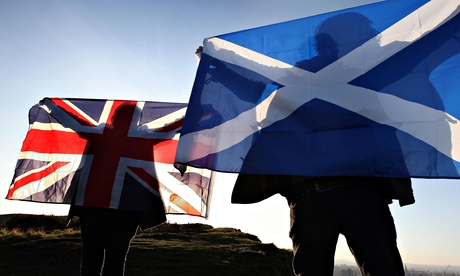
Business owners aren’t always keen to discuss the issue of Scottish independence. Some outspoken entrepreneurs have been pilloried as a result and many fear antagonising employees, suppliers or campaigners.
However, last week, many decided to make their views known. More than 130 prominent Scottish business leaders signed an open letter warning that the case for Scottish independence has not been made. Then a day later more than 200 business figures signed an open letter backing Scottish independence.
Big issues over currency, oil and trade loom large in the debate. But each come with their own set of question marks, and businesses yearning for certainty are understandably frustrated.
Trade
Scotland currently does a healthy trade with the rest of the UK, which is by far its biggest market. No entrepreneur wants this to be threatened, but not all are concerned. A recent survey conducted by Vistage of more than 400 company heads running medium-sized businesses found that 66% didn’t think independence would make any difference to them, whereas just 26% thought it would have a negative impact. Yet other studies by Ingenious Britain and the Federation of Small Businesses (FSB) have found greater levels of concern.
Scottish and English entrepreneurs currently trade freely across the border on a daily basis, and Keith Forbes is one of them. Co-founder of brand consultancy Good, Forbes has offices in both London and Glasgow. “Being able to run the business in both places allows us to develop global credentials via London while growing a large Scottish talent pool,” he says. “Having a London office has opened up new markets for us that we weren’t able to access when based only in Scotland. It’s where UK and international companies head for their big brand thinking.”
Financial services
If there’s one industry in the UK that is concerned about independence, it’s the financial industry. Uncertainty over currency and regulations can make investors jittery, and some fear a flight of capital, jobs and confidence following a yes vote. London is a major player on the world’s financial scene, but not all jobs are in the capital. Scotland’s banking, insurance and finance sector is substantial, supporting 200,000 jobs [PDF]. But bankers have a poor public image and politicians are avoiding the topic.
Callum Campbell is the founder and CEO of Fireflock, which raises finance for small businesses and startups. He says finance is being edited out of the debate. “The nationalists talk about Scotland’s economy and its oil and engineering, but never its financial services, which generate about £8bn for the economy – that’s missed out,” he says.
Currency
The battle over the pound has been the lynchpin argument for the Better Together campaign, which has predicted that voters uncertain about their future currency will vote no. The eurozone crisis has only given credence to the view that fiscal and monetary policies need to work in tandem. The Scottish Nationalist Party (SNP) has said it wants a currency union with the rest of the UK, but this has been flatly ruled out by the Westminster parties. So would Scotland use the euro, or print its own currency, or just use the pound anyway? The answer is regrettably unclear but looks set to be a major area of negotiation if a yes vote occurs.
Tax
The SNP has positioned itself as a left of centre party and, if it remains in power, many feel it will raise taxes to pay for social reforms. Also, the new government would have to spend money creating new systems and processes, as well as directly funding agencies and services currently provided by the British government. It’s difficult to see how taxes would not rise in order to cover these bills. So Scotland’s tax regime could alter significantly from the rest of the UK. However, even in the event of a no vote, the Scottish parliament will get new borrowing powers and be able to set a separate rate of income tax as the Scotland Act 2012 will come into force. Some degree of fiscal disparity looks likely in either event.
Oil and energy
If currency is the stick of this debate then oil is the SNP’s carrot. The prospect of becoming an oil rich state fuels desire for nationalists, who look on at Norwegian sovereign funds with envy. No one is exactly sure how much North Sea oil remains, but groups such as Business for Scotland are confident there are billions of barrels. Pro-independence businessman Adam Davidson, who owns the Danish furniture maker Bo Concept franchise for Scotland, says there’s bound to be money in the oil reserves. “When did you last fill up your car and find the price had gone down. Sure, there’s some fluctuation, but the overall trend is that prices are going up,” he says.
Negotiations
In the event of a yes vote, the two governments would enter into a period of high stakes negotiation. Alex Salmond would have a mandate from the people, which the UK is bound to accept. However, he wouldn’t be holding all the cards. Salmond has North Sea oil in his favour, along with the fact that the British government will want Scotland to take on a share of its debt. But issues such as defence, continued trade and, of course, the pound, would suggest a trade-off would take place. Mr Salmond has also stated he wants to retain the BBC and even the Queen as head of state. So exactly how independent would Scotland be? With more power heading north irrespective of the decision, it’s likely Scotland will increasingly become more independent. Just how much more remains to be seen.
Why I am voting yes
Adam Davidson owns the Danish furniture maker Bo Concept franchise for Scotland. He loves Scandinavian business techniques and is also a big fan of their small, well-run governments. He’s voting yes in the referendum, but says he took his time coming to the decision.
“The figures absolutely stack up, we can become a very wealthy country,” he says. “The best question for me in the debate was: ‘if we are better together in the future, then why aren’t we now? Since the war, Scotland never gets the government it votes for, unless England votes for it. If Scotland votes Labour and England votes Tory we get a Tory government. I don’t believe that everything is going to be sweetness and light, we will have problems and disagreements. But I am confident that we are a sensible people, and having a parliament here will make it a lot easier to influence policy.
“Logic says that there will be a currency union, because if Scotland doesn’t take on some of the debt, it will be economic suicide for both countries. The economies of England and Scotland are very similar, so a currency union could work.”
Why I am voting no
Callum Campbell, founder and CEO of Fireflock, has offices in Canary Wharf, London, although he is resident in Stirling, Scotland. He’s voting no in the independence referendum and is greatly concerned about the impact it could have on his business and the economy in general. “From our point of view, Fireflock is about raising funds for businesses, and we want to do that UK-wide. London is a major financial centre and presently Scottish businesses have access to that. But if any barriers were put up then that could choke that growth.
“There’s also still the question of currency. Sterling works really well, so why change that to a new currency with new transaction charges? The nationalists speak about walking away from their debts, I find this terrifying. If we did this, who would lend Scotland money in the future, and at what rate? Two years down the line and we still don’t have answers. There’s a lot of uncertainty and this isn’t something businesses like.”
Sign up to become a member of the Guardian Small Business Network here for more advice, insight and best practice direct to your inbox.