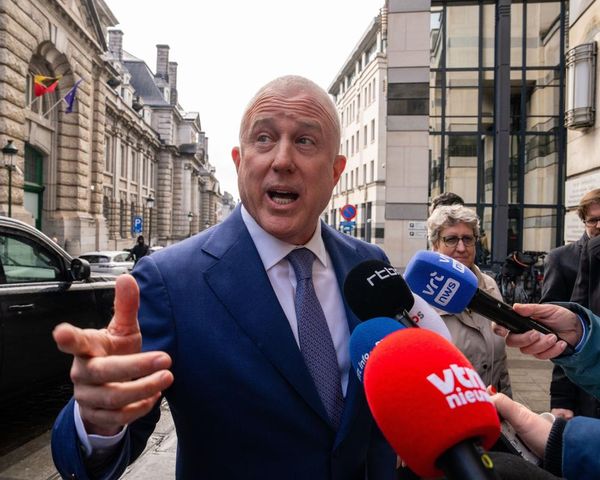
If you want to get a lot of homes built there are two things you cannot do without: places to put them and money to pay for them. Without those, house-building promises are just noise. James Murray, who is Sadiq Khan’s deputy mayor for housing, does not have a noisy style. He is seen by some in London’s large and varied housing sector as one of the capital’s most left-wing housing politicians, thanks to his time at Islington Council. That may be so. But he is also, like his boss, an able and practical one.
Murray made his first appearance before the London Assembly’s housing committee on Tuesday. He was calm, he was assured and his command of his arguments was strong. The committee’s Conservatives tried to pin down a target or two. How many new homes did Mayor Khan intend to oversee the building of each year? How many would be “affordable”? What, in Khan’s terms, did “affordable” exactly mean? Such questions informed a larger, more general one: what will count as success in Khan and Murray’s terms?
This was not precisely spelled out. Murray explained that setting targets is “very wrapped up with the review of the London Plan” - the master blueprint for the capital’s spatial development - and that London Plans don’t get changed overnight. He said he couldn’t imagine setting an overall target lower than the one inherited from Boris Johnson’s London Plan of 42,000 new homes a year, but that was as far as he would go. He refrained from setting a numerical “affordable” target too, though he confirmed a “long-term strategic” goal of 50% of all new homes built in London being “genuinely affordable”.
How does “genuinely affordable” differ from plain old “affordable”, a term whose meaning has been stretched to the point of meaninglessness? It seems clear that some forms of housing deemed “affordable” by national government will not be judged “genuinely” so by Murray and Khan. Murray said the discounted “starter homes” to be directly commissioned on brownfield sites by the government for first time buyers under the age of 40 would be “very tricky” to count as “genuinely affordable”. Khan rubbished them often during the election campaign as some will cost up to £450,000. However, not all of them will.
Khan also knocked “affordable rent” homes, a creation of the Con-Lib coalition, which are built by housing associations and can cost as much as 80% of local market rates. However, as Murray noted, “affordable rent” levels can also be much lower than that and, in some parts of town, be pretty much the same as traditional social rents. Social rent definitely qualifies as “genuinely affordable”, so maybe some “affordable rent” homes will meet the Murray-Khan requirement too.
Johnson included a housing product called “rent to save” in his “affordable” total. It enables aspiring homeowners to rent the home they wish to buy at a discount while they save for the mortgage deposit they need in order to purchase it. Will that make the cut with Khan and Murray? We must wait and see.
However, Murray underlined three types of “affordable” home that will definitely be deemed “genuinely” so. Along with social rent, shared ownership homes, aimed at households on low to middle incomes and strongly supported by Johnson (as social rent was not), is another. The third will be a new type - Khan’s promised “London living rent” tenure, a new kind of “intermediate” affordable home designed for private sector renters. Rents for these properties will be linked to average local earnings rather than local market rents and set at 30% of that average - considerably lower than most private renters currently endure.
Perhaps it will be the number - as opposed to the percentage - of “genuinely affordable” homes built that will be the best measure of housing policy success at the end of the four year term of Mayor Khan. “It’s always been the priority of the mayor to make sure we focus on what sort of homes are built within whatever numerical target is ultimately set,” Murray said. “If every single home was an overseas investment left empty rather than a home for someone to live in, that wouldn’t be tackling the housing crisis.”
This is where sharp contrasts - and very political ones - between Khan’s intended approach to building homes and Johnson’s begin to come into focus. The process of arriving at the point where builders’ shovels hit the ground might be likened to a complex mathematical equation comprising many factors and variables. Murray’s aim is to adjust that equation in order to generate better results.
Sceptics claim this will just make things worse. They might begin by arguing that the number of homes left empty by overseas investors is greatly exaggerated, confined to a few “prime” sites in Central London and of little relevance to the London housing picture as a whole. They might continue by pointing out that much of such affordable housing as is built on such prime sites is, in fact, paid for by such overseas investors and would not be built otherwise. They might add that imposing a 50% affordable requirement will only deter such investment and, indeed, housing investment of all kinds. They might conclude by asserting that Khan’s goal of restricting “off plan” sales to such investors will therefore result in even fewer affordable homes being built.
Murray, though, would have answers. He laid out some for the committee. Asked what would be required to achieve a long-term 50% affordable target, he said that a combination of “clear planning rules”, investment and a “contribution from public land” will provide the necessary conditions. He was also receptive to foreign and institutional investment being brokered through City Hall to help fund the sorts of housing London needs.
The price of land is a key component of the house building equation and one Murray hopes to change for the better. Land in London is scarce and therefore very expensive. That high cost pushes up the cost of any housing built on it and therefore tends to lessen the amount of “affordable” that can be negotiated with the land’s developer, who has to pay for the land in the first place. Murray put it like this: “At the moment, with there being such unclear requirements in terms of affordable housing, landowners are able to effectively overcharge for their land. A developer might then buy that land for a higher price then come to the [borough] planning authority and say, ‘I’ve overpaid for land, therefore I can’t provide affordable housing,’ knowing that the permission will probably go through.”
Murray said developers themselves can see that this is not a good way to do things: “There really is an overlap between different people I’ve been speaking to over recent weeks - councillors, developers and housing associations - who say that the current way that viability is done is so fuzzy and contested it simply means land values get bumped up at the expense of affordable housing. If developers could go to landowners and say ‘there’s a really clear expectation of what we need to do on that site, and affordable, and on that basis we can only pay you this for the land,’ it would help.” He said he has found “a coalition of interests” favouring greater certainty in this area.
This is the politics of intervention as deployed through the mayor’s planning powers. These enable him to block, require adjustments to or even appropriate planning applications made at borough level. They don’t have to be used to have the desired effect: the knowledge that they could be concentrates the minds of boroughs and developers alike. Johnson sometimes used these powers but in the context of an attitude to planning that Murray thinks too relaxed and insufficiently supportive of boroughs. Here is a defining difference between practice under Mayor Johnson and aspiration under Mayor Khan.
Murray hopes that publicly-owned land will play a big part in getting things moving, notably land owned by Transport for London (TfL). The aim is to bring forward far more of this for development than has been already lined up, notably in Outer London, and to build far more “affordable” homes on it than TfL, mindful of its budgets, had in mind under the last mayor.
All well and good. But how many homes, affordable and otherwise, might actually be built under Mayor Khan? Under Johnson, London got nowhere near his overall target of 42,000 a year. Can Khan really do better? Can he increase the number - not just the percentage - of affordable homes delivered, especially as they must meet his higher standard of being “genuinely” so?
There are sound reasons for having doubts. Two reports published during the election campaign into how housebuilding in London could be pushed up to the overall 50,000 a year widely thought necessary to meet demand - a figure Khan’s manifesto acknowledged without committing to - said this would require doing two things that Khan is not keen on.
One is building on green belt land, which he has pledged to protect. The other is redeveloping large numbers of housing estates on borough land to higher densities, which Khan and Murray - as the latter’s time at Islington showed - are instinctively reluctant to do. Murray assured the Green Party’s Siân Berry, a strong opponent of demolition, that he’ll soon start work on drawing up a “common standard” for community involvement in decisions to rebuild or densify estates. That’s a long way from giving a green light to boroughs to knock lots of them down.
It was a polished performance by Murray, although, understandably in these early days, it didn’t tell the committee or the capital everything it needs to know. What might success look like in three or four years time? Generating far more “genuinely affordable” housing than Johnson managed, with the minimum disruption to people living in or very near such housing already, looks like a big part of the answer. That and other parts might depend quite heavily on the attitude of national government in terms of funding and devolving powers: Murray said he’d been having “really constructive” negotiations with it, but couldn’t elaborate.
Lots more on all this to come. You can watch a full webcast of Tuesday’s housing committee meeting here.